
RUNWAY CONSTRUCTION ON A BUDGET
Bob Holmes Jr.
Background
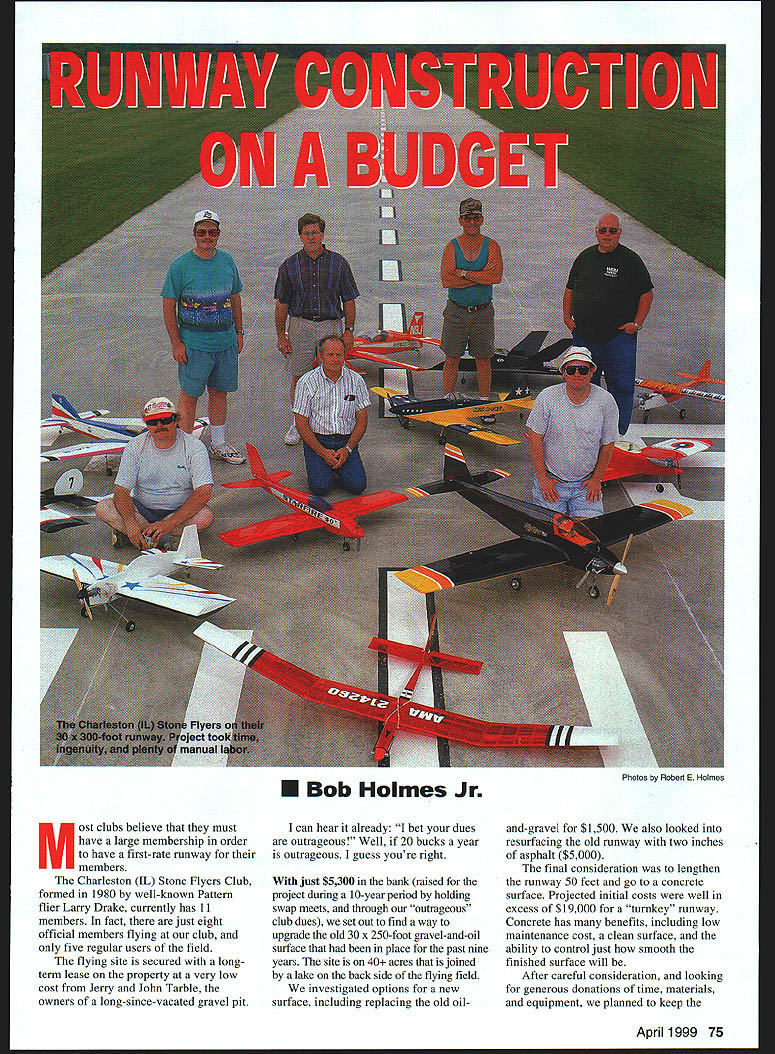
Most clubs believe they must have a large membership to afford a first-rate runway. The Charleston, IL Stone Flyers Club, formed in 1980 by well-known pattern flier Larry Drake, currently has 11 members. In fact, only eight are official flying members and just five are regular field users.
The flying site is secured on 40+ acres through a long-term, low-cost lease from Jerry and John Tarble, owners of a long-vacated gravel pit. Annual dues are $20.
With just $5,300 in the bank (raised over 10 years by swap meets and dues), we set out to upgrade an old 30 x 250-foot gravel-and-oil surface that had been in place for nine years. The site backs onto a lake.
Planning and Budgeting
We investigated several resurfacing options:
- Replace the old oil-and-gravel: $1,500.
- Resurface with two inches of asphalt: $5,000.
- Lengthen the runway 50 feet and install concrete: turnkey quotes exceeded $19,000.
Concrete appealed because of low maintenance, a clean surface, and controllable smoothness. After careful consideration and seeking donations of time, materials, and equipment, we committed to keeping total cost below $5,000. In April 1999 the club voted to build a concrete runway. Keith Walker was elected foreman to delegate responsibilities, survey, and oversee the job.
An important factor in securing business donations was that the club is a nonprofit. Businesses can take a tax write-off for the difference between fair market value and cost of materials sold to a nonprofit. Commercial firms were willing to help once we identified the right contacts.
Donations and Materials
We secured substantial donations and discounts that made the project possible:
- Lumber for concrete forms: $250 value, donated by club member Larry Drake.
- Concrete: supplied by Farrier Construction Co. at $36.50 per cubic yard (5-1/2-bag mix).
- Plasticizer for the mix: $6.50 per gallon.
- Lime screenings (quarry byproduct) for the base: several dozen truckloads obtained free of charge.
- Heavy earth-moving equipment: supplied by Charleston Stone Co. at no charge to level the runway.
- Wire mesh for reinforcement: donated by Mike Erickson, Central Illinois Pre-Cast.
- Power screed (used to level concrete): donated by Drake Homes.
- Power trowel: one donated; additional units rented from a local tool company.
- Soft-cut saw for scoring: furnished by G.R. Mast Concrete (operated by Keith Walker).
- Professional concrete finishers: hired at a bargain rate and available on a Saturday.
Contributors who donated time and labor included Keith Walker, Mike Vaughan, Richard McDivitt, John Paggett, Rick Newkirk, Bob Stout, and others.
Site Preparation
After securing materials and equipment, the next task was to survey and lay out the runway. Heavy equipment removed nearly a foot of dirt from the north end of the proposed runway using a road grader and front-end loader. Keith Walker and Mike Vaughan donated the equipment operation time.
A practical tip: contact your state National Guard for heavy-equipment operators — they will often perform the work as practical experience at no cost, which can yield huge savings.
Leveling and Base Preparation
Leveling the grade was the hardest part but could be done cost-effectively with manual labor. Grade stakes were driven to establish a 300-foot level run. We decided on a 30-foot width with a six-inch slope across the width to prevent standing water after heavy rains.
Leveling the base is critical and must be extremely accurate. The concrete thickness was no less than three inches and reached three-and-a-half inches in some areas to stay within budget. Irregularities larger than four inches in total thickness would have increased material costs by about $1,500.
Club members worked in shifts pulling a straight 16-foot 2 x 4 twice the length of the runway. It took roughly two full weeks to prepare the first 30 x 150 feet; the second half took about 10 evenings. This meant a lot of kneeling, pulling lime screenings, and manual levelling — effective, if tiring, exercise.
The night before the pour, we pumped hundreds of gallons of lake water onto the lime screenings to pack them down and slow the concrete curing.
Pouring and Finishing
Wire was staked down in the 30 x 150-foot section to be poured the following Saturday. A power screed was brought in on a flatbed truck.
- It took about three hours to pour the first half and another three hours to float and finish the concrete using three power trowels (one donated, two rented).
- Professional finishers handled final finishing at a bargain rate; Saturdays are often the most available day for such help.
- The slab was scored into 10 x 10-foot squares with a soft-cut saw to control cracking. This saw was operated by Keith Walker.
- After scoring, rope was packed into the saw cuts and a special caulking applied to keep water out and protect the cuts over winter. Scoring dictates where cracks will occur, and the caulking keeps them out of sight and protected.
Final Touches and Cost
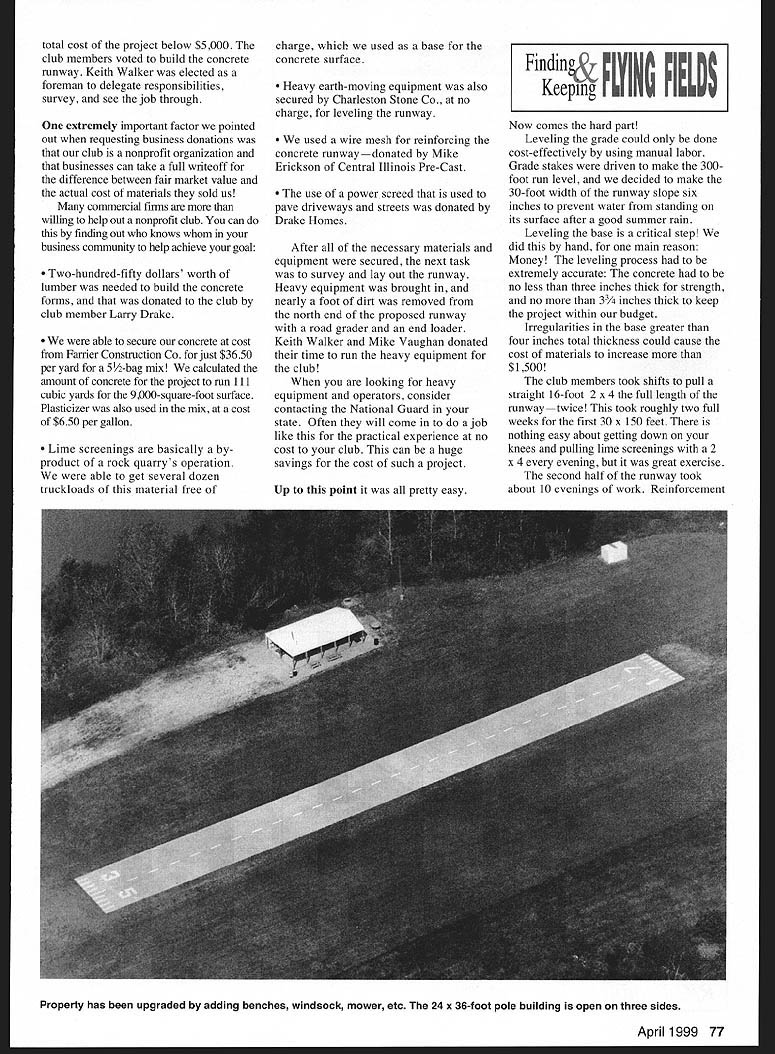
The finishing touches included painting accurate runway numbers, applying a dashed white center stripe the full length of the runway, filling dirt around the perimeter, and seeding grass into topsoil.
Total cost to build the 30 x 300-foot concrete runway: less than $4,500. The work required about six hard weeks by the core team, with additional labor from several club members.
Club Facilities
Over the past 10 years we have continually upgraded the property. Current facilities include:
- A 24 x 36-foot pole building with two open sides
- A large Farmall tractor mower
- Three park benches
- Two picnic tables
- Two RC work tables
- A windsock
- An outhouse
- The excellent concrete runway
For a membership of this size, the field is exceptional — all for $20 a year.
Acknowledgments and Contacts
Special thanks to: Larry Drake, Keith Walker, Mike Vaughan, Mike Erickson (Central Illinois Pre-Cast), Farrier Construction Co., Charleston Stone Co., Drake Homes, G.R. Mast Concrete, and all volunteers.
Bob Holmes Jr. RR 5 Box 33 Charleston, IL 61920
Transcribed from original scans by AI. Minor OCR errors may remain.

