
Rx for Hangar Rash
By Larry Kruse
Is there anything worse than crashing your beloved model? Maybe not, but spending the day flying without getting a single scratch and then dinging it to pieces on the car ride home is a very close second. On long trips, it can be even worse. This inexpensive carrier can take care of the "transit dings;" the rest is up to your flying abilities.
Transporting models to and from contests is probably the biggest cause of hangar rash a model may encounter. More cuss words are spat out, more rudders are broken off, and more wing panels get shortened in the process of hauling model planes around than by any other cause.
Faced with the problem of carrying three scale models some 4,500 miles for our 1983 National Contest trek, I decided that simply laying them on top of the luggage in the trunk and hoping for the best probably wouldn't cut it. I began looking around for appropriate-sized cardboard boxes, but either my planes would have to be shortened to fit some of them, or the boxes I found were so cavernous that there was room to pack the family dog and a case of Alpo, in addition to the planes.
What I needed were custom-sized, custom-made boxes to suit my particular needs. Plywood seemed to be the answer, but a quick push of the pencil showed me that I would have to invest about $50 in boxes that I probably wouldn't have a lot of use for after the Nats trip. What to do . . . what to do.
Since I'd been building some cabinets for our family workroom, I'd been spending a lot of time at local lumberyards, stumbling around trying to find everything I needed. In the course of one of my weekend stumbles, I fell into a stack of beaded Styrofoam panels intended for insulation purposes and available in 4-ft. sheets in various thicknesses from 1/8 in. to 2 in. The really neat thing about all this Styrofoam was that each sheet was under $5. Here was the answer to my problem—if I could find some way to stick the stuff together.
Materials and tools
- Beaded Styrofoam panels (various thicknesses, 4-ft sheets)
- 3M Contact Cement (brush-on)
- Table saw (best) or crosscut hand saw
- Small square
- Ballpoint pen
- Foam packing "peanuts" or other packing material
- Helper (recommended for assembly)
Contact cement can be brushed on, allowed to dry, and then the pieces are stuck together. It's compatible with practically all surfaces, including foam, and produces an immediate, permanent bond upon contact.
Making the boxes
After measuring my planes to determine suitable box dimensions, I cut the needed side panels, tops and bottoms on my table saw. The foam cuts like butter and leaves no ragged edges. Total elapsed time from start of making the first box to finish: two hours total for all three boxes.
A good approach is:
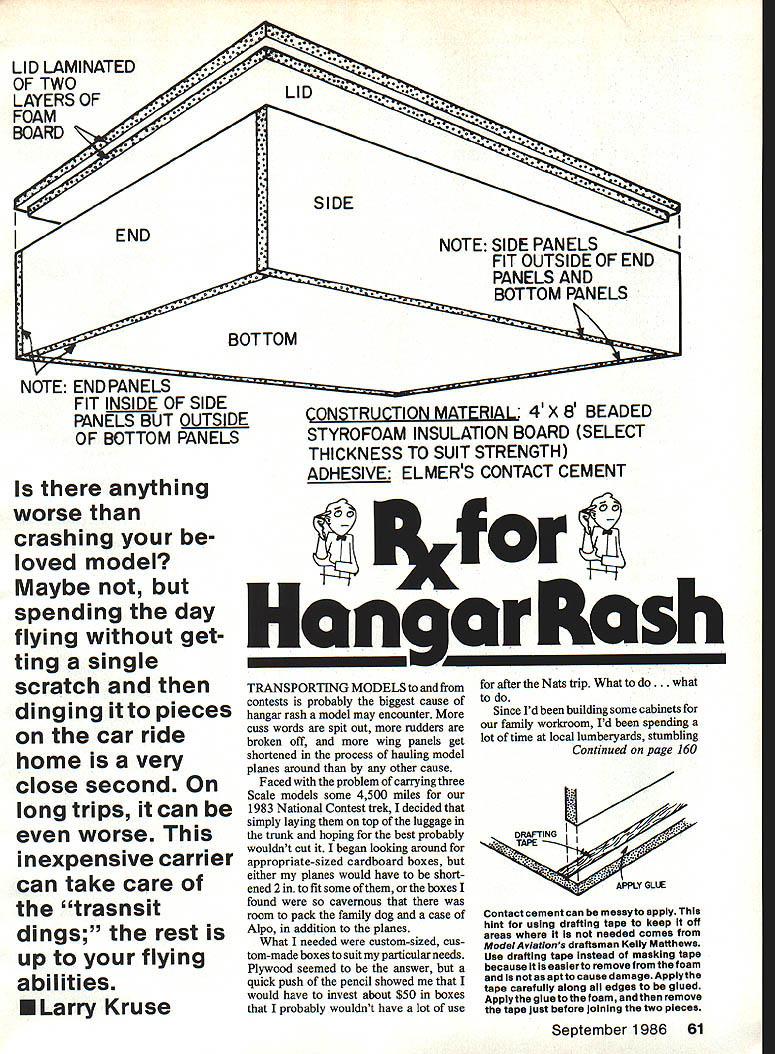
- Cut the ends and the bottom pieces to the required width and length. The second bottom piece will become the bottom of the lid, which will fit down inside the box.
- Cut the sides to size. Remember that the thickness of the foam board dictates the length of the sides. For example, if you're using 3/4-in. foam, each side will be two times this thickness, or 1-1/2 in., longer than the bottom panel (to account for both wall thicknesses).
- A table saw works best for these cuts, but a crosscut hand saw will also work (it may leave a more ragged edge).
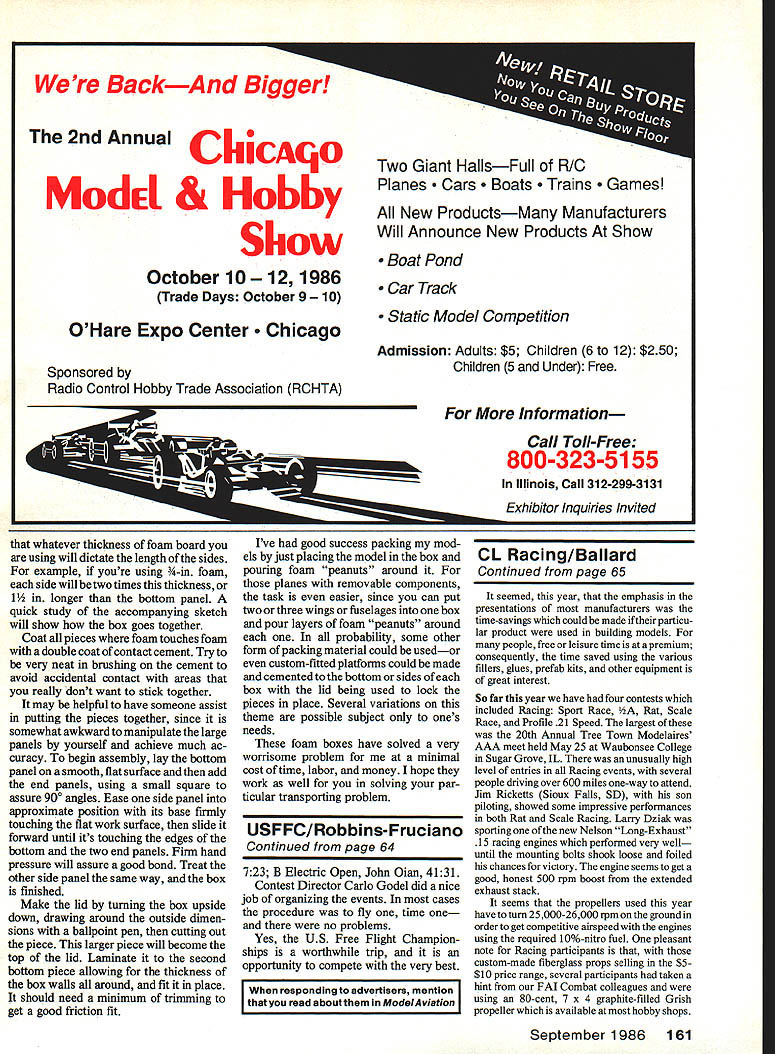
Coat all pieces where foam touches foam with a double coat of contact cement. Try to be very neat in brushing on the cement to avoid accidental contact with areas that you really don't want to stick together.
Assembling the boxes
It may be helpful to have someone assist in putting the pieces together, since it is somewhat awkward and you can't manipulate the large panels by yourself and achieve much accuracy.
Assembly steps:
- Lay the bottom panel on a smooth, flat surface.
- Add the end panels, using a small square to assure 90° angles.
- Ease one side panel into approximate position with its base firmly touching the flat work surface, then slide it forward until it's touching the edges of the bottom and the two end panels. Firm hand pressure will assure a good bond.
- Treat the other side panel the same way. The box will then be set.
Making the lid
Make the lid by turning the box upside down and drawing around the outside dimensions with a ballpoint pen. Cut out this larger piece—this will become the top of the lid. Laminate it to the second bottom piece, allowing for the thickness of the box walls all around, and fit it in place. It should need a minimum of trimming to get a good friction fit. For tidiness, I cut one top panel to the inside dimensions of each box and one to the outside dimensions, then laminated the two with contact cement to form a tidy, friction-fit lid.
Packing the models
I've had good success packing my models by just placing the model in the box and pouring foam "peanuts" around it. For planes with removable components, the task is even easier: you can put two or three wings or fuselages into one box and pour layers of foam "peanuts" around each one.
In all probability, some other form of packing material could be used. Very often custom-fitted platforms could be made and cemented to the bottom or the sides of each box, with the lid used to lock the pieces in place. Several variations on this theme are possible, subject only to one's needs.
Results and costs
My total cost was less than $12 for all three boxes, and I still had enough foam board and contact cement to do another box if needed. The only negative note to this whole project was that, upon arriving at the Nats and unpacking my planes, several people rushed over—to look at the boxes and ask how they were made. Nobody asked about my planes! Maybe I'm in the wrong end of this hobby.
These foam boxes have solved a very worrisome problem for me at a minimal cost of time, labor, and money. I hope they work as well for you in solving your particular transporting problem.
Transcribed from original scans by AI. Minor OCR errors may remain.

