
The Ryson Cloudster
Warren D. Shipp
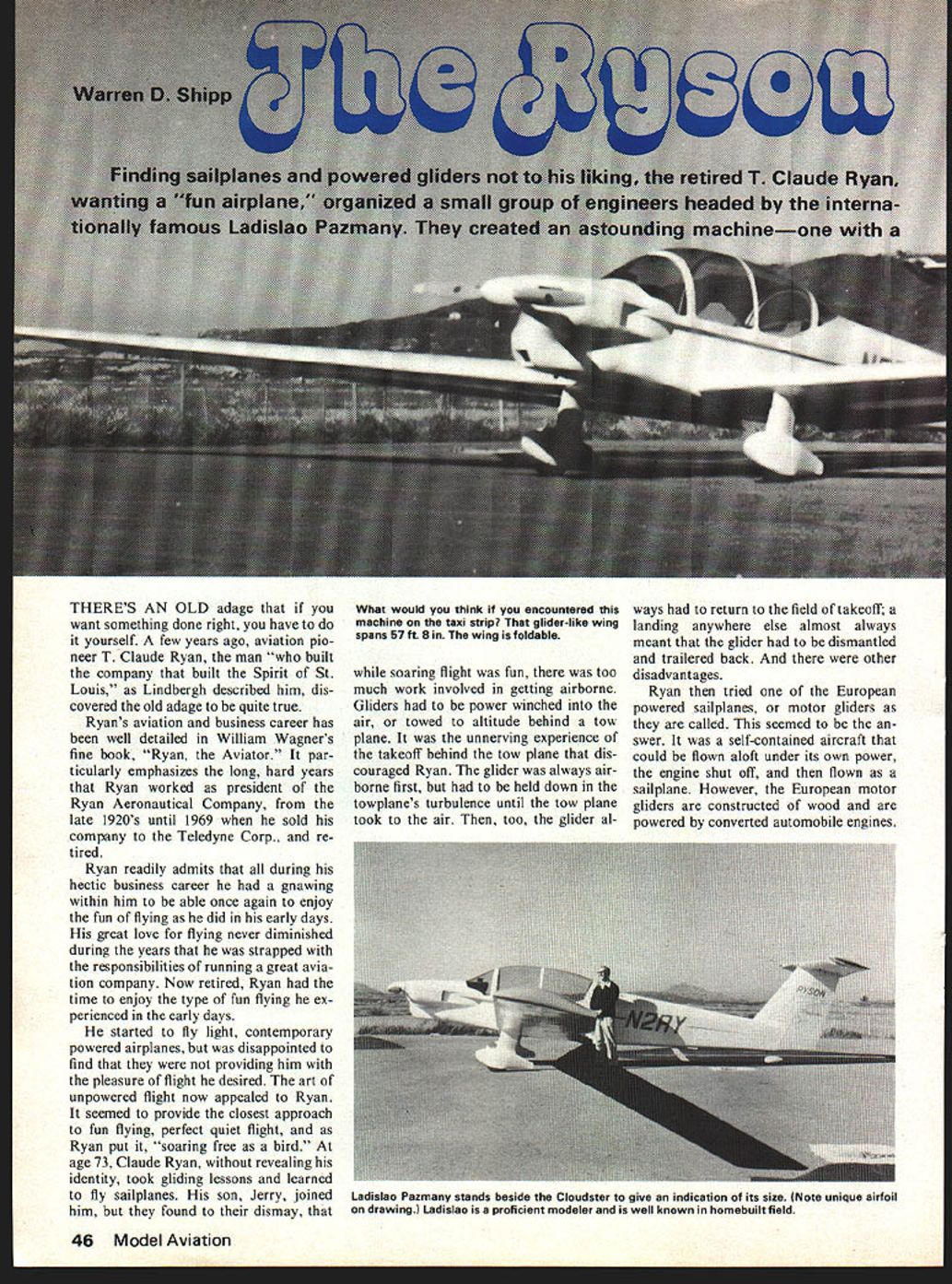
Finding sailplanes and powered gliders not to his liking, the retired T. Claude Ryan, wanting a "fun airplane," organized a small group of engineers headed by the internationally famous Ladislao Pazmany. They created an astounding machine—one with a
THERE'S AN OLD adage that if you want something done right, you have to do it yourself. A few years ago, aviation pioneer T. Claude Ryan, the man "who built the company that built the Spirit of St. Louis," as Lindbergh described him, discovered the old adage to be quite true.
Ryan's aviation and business career has been well detailed in William Wagner's fine book, "Ryan, the Aviator." It particularly emphasizes the long, hard years that Ryan worked as president of the Ryan Aeronautical Company, from the late 1920's until 1969 when he sold his company to the Teledyne Corp., and retired.
Ryan readily admits that all during his hectic business career he had a gnawing within him to be able once again to enjoy the fun of flying as he did in his early days. His great love for flying never diminished during the years that he was strapped with the responsibilities of running a great aviation company. Now retired, Ryan had the time to enjoy the type of fun flying he experienced in the early days.
He started to fly light, contemporary powered airplanes, but was disappointed to find that they were not providing him with the pleasure of flight he desired. The art of unpowered flight now appealed to Ryan. It seemed to provide the closest approach to fun flying, perfect quiet flight, and as Ryan put it, "soaring free as a bird." At age 73, Claude Ryan, without revealing his identity, took gliding lessons and learned to fly sailplanes. His son, Jerry, joined him, but they found to their dismay, that while soaring flight was fun, there was too much work involved in getting airborne. Gliders had to be power winched into the air, or towed to altitude behind a tow plane. It was the unnerving experience of the takeoff behind the tow plane that discouraged Ryan. The glider was always airborne first, but had to be held down in the towplane's turbulence until the tow plane took to the air. Then, too, the glider always had to return to the field of takeoff; a landing anywhere else almost always meant that the glider had to be dismantled and trailered back. And there were other disadvantages.
Ryan then tried one of the European powered sailplanes, or motor gliders as they are called. This seemed to be the answer. It was a self-contained aircraft that could be flown aloft under its own power, the engine shut off, and then flown as a sailplane. However, the European motor gliders are constructed of wood and are powered by converted automobile engines.
Ryan knew he could do better. So he and his son Jerry formed Ryson Aviation Corp., gathered together a small group of experienced aeronautical engineers and aircraft constructors to design and build an aircraft that would meet American standards—all-metal, with a proven certificated aircraft engine. Since the goal was an optimum modern aircraft design using contemporary construction techniques, they hired internationally famous aeronautical engineer Ladislao Pazmany as chief engineer. Pazmany is well known among airplane homebuilders; his PL series airplanes, the latest being the PL-4A T-tailed low-wing design, and as an active member of the EAA he has contributed much to the development of efficient aircraft for the average homebuilder.
What generally is not known, though, is that Pazmany is an old-time model airplane designer, builder and flier. Born in Hungary, he came to Argentina at three years old. The first model airplane he made was with a Meccano set. He built and flew models; in 1937 he built his first balsa wood flying model, a Curtiss Robin. He became a bookworm delving into the science of flight, applying models and intricate mechanisms either to stabilize, retract landing gears, etc., and won a number of contests. His major interest was flying scale models. He studied aeronautical engineering in college and later taught aerodynamics at a trade school in Argentina. He came to the United States and became busy designing and building real airplanes and had no time for models then, which he regrets. Pazmany firmly believes designing and building flying model airplanes taught him much that he could not have obtained merely by reading books. He has often used model airplanes to try out ideas and see how a new design might look. He holds a private pilot and glider license.
Pazmany, an ex-model builder, is heading a small corps of engineers and mechanics at Ryson. The company labored two and a half years designing, testing and building an aircraft they felt would be the ultimate in performance. Finally, as the result of combined efforts, the Ryson ST-100 Cloudster was unveiled for the first time in 1977.
The Ryson Cloudster
686-mile range that cruises at 135 mph on 100 horsepower, yet has a 26-to-1 glide ratio for soaring.
Ryan knew he could do better.
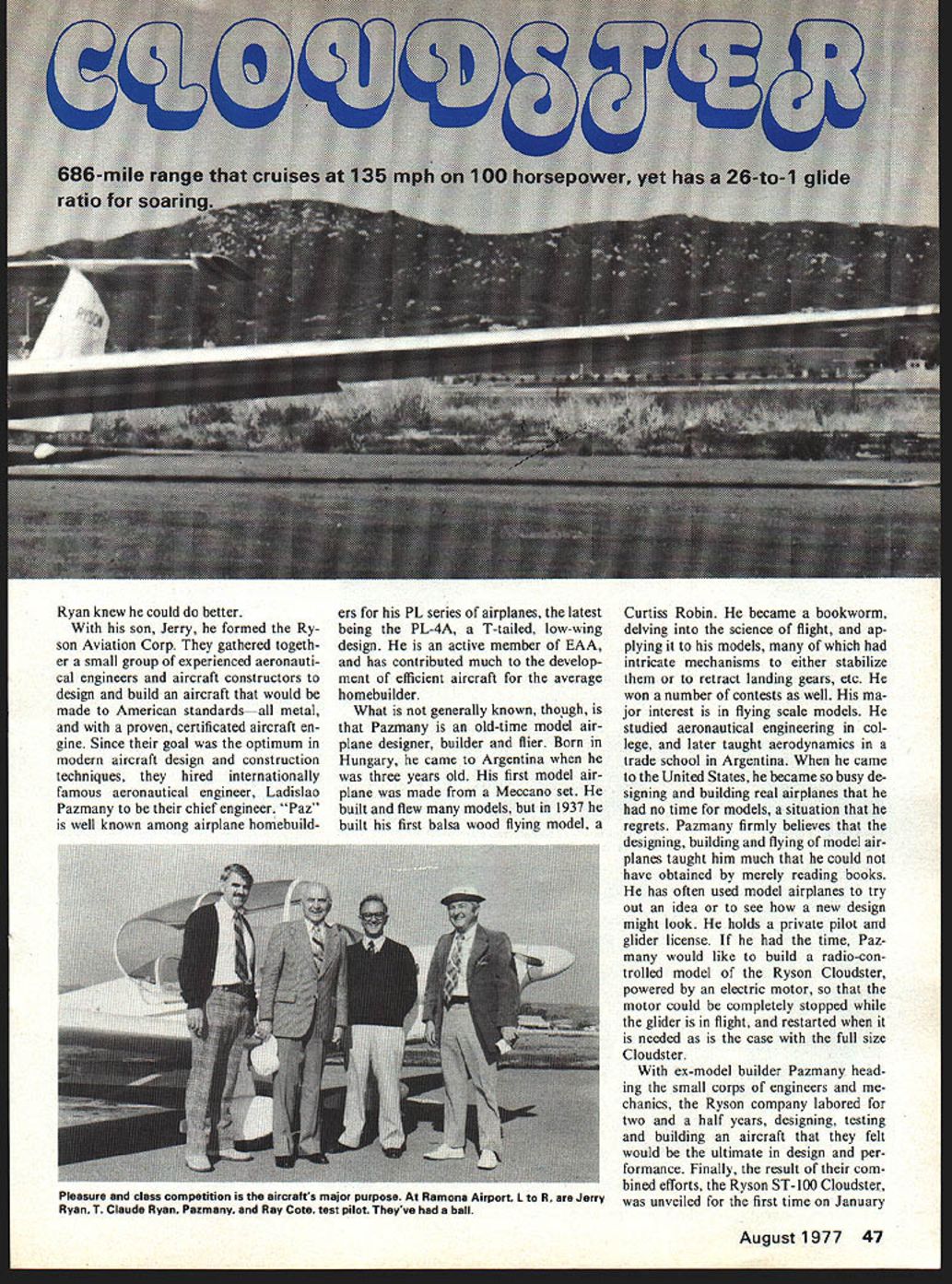
With his son, Jerry, he formed the Ryson Aviation Corp. They gathered together a small group of experienced aeronautical engineers and aircraft constructors to design and build an aircraft that would be made to American standards — all metal, and with a proven, certificated aircraft engine. Since their goal was the optimum in modern aircraft design and construction techniques, they hired internationally famous aeronautical engineer Ladislao Pazmany to be their chief engineer. "Paz" is well known among airplane homebuilders for his PL series of airplanes, the latest being the PL-4A, a T-tailed, low-wing design. He is an active member of EAA, and has contributed much to the development of efficient aircraft for the average homebuilder.
What is not generally known, though, is that Pazmany is an old-time model airplane designer, builder and flier. Born in Hungary, he came to Argentina when he was three years old. His first model airplane was made from a Meccano set. He built and flew many models, but in 1937 he built his first balsa wood flying model, a Curtiss Robin. He became a bookworm, delving into the science of flight, and applying it to his models, many of which had intricate mechanisms to either stabilize them or to retract landing gears, etc. He won a number of contests as well. His major interest is in flying scale models. He studied aeronautical engineering in college, and later taught aerodynamics in a trade school in Argentina. When he came to the United States, he became so busy designing and building real airplanes that he had no time for models, a situation that he regrets. Pazmany firmly believes that the designing, building and flying of model airplanes taught him much that he could not have obtained by merely reading books. He has often used model airplanes to try out an idea or to see how a new design might look. He holds a private pilot and glider license. If he had the time, Pazmany would like to build a radio-controlled model of the Ryson Cloudster, powered by an electric motor, so that the motor could be completely stopped while the glider is in flight, and restarted when it is needed as is the case with the full-size Cloudster.
With ex-model builder Pazmany heading the small corps of engineers and mechanics, the Ryson company labored for two and a half years, designing, testing and building an aircraft that they felt would be the ultimate in design and performance. Finally, the result of their combined efforts, the Ryson ST-100 Cloudster, was unveiled for the first time on January 13, 1977 at Ramona Airport, Calif. T. Claude Ryan proudly presented what he considered to be a fun flying machine. The Cloudster is a two-place, ultra-efficient airplane that is also an excellent sailplane. Its major features are its all-metal construction, the use of a certificated aircraft engine, conventional landing gear, and outstanding performance both as an airplane and as a sailplane.
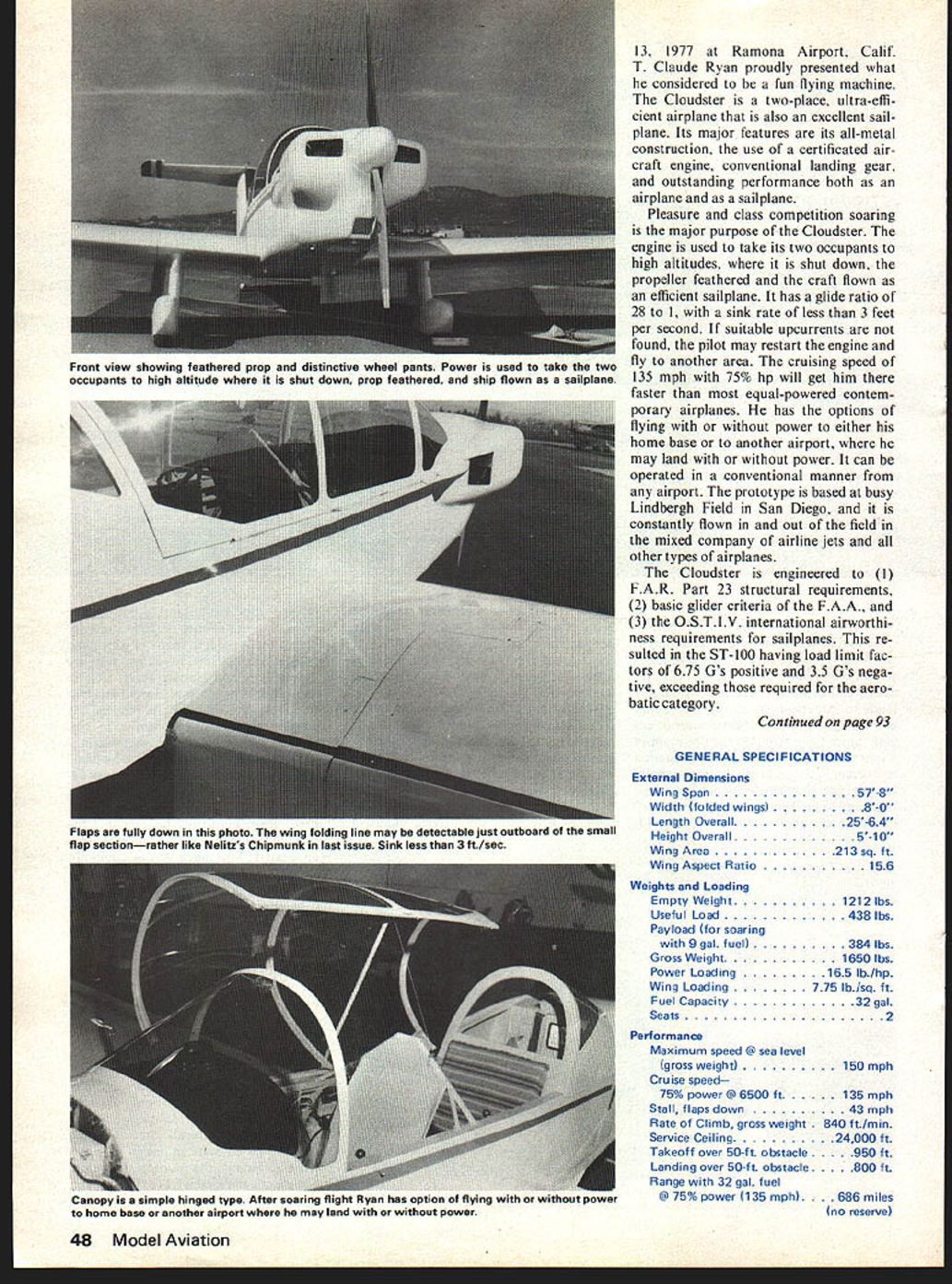
Pleasure and class competition soaring is the major purpose of the Cloudster. The engine is used to take its two occupants to high altitudes, where it is shut down, the propeller feathered and the craft flown as an efficient sailplane. It has a glide ratio of 28 to 1, with a sink rate of less than 3 feet per second. If suitable upcurrents are not found, the pilot may restart the engine and fly to another area. The cruising speed of 135 mph with 75% hp will get him there faster than most equal-powered contemporary airplanes. He has the options of flying with or without power to either his home base or to another airport, where he may land with or without power. It can be operated in a conventional manner from any airport. The prototype is based at busy Lindbergh Field in San Diego, and it is constantly flown in and out of the field in the mixed company of airline jets and all other types of airplanes.
The Cloudster is engineered to (1) F.A.R. Part 23 structural requirements, (2) basic glider criteria of the F.A.A., and (3) the O.S.T.I.V. international airworthiness requirements for sailplanes. This resulted in the ST-100 having load limit factors of 6.75 G's positive and 3.5 G's negative, exceeding those required for the aerobatic category.
GENERAL SPECIFICATIONS
External Dimensions
- Wing span: 57' 8"
- Width (folded wings): 8' 0"
- Length overall: 25' 6.4"
- Height overall: 5' 10"
- Wing area: 213 sq. ft.
- Wing aspect ratio: 15.6
Weights and Loading
- Empty weight: 1212 lbs.
- Useful load: 438 lbs.
- Payload (for soaring with 9 gal. fuel): 384 lbs.
- Gross weight: 1650 lbs.
- Power loading: 16.5 lb./hp.
- Wing loading: 7.75 lb./sq. ft.
- Fuel capacity: 32 gal.
- Seats: 2
Performance
- Maximum speed @ sea level (gross weight): 150 mph
- Cruise speed — 75% power @ 6500 ft.: 135 mph
- Stall, flaps down: 43 mph
- Rate of climb, gross weight: 840 ft./min.
- Service ceiling: 24,000 ft.
- Takeoff over 50-ft. obstacle: 950 ft.
- Landing over 50-ft. obstacle: 800 ft.
- Range with 32 gal. fuel @ 75% power (135 mph): 686 miles (no reserve)
bellcrank is installed near the wing root and the cables are led from this through the pulley wheels to the aileron horns. The cable will remain taut when the wing halves are disassembled from the fuselage. A servo connecting arm is led from one end of the bellcrank out through the root rib. I have used plastic tube bent at right angles, and epoxied to braces in lieu of pulley wheels. This, of course, is simpler to do. Both methods work equally well.
The commercially available fuel tanks are not suitable when using the larger engines, such as the Aerotec and the Quadra. There are many sources for plastic bottles suitable for our needs. Tanks are easily made up, especially if the "stick-a-tube" method is used. For the Aerotec engine I used a 20-oz. plastic bottle, but for the Quadra (it runs on gasoline) I made up a metal tank that works very well and could conceivably reduce the possibility of fire in the event of a serious crash.
Propellers are fairly easy to carve, including laminated, provided the proposed prop is laid out properly, the blank cut accurately, and close attention is paid to the washout. A good sanding disc mounted on a headstock will easily do the shaping. However, owing to the availability of good large props at a fair price, it is hardly worth while to carve your own except to satisfy your creational desires. Whether bought or home-made, propellers should be well balanced before use.
In nearly all cases, the hinges used for flying surfaces are miniature copies of the particular airplane being built. Some are surprisingly simple. Others take a little work to form, but all draw attention to the airplane at the field.
I believe that in a serious approach to the successful construction of a large "miniature airplane," we must develop a technique, whereby we concentrate our total effort on sound constructional methods, applying them to whatever part of the project we are required to manufacture. Be it a wheel, hinge, prop, machine gun, instruments, coverings or building techniques, a thorough investigation into the various construction possibilities should be undertaken. Effort is then directed to the manufacture of that one item, just as if it were the complete program.
SOURCES
- Du-Bro Products Incorporated, Wauconda, IL 60084.
- R. Shetter Ent., Pottery Road, R.R. 3, Vernon, B.C., Canada.
- Kolbe Korp., 230 N. Crescent Way, Unit H, Anaheim, CA 92801.
- Horner's Sales, Dixie Highway, Beecher, IL 60401.
- Acrotec Model Engineering Co., Box 116, Lincolndale, NY 10540.
- Brice Machine Specialties, 8229 Compton Blvd., Paramount, CA 90723.
- Midwest Industries, Inc., Ida Grove, IA 51445.
- Hobby Shack, 15480 Basildier Circle, Fountain Valley, CA 92708.
- World Engines, 8960 Rossash Ave., Cincinnati, OH 45236.
- Model Rectifier Corporation, 2500 Woodbridge Avenue, Edison, NJ 08817.
- Fox Manufacturing Company, 5305 Towson, Ft. Smith, AR 72901.
- *Also line of propellers.
From the side, the Cloudster does not appear to be a sailplane. Rather, it has the lines of a 2-place Formula 1 racer, if such an animal were to be made. Perhaps this is one reason that test pilot Ray Cote, owner and pilot of the famous Shoestring racer, is so comfortable in the Cloudster. However, he got involved in soaring while the craft was being built, and he thoroughly enjoys his work as test pilot, often flying longer than required just for the sheer fun of it. Viewing the craft from underneath as it flies overhead, reveals the long, tapered wing, and it takes on the clean lines of an efficient sailplane.
The type and design of the landing gear received much consideration. Most of the European motor gliders have a single retractable wheel in the fuselage, with supporting outrigger wheels dangling from the wings. This requires a pilot to learn new ground handling techniques, which Ryan was not happy about. Also, while taxiing, the low wing tips must be carefully watched to prevent hitting obstructions such as boundary lights. The Ryson engineers considered all types of landing gears—single wheel, a bicycle arrange- ment, tricycle gear, and the two-wheel taildragger type.
The advantages and disadvantages of each were carefully weighed, and the two-wheel taildragger type was selected. Retraction of the main wheels was found to be of practically no advantage as the increased weight of the retraction mechanism required a larger wing, resulting in a mere three miles-per-hour increase in the top speed. Therefore, the main wheels are fixed, but well streamlined. The tail wheel, enclosed in a streamlined housing, is steerable, and may be swiveled through 360°. On the ground, the Cloudster handles like any other taildragger, even in strong, gusty crosswinds.
Construction of the ST-100 is conventional metal, entirely flush riveted. The basic alloy used is aluminum 2024-T4, and other aluminum alloys are used for the extruded spar caps, fittings and miscellaneous components. The wing utilizes the new Wortmann FX-67K-170/17 airfoil. It has a single spar located at 40% of the chord, the point of maximum thickness of the airfoil.
The 57'-8" span wing may be folded for storage or trailering, cutting the width of the craft to a mere eight feet. By removing two shear pins, the wing may be pulled outward on a telescopic tube about six inches and then rotated with the leading edge down, and folded back alongside the fuselage. The outboard panel tips may be supported by a cradle, while the swivel joint at the center panel supports the inboard part of the wing.
One of the major innovative features that improves the performance of the craft is the aileron-flap interconnection during certain settings of the flaps. The electrically actuated flaps may be operated through 84°, from an up position of -12° to a full down position of +72°. As the flaps are raised from the full-down position they operate independently of the ailerons until they reach a +8° position where a "lost motion" device engages the neutral point of the ailerons. The ailerons then operate in conjunction with the flaps at any point on up to the full up flap position of -12°. Flight tests so far have indicated an increase in cruising speed of about 15 mph with the flaps in the full up position. The Cloudster does not use spoilers; the flaps serve as powerful airbrakes for glide and dive control.
The fuselage is semi-monocoque in construction with sheet-metal frames and bulkheads and extruded aluminum stringers. The center panel of the wing is built integral with the fuselage, and the leading-edge torque box adjacent to the fuselage on both sides forms with two fuel tanks. A large removable panel at the rear of the right side of the fuselage permits access to the controls and tail-wheel shock absorber. Also, there is provision for attaching a tow tripod to the tail so that the Cloudster, itself a powered glider, may be used to tow other gliders.
One instrument panel is provided for the forward occupant, but is easily visible from the rear seat. The seats were designed to accommodate parachutes, and the cockpit is ventilated and heated. The one-piece canopy is hinged on the right side, and has an emergency release. All of the spacious interior is carefully contour rounded, there are no sharp edges. Dual controls are provided for stick, rudder, brakes, flaps, propeller pitch and throttle.
The vertical fin is welded directly to the fuselage tail cone. It has one sheet metal spar at 45% of the chord. The rudder is hinged to the fin at three points. The horizontal stabilizer consists of one spar, six sheet-metal ribs and intermediate foam ribs. It is attached to the top of the vertical fin by two bolts at the spar and one bolt at the leading edge. The pilot tube and Braunschweig tube are incorporated on a stainless-steel boom extending forward of the stabilizer leading edge on the centerline of the airplane. The tips of the elevators are removable to reduce the width of the craft for transportation and are attached to the elevator by piano hinges on the top and bottom surfaces. A fibreglass fairing attached to the lower skin of the elevator slides inside the vertical fin to eliminate the aerodynamic base drag of the intersection.
Bolted to the leading edge of the wing center section outboard of the fuel tanks are the main gear oleo-pneumatic shock absorbers which were designed and fabricated by the Ryson Aviation Corp. The wheels and brakes are Cleveland, and the whole of the gear is enclosed in carefully streamlined fiberglass. The tail-gear shock absorber is made of solid rubber "doughnuts" separated by aluminum sheet plates.
Power is provided by a Continental O-200 engine of 100 hp driving a Hoffmann, two-blade, three-position metal propeller. Propeller pitch control is manual through a handle on the right side in the cockpit. The forward position of the handle puts the prop in low pitch for takeoff and climb, mid-position is for cruise, and full aft feathers the propeller for soaring flight. The propeller is spring-loaded in the low-pitch position. The two-piece cowl and the propeller spinner are made of fiberglass. Two large rectangular cut-outs are provided in the aft section of the cowl for cooling air outlets. Flexible aluminum cowl flaps are attached, and can be set at any position between full open and full closed.
According to Ryan, the ST part of ST-100 has meaning. The "S" is for soaring without power, the "T" for touring with power. The aircraft is presently undergoing a flight test program and performance figures are being compiled. To date, the Cloudster has gone to 24,000 feet and was still climbing at 250 fpm. It has over 100 hours in the air, but the tachometer reads only 45 hours. When test flights are completed, plans for the production of the Cloudster will be made. T. Claude Ryan has finally realized his ambition to have some fun with an airplane. Nearing 80 years of age, he keeps the younger people around him constantly on the run. When his Cloudster is out on the field, it is sure to attract many curious aviation people, and Ryan's almost boyish enthusiasm for his new product is noticeably infectious. And every chance he gets, when Ray Cote has to run a flight test, T. Claude Ryan climbs into the rear seat, where you can see him smiling, thoroughly enjoying his new airplane.
ACKNOWLEDGEMENTS
For Data on the Airplane: T. Claude Ryan, Jerome Ryan, Ladislao Pazmany, Bob Fronus, Ray Cote.
For Advice and Encouragement on the Drawing: Bill Hannan, Bob Peck.
Transcribed from original scans by AI. Minor OCR errors may remain.

