
SAE Student RC Cargo Competition
Daniel Cencer
When most of us think of RC contests, we think of going fast, flying a prescribed pattern, or even a fun-fly. This event, sponsored by Western Michigan University, takes us in a new direction: it pits college engineering teams against each other to see whose design can get the most cargo aloft.
Event
The Society of Automotive Engineers Student Branch of Western Michigan University held the first SAE RC Cargo Aircraft Competition at Lake Jacomo Flying Field in Blue Springs, MO on Saturday, May 24, 1986.
The students, all aircraft engineering majors, organized a design and flight competition for radio-controlled high-lift cargo-carrying aircraft to provide student groups with valuable experience in the design of aircraft with a real-world practical application. The competition was also intended to stimulate activity within SAE student members in aerospace curricula, who previously did not have an aerospace-oriented competition in which to participate.
Design notes and entries
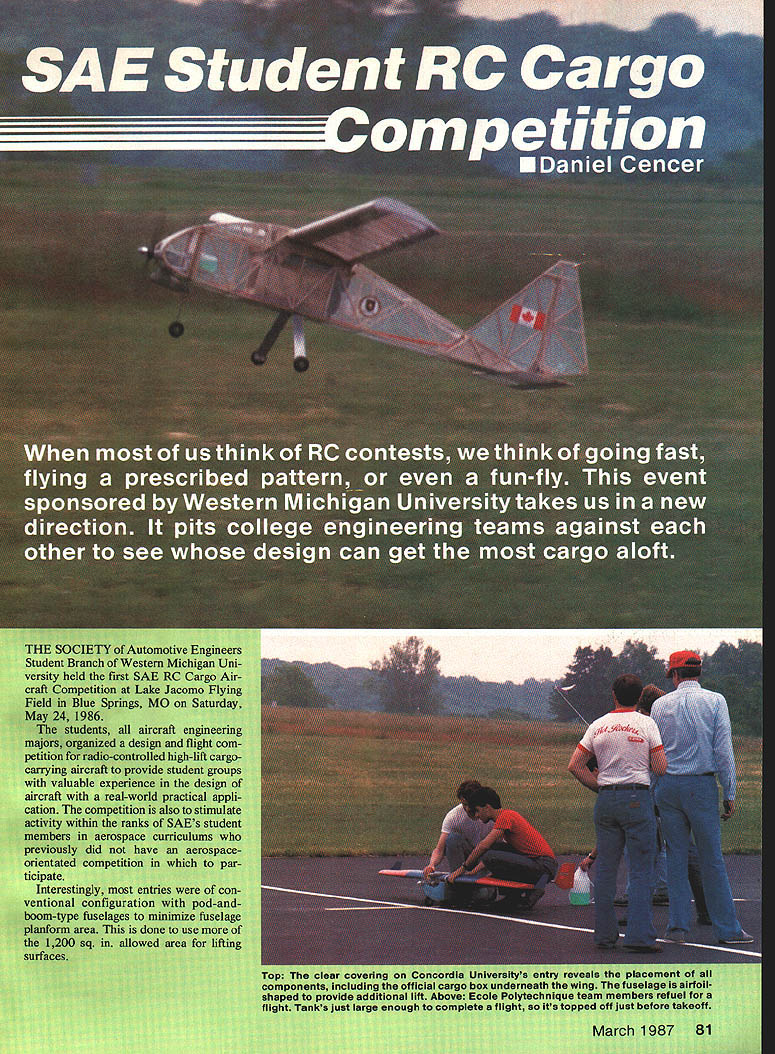
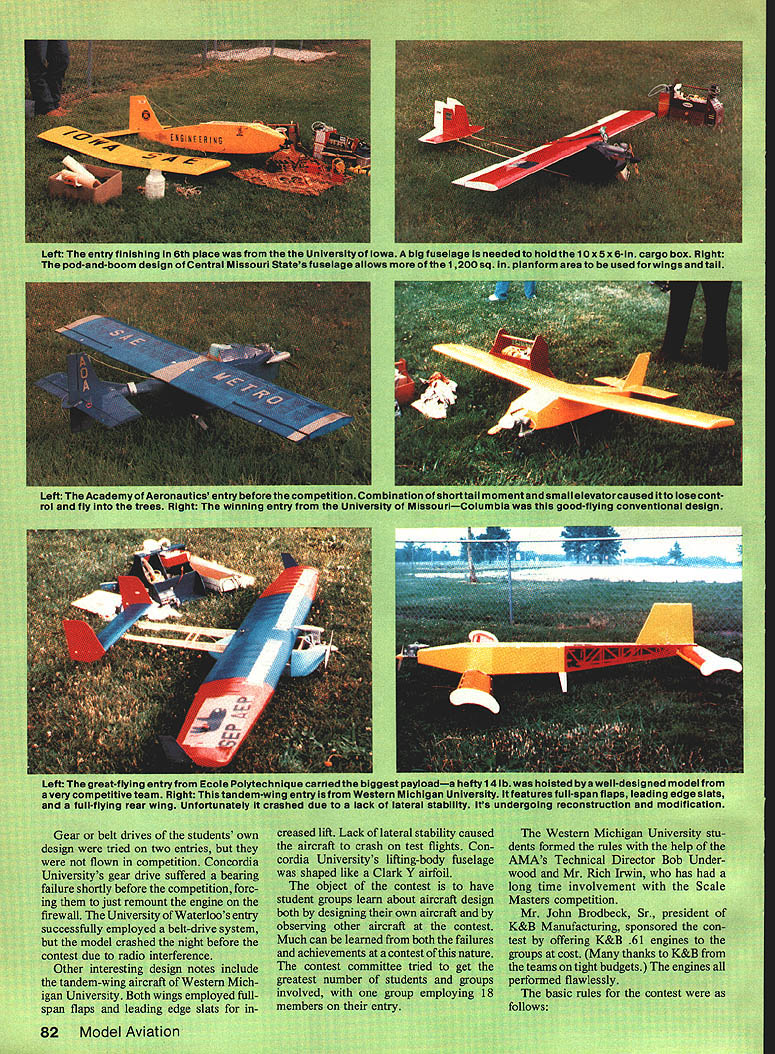
- Interestingly, most entries were of conventional configuration with pod-and-boom-type fuselages to minimize fuselage planform area. This was done to use more of the 1,200 sq. in. allowed area for lifting surfaces.
- Two teams attempted gear or belt drives of their own design, but neither system flew successfully in competition. Concordia University's gear drive suffered a bearing failure shortly before the contest, forcing them to remount the engine on the firewall. The University of Waterloo's entry successfully employed a belt-drive system, but the model crashed the night before the contest due to radio interference.
- Western Michigan University entered a tandem-wing aircraft. Both wings employed full-span flaps and leading-edge slats for increased lift, but lack of lateral stability caused the aircraft to crash on test flights.
- Concordia University's lifting-body fuselage was shaped like a Clark Y airfoil.
Objectives and participation
The object of the contest was for student groups to learn about aircraft design both by designing their own aircraft and by observing their aircraft at the contest. Much can be learned from both failures and achievements at a contest of this nature. The contest committee tried to involve the greatest number of students and groups possible; one group employed 18 members on their entry.
The Western Michigan University students formed the rules with the help of the AMA's Technical Director Bob Underwood and Rich Irwin, who has long been involved with the Scale Masters competition.
John Brodbeck, Sr., president of K&B Manufacturing, sponsored the contest by offering K&B .61 engines to the winning teams at cost. (Many thanks to K&B from the teams on tight budgets.) The engines all performed flawlessly.
Airplane Configuration
- Fixed-wing aircraft only. No dirigibles, lighter-than-air craft, gyrocopters, or helicopters allowed to compete.
- Maximum planform area limited to 1,200 sq. in. — all flying surfaces (e.g., flaps) positioned for maximum area.
- One unaltered and unmodified K&B .61 RC engine and muffler must be used.
- Radio control will be used to fly and maneuver the aircraft. No gyroscopic assist of any kind is allowed. Servos must be capable of handling air loads. All planes will be inspected for safety and conformity to the rules before flight.
- A cargo bay no less than 5 in. tall, 6 in. wide, and 10 in. long must be included in the aircraft. This cargo bay must be fully enclosed in flight and accessible on the ground to install an official contest cargo box. The box must be installed in the orientation stated (not on its side or tilted).
- Tricycle landing gear must be used: one wheel in front, two wheels in back.
- Fuel tank must be accessible to determine contents during inspections and be at least large enough to complete one contest round. The fuel tank may be pressurized by the stock fitting on the muffler only (no pumps).
- A propeller spinner or rounded safety nut must be used. No metal propellers allowed.
Contest rules
- Contestants will predict the weight in the cargo box that their aircraft will carry before the competition. The first flight for the craft in the competition will be with this predicted weight.
- After the craft has flown with the predicted weight, additional flight attempts will be allowed to carry additional weight to improve the team's score.
- The total score of an entry will be computed using the following formula:
Total score = (predicted wt. in oz.) x 3 + (additional wt. in oz.) x 1.
- The plane is to take off from the field in less than 200 ft., make a 360° turn, and land on the same runway in the same direction as takeoff. A landing is considered acceptable when the craft's first touch on the ground is within the runway area.
- A 500 mAh battery pack is the minimum required size for the competition.
Acknowledgments
With the help of Kirk Randolph, Vance Martin, and all the other members of the KCRC Flying Club, the competition was a success. Our sincere thanks and appreciation go to the members of this club who helped organize, sponsor, and run the contest. Without them it would not have been possible.
An enthusiastic turnout of participants, helpful club members, and many spectators at the 1986 competition is a good indicator that future events will be even more exciting and competitive.
Results and closing
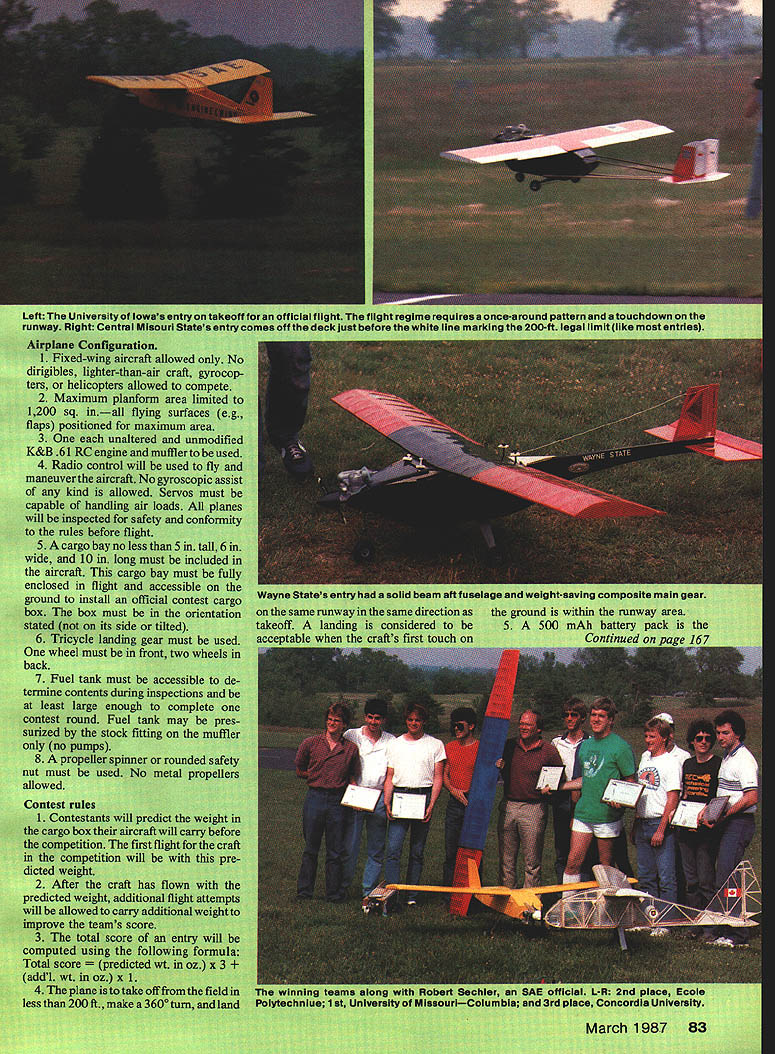
When it was all over, the University of Missouri, Columbia captured 1st place; École Polytechnique de Montréal, 2nd; Concordia University, Montréal, 3rd. Also competing: Central Missouri State University, Wayne State University, University of Iowa, University of Waterloo, Academy Aeronautics, and Western Michigan University.
École Polytechnique's entry carried the heaviest cargo, hoisting 14 lb aloft. This first event of its kind proved very worthwhile. Planning for the 1987 event has already begun.
Anyone involved in a college or university group (aeronautical or engineering-oriented) interested in participating in the event should write for entry information and start working on designs. Hope to see you there.
For further information write: Dr. Sam Haddad Faculty Advisor, Society of Automotive Engineers Student Branch Department of Aircraft and Automotive Engineering Western Michigan University Kalamazoo, MI 49008
Transcribed from original scans by AI. Minor OCR errors may remain.

