
Safari to South Africa
Don Lowe
Team Manager, U.S. International RC Aerobatic Team
It all began in Celina, Ohio, where many brave souls met in combat to try for the 1979 USA R/C Aerobatic Team. When the smoke cleared, Dave Brown, Mark Radcliff and Dean Koger had clearly earned that honor. Fortunately for yours truly, the team selected me to act as their team manager.
Preparation and High-Altitude Practice
The site of the World Championships is close to 5,800 feet above mean sea level, so we held a team practice session to sort out this possible problem. Off we went on Labor Day weekend to Denver, Colorado for adjustments to the high-altitude conditions. Thanks to Bob Graber, Travis McGinnis and other modelers in the Denver area, we spent a very enjoyable and profitable weekend and learned some important things.
Flying at high altitude demands:
- a lighter wing loading,
- more elevator throw, and
- less aileron throw.
In the process we discarded an overweight backup ship for Mark Radcliff and substituted a lighter aircraft. All fliers increased elevator throw (after Mark nearly scrubbed the ground) and decreased aileron throw. Engines generally ran well, although Mark had to change mixture settings; props with good blade area were selected.
Travel to South Africa
With this confidence-building experience behind us, we met in New York on September 15 for the long Boeing 747 South African Airways flight to Johannesburg. The 747 was a big airplane, which it needed to be to accommodate:
- Dean Koger's two EU-1s,
- Mark Radcliff's three Phoenix 8s,
- Dave Brown's three Tiporares (modified Curare),
- piles of baggage, and
- a contingent of team members, wives, mechanics and supporters.
We had arranged in advance for SAA to accommodate the model boxes without excess baggage payment, although an uninformed agent tried to have us pay an extra $75 per box. A word to future travelers: always arrange in advance for items of this nature so you aren't rudely surprised. The basic model box arrangement had been made by SAARF (South African Association of Radio Flyers) for all teams traveling on South African Airways. Note that one team was later surprised by very high model-box charges when they attempted to change return accommodations to another airline.
The 747 struggled into the sky for a 15-hour flight to Johannesburg, with one refueling stop at Ilha do Sal off the coast of Africa. After an almost sleepless night, we arrived at Johannesburg Jan Smuts Airport at 5:00 p.m. local time (11:00 a.m. U.S. Eastern Standard Time). The adventure in South Africa began as a tremendously pleasant surprise.
Local Host and Arrival Logistics
The locals, organized under Gerry Levy, had a system to host foreign teams. Each team was assigned a local modeler to arrange transport, lodging, sightseeing directions, etc. Gerry assigned himself to the U.S. team and proved an inexhaustible, superb host for our entire stay. Having a liaison member was a tremendous idea — a single important factor making the stay memorably enjoyable.
Through prior efforts by SAARF, customs processing was painless. Eventually, piled with the large volume of boxes, baggage and people, three kombis (microbuses) headed to headquarters at the Holiday Inn Milpark. A good night's sleep didn't completely erase jet lag. The next day the guys were anxious to test fly and spent the first several days fine-tuning.
Practice Problems and Fixes
Mark immediately ran into engine problems with two airplanes. It took two days to sort out mysterious flameouts; several hazardous dead-engine landings caused minor damage to some ships, which required patch-up work. The problem was finally solved by switching to a hotter glow plug. Dave cruised right along with no difficulties. Dean performed a receiver switch after glitching occurred on one airplane. On the 23rd we arrived at the practice/competition site, which allowed the guys to peak and be ready.
The Competition Site and Context
Competition began September 26 at Baragwanath Airfield. At contest time 18 nations fielded teams, a total of 50 fliers. Notably absent were Japan, Mexico and Australia — their governments' positions on South Africa's apartheid policy prevented them coming. Other teams chose to ignore politics and concentrate on friendly competition. Our good friend "Head Squirrel" Jeff Tracy from Australia showed up to watch; it was apparent he ached to fly.
We found a very friendly and hospitable people in a beautiful, thriving country. Social change was taking place rapidly in the cities, but at a slower pace in more conservative rural areas. South Africa is rich in heritage and natural resources — gold, diamonds and minerals. Johannesburg and other major cities are modern, thriving communities. The surrounding country is dotted with farms and ethnic housing, and Johannesburg is the center of gold mining, with huge tailings mounds everywhere.
One major practical difference is driving on the left side of the road; we had our problems at first but emerged as skilled drivers with only a few "close ones."
Competition Format
The contest used the familiar F.3.A A, B, and C schedules:
- Every flier had two A and two B flights.
- The addition of the best single A and B rounds determined the finalists.
- Finalists flew two C rounds with maneuvers of their selection, totaling a maximum of 450 points for 14 maneuvers.
- Final standings were determined by adding the best A, B, and C scores.
Thus, it was important to get very good A and B scores to make the finals and place high in the final standings.
Equipment and Design Notes
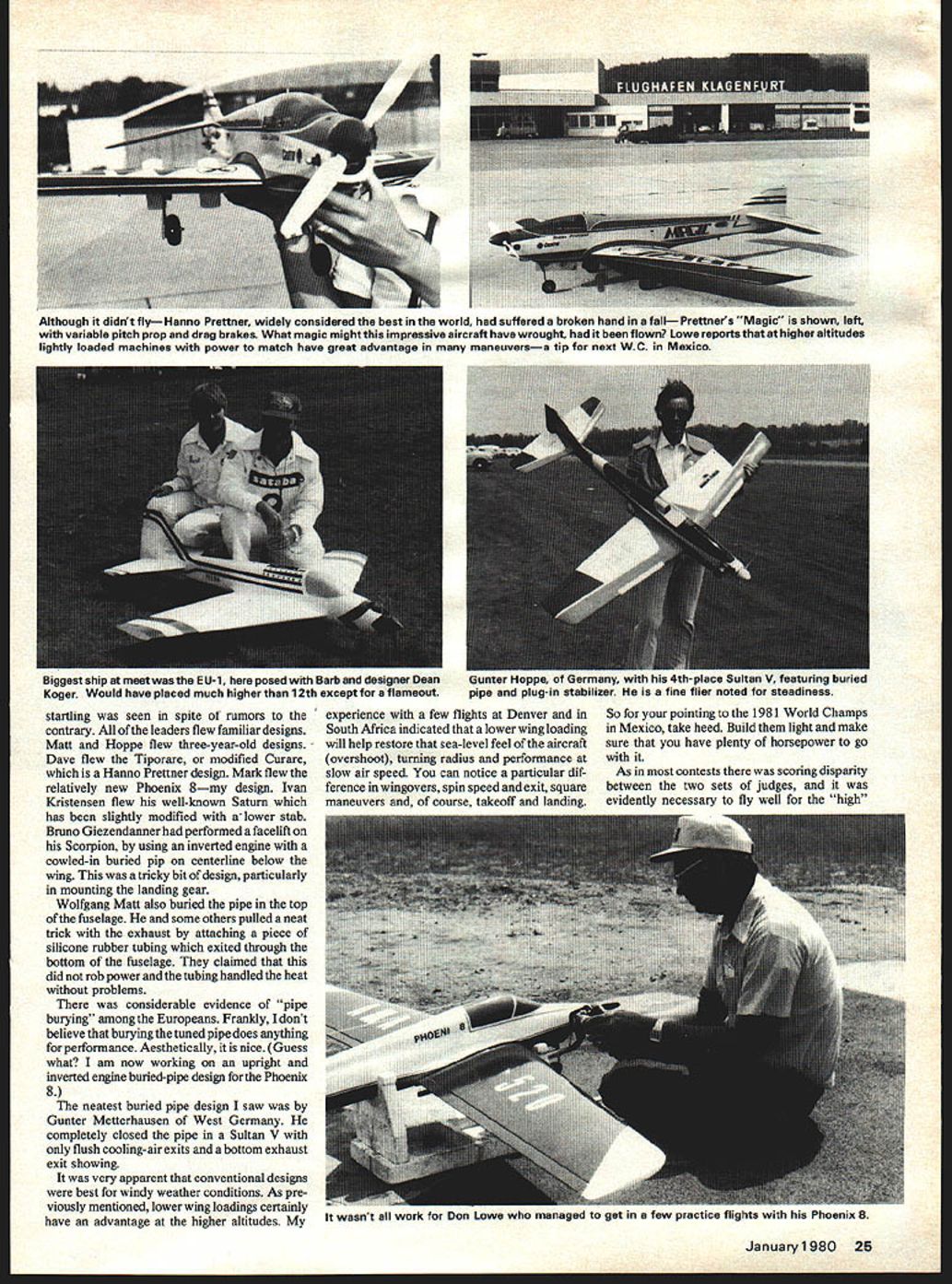
A real bombshell hit just prior to competition when Hanno Prettner, the reigning champion, broke his hand a few days before the contest and could not compete. Hanno sent regards with pictures of his new ship, Magic, which incorporates a variable-pitch propeller and dive brakes for constant-speed flying. Hanno's absence was a disappointment; only one other competitor, Wolfgang Matt, flew a variable-pitch prop in the competition.
No major surprises in aircraft or equipment design appeared:
- No geared engines.
- No huge airplanes (Koger's EU-1 was the largest).
- No specific designs purely for high altitude, though some attempted to keep weight down.
Most leaders flew familiar designs:
- Matt and Hoppe flew three-year-old designs.
- Dave flew the Tiporare (modified Curare), a Hanno Prettner design.
- Mark flew the relatively new Phoenix 8 — my design.
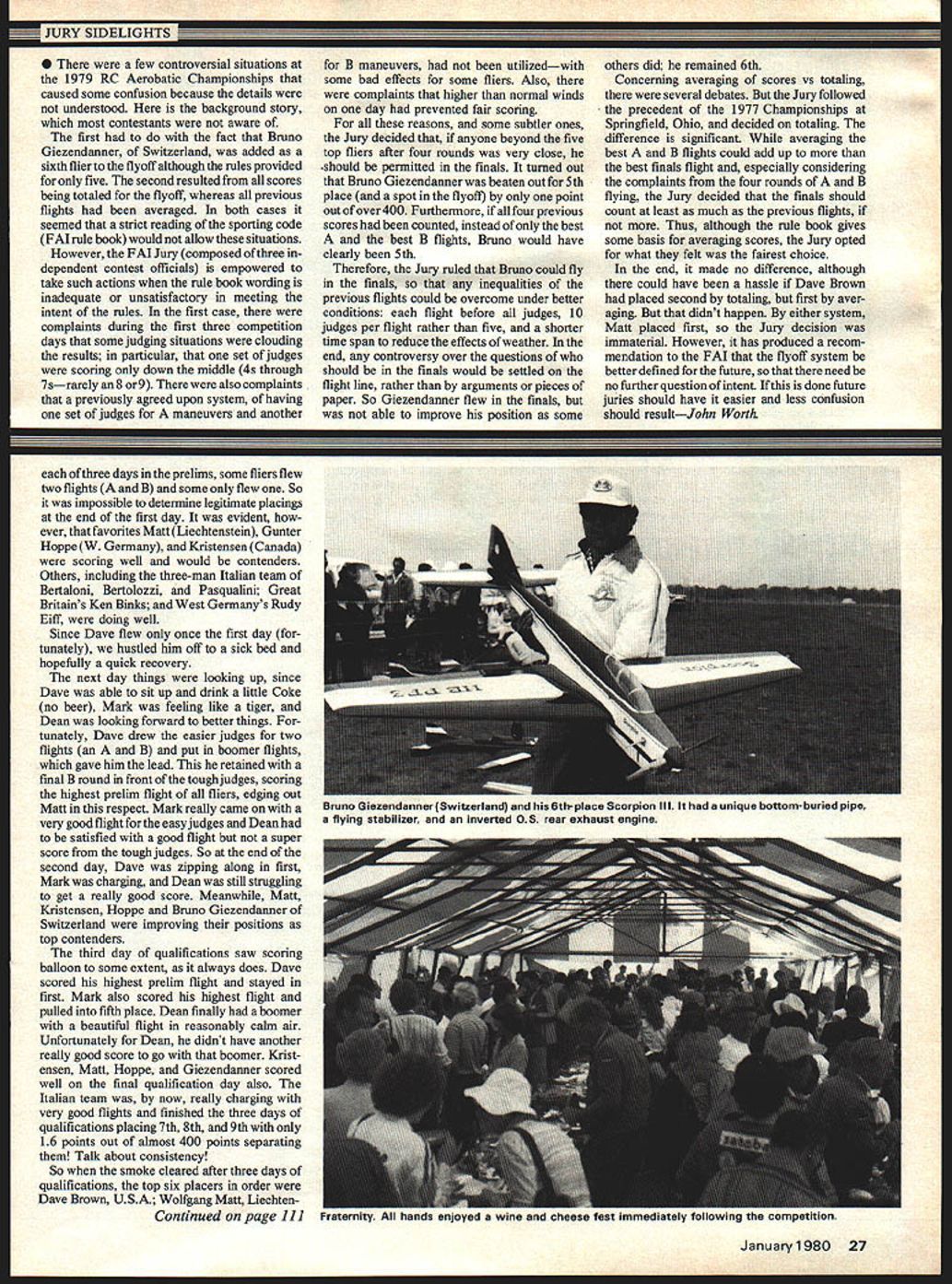
- Ivan Kristensen flew his well-known Saturn with a slightly lower stab.
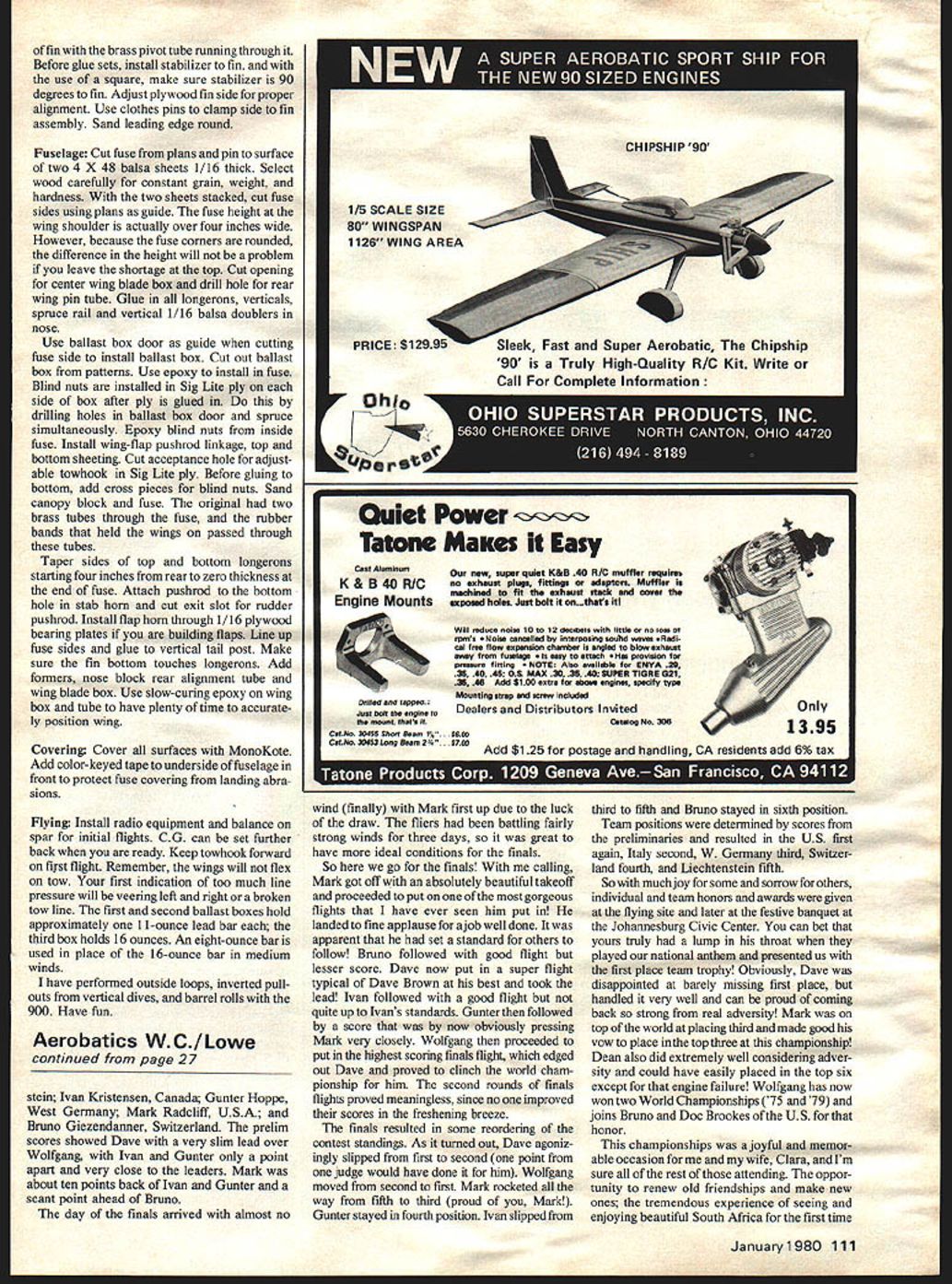
- Bruno Giezendanner facelifted his Scorpion by inverting the engine and cowling a buried pipe below the wing.
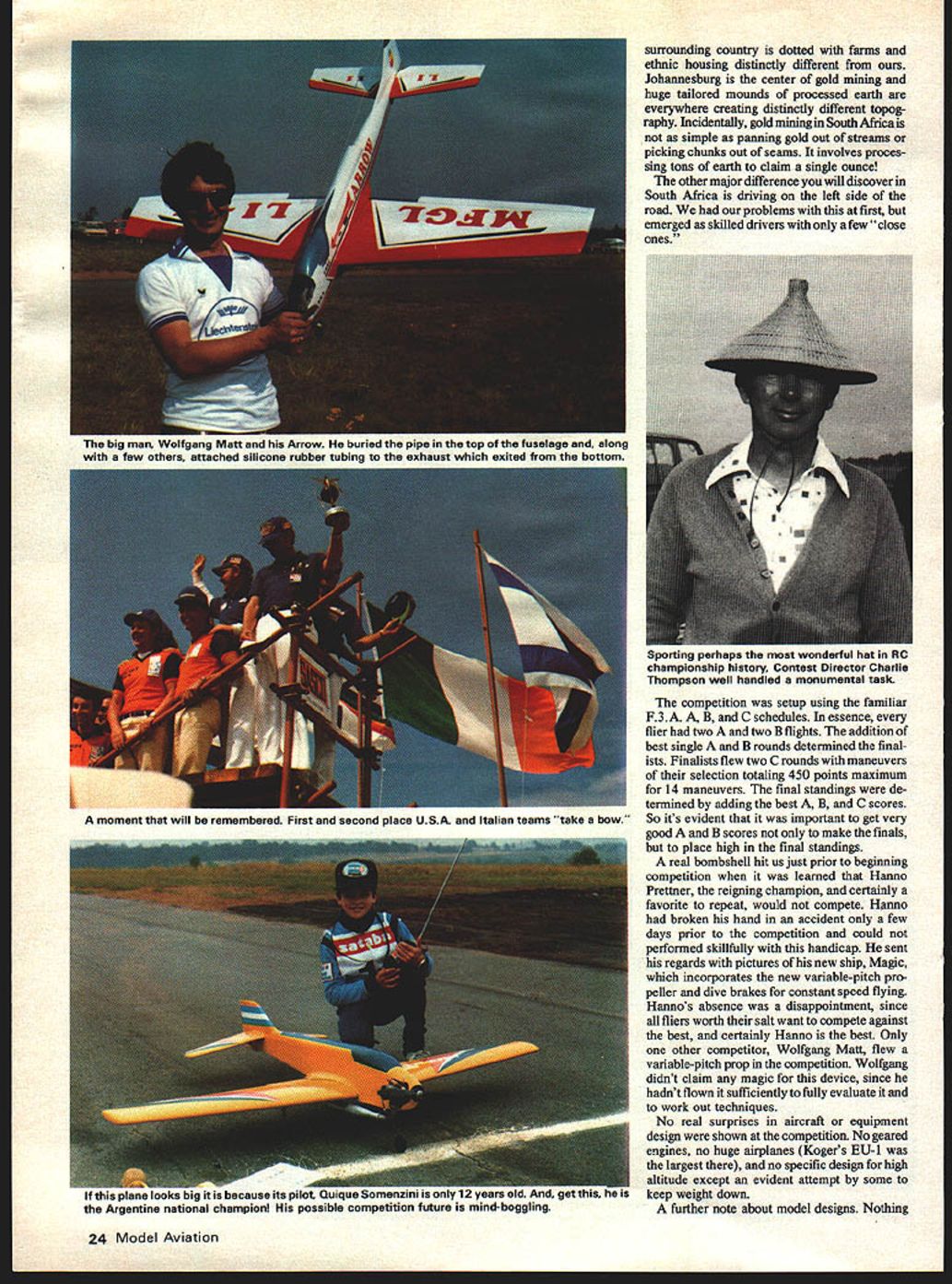
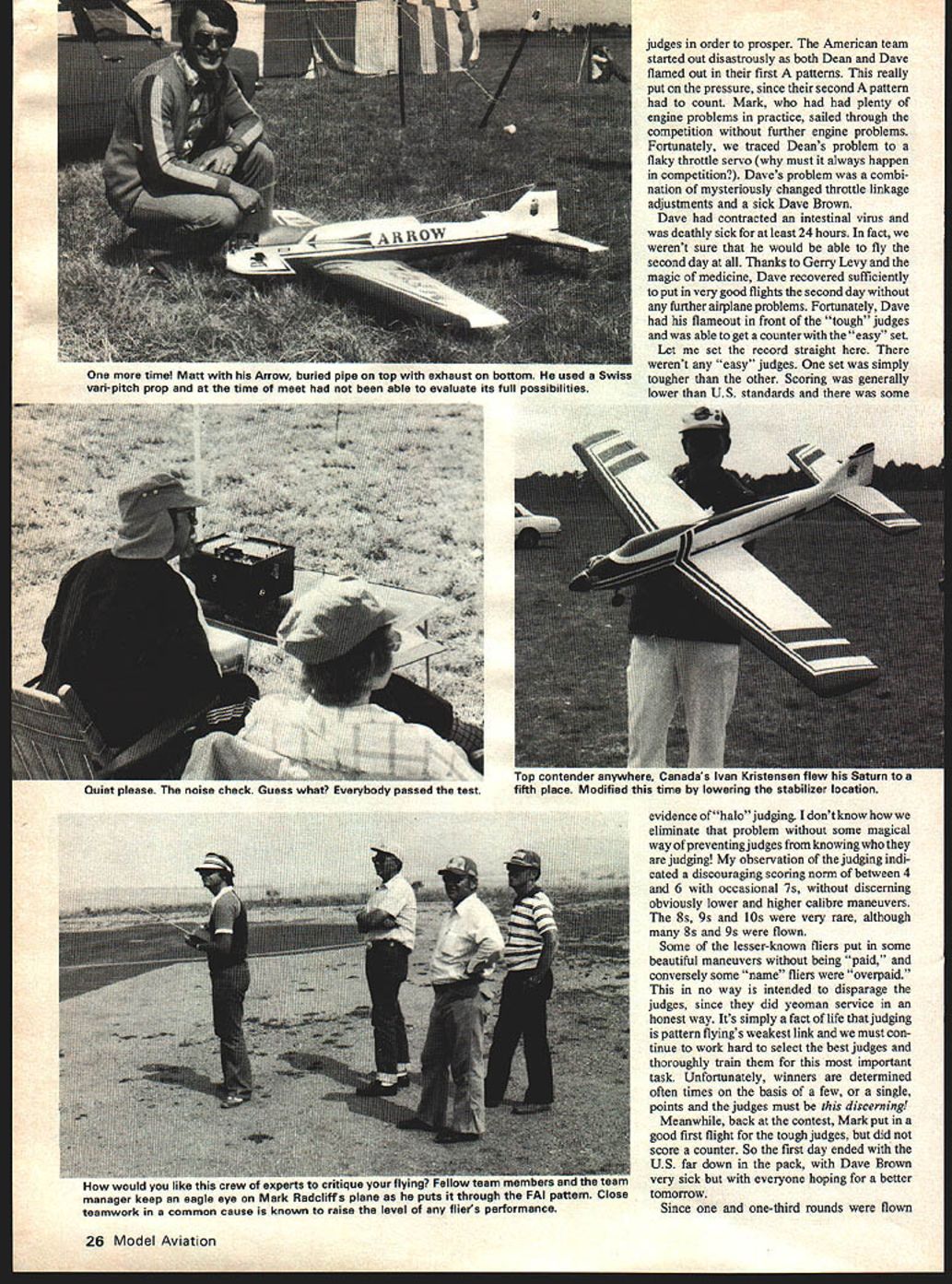
- Wolfgang Matt also buried the pipe in the top of the fuselage and used a silicone rubber tube to exit exhaust through the bottom of the fuselage.
There was considerable "pipe burying" among the Europeans. Frankly, I don't believe burying the tuned pipe improves performance; aesthetically it is nice. (Guess what? I am now working on an upright and inverted engine buried-pipe design for the Phoenix 8.) The neatest buried-pipe design I saw was by Gunter Metterhausen of West Germany: he completely closed the pipe in a Sultan V with only flush cooling-air exits and a bottom exhaust exit showing.
It was apparent that conventional designs were best for windy weather. Lower wing loadings certainly have an advantage at higher altitudes, helping restore the sea-level feel of the aircraft — noticeable in wingovers, spin speed and exit, square maneuvers, takeoff and landing. For those pointing to the 1981 World Champs in Mexico: build them light and make sure you have plenty of horsepower to go with it.
Judging and Early Competition Troubles
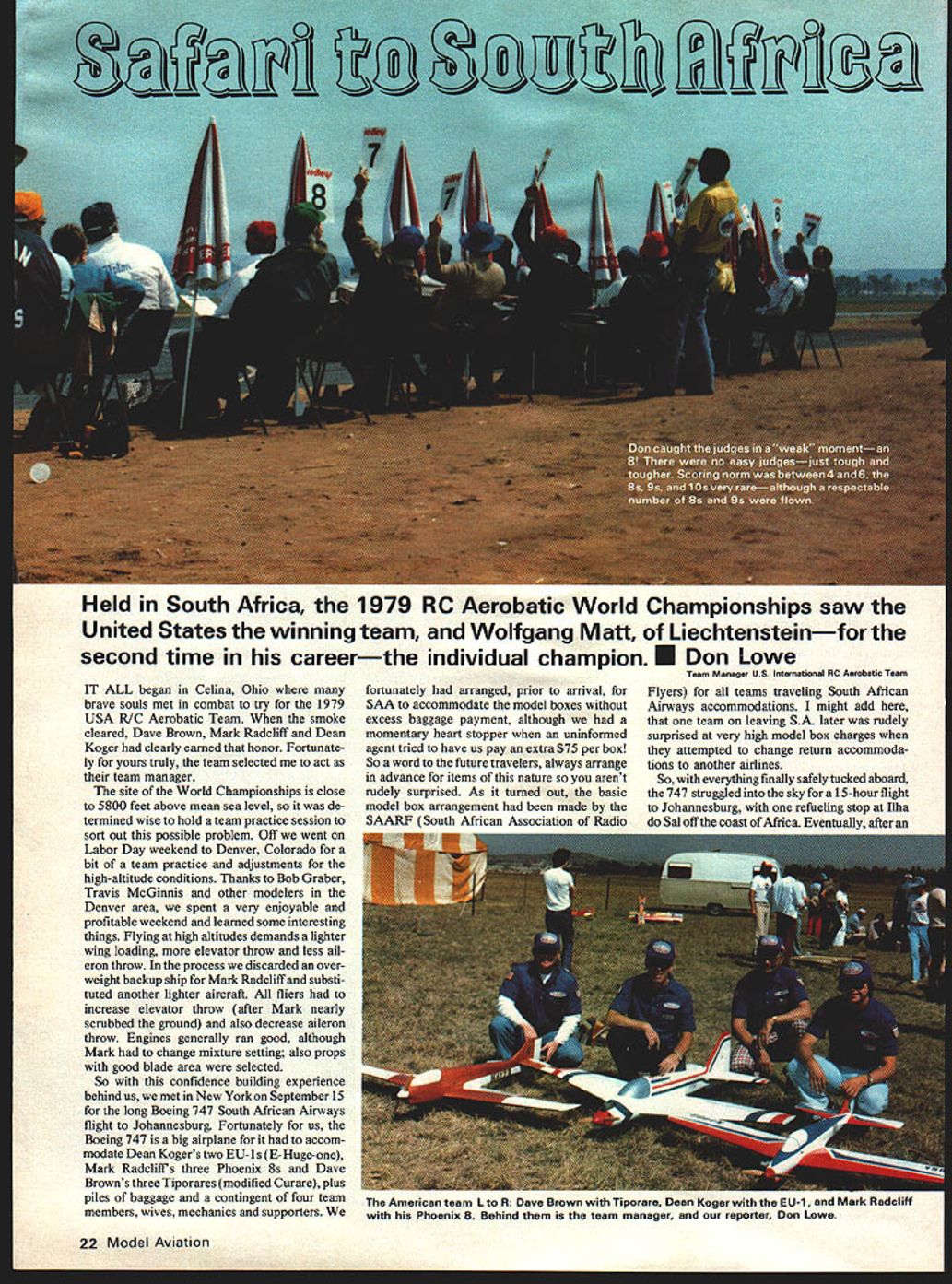
As in most contests there was scoring disparity between the two sets of judges, and it was necessary to fly well for the "high" judges to prosper. The American team started disastrously as both Dean and Dave flamed out in their first A patterns. This put pressure on the team, since their second A pattern had to count. Mark, despite earlier engine problems in practice, sailed through the competition without further engine trouble.
We traced Dean's problem to a flaky throttle servo. Dave's problem was a combination of mysteriously changed throttle linkage adjustments and illness — he had contracted an intestinal virus and was deathly sick for at least 24 hours. We weren't sure he would be able to fly the second day at all. Thanks to Gerry Levy and the magic of medicine, Dave recovered sufficiently to put in very good flights the second day.
Let me set the record straight: there weren't any "easy" judges. One set was simply tougher than the other. Scoring was generally lower than U.S. standards and there was some evidence of "halo" judging. My observation indicated a discouraging scoring norm of between 4 and 6 with occasional 7s; 8s, 9s and 10s were very rare, although many 8s and 9s were flown. Some lesser-known fliers put in beautiful maneuvers without commensurate scores, and conversely some name fliers were overpaid. This is not to disparage the judges — they did yeoman service — but judging is pattern flying's weakest link and we must continue to train and select the best judges.
Preliminaries: Three Days of Qualifications
Since one and one-third rounds were flown each day over three days, some fliers flew two flights (A and B) and some only flew one, making early placings unclear.
Favorites scoring well included:
- Wolfgang Matt (Liechtenstein),
- Gunter Hoppe (West Germany),
- Ivan Kristensen (Canada).
Other strong performers included the Italian three-man team of Bertaloni, Bertolozzi, and Pasqualini; Great Britain's Ken Binks; and West Germany's Rudy Eiff.
Day-by-day summary:
- First day: The U.S. was far down in the pack after early flameouts. Dave flew only once and we hustled him to a sick bed.
- Second day: Dave recovered and, with easier judges for two flights, put in boomer flights and took the lead. Mark improved, and Dean put in a good flight but not a super score.
- Third day: Scores rose. Dave scored his highest prelim flight and stayed in first. Mark scored his highest flight and pulled into fifth. Dean had one boomer but lacked a second strong score. Kristensen, Matt, Hoppe and Giezendanner scored well. The Italian team finished with impressive consistency, placing 7th, 8th, and 9th with only 1.6 points separating them out of nearly 400.
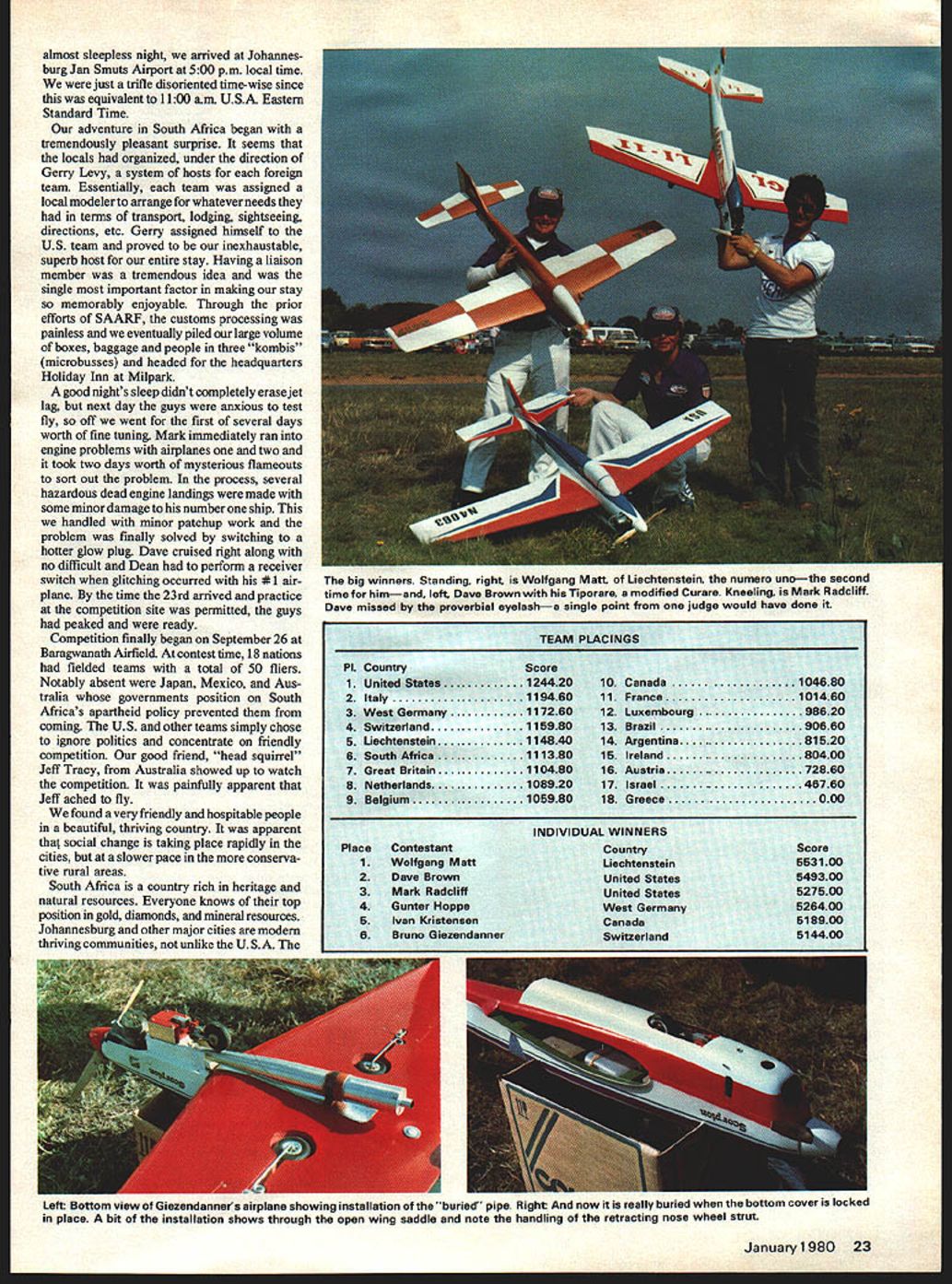
When the smoke cleared after three days, the top six placers in order were:
- Dave Brown, USA
- Wolfgang Matt, Liechtenstein
- Ivan Kristensen, Canada
- Gunter Hoppe, West Germany
- Mark Radcliff, USA
- Bruno Giezendanner, Switzerland
Prelim scores showed Dave with a very slim lead over Wolfgang, Ivan and Gunter very close behind, and Mark about ten points back of Ivan and Gunter and just ahead of Bruno.
Finals
The day of the finals arrived with almost no wind. Mark was first up due to the luck of the draw. With me calling, Mark put in an absolutely beautiful takeoff and one of the most gorgeous flights I've seen from him. Bruno followed with a very good flight but scored less. Dave then put in a super flight and took the lead. Ivan followed with a good flight but not up to his standards. Gunter then scored enough to press Mark closely. Wolfgang followed with the highest scoring finals flight, which edged Dave and clinched the world championship for him. The second rounds of finals flights proved meaningless, since no one improved their scores in the freshening breeze.
Final standings in the top six after the finals:
- Wolfgang Matt — World Champion (moved from second to first)
- Dave Brown — second (slipped from first)
- Mark Radcliff — third (rocketed from fifth)
- Gunter Hoppe — fourth (held position)
- Ivan Kristensen — fifth (slipped from third)
- Bruno Giezendanner — sixth (held position)
Team positions (determined by preliminary scores):
- United States
- Italy
- West Germany
- Switzerland
- Liechtenstein
Awards and Reflections
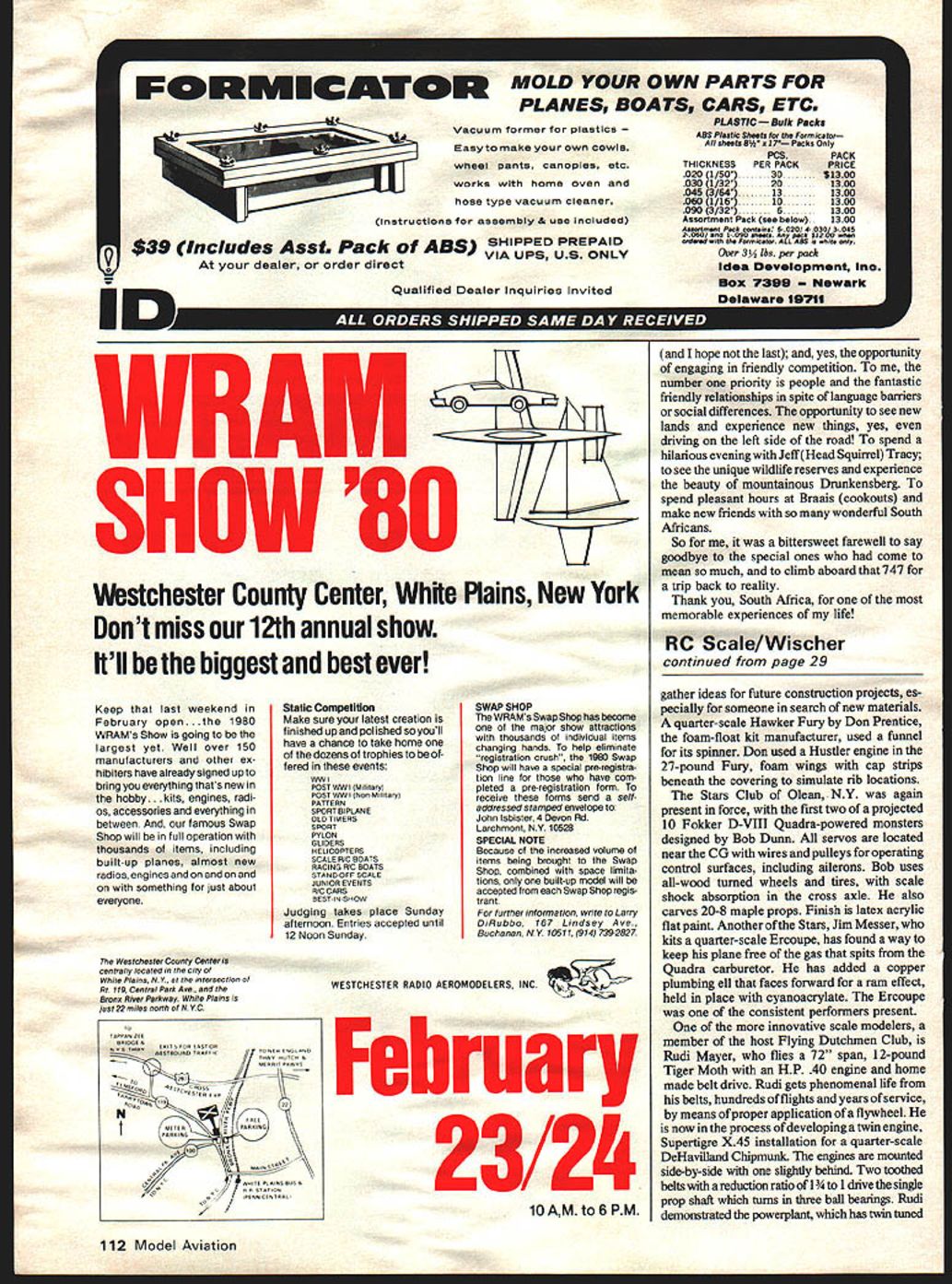
Honors and awards were given at the flying site and later at the banquet held in the Johannesburg Civic Center. I had a lump in my throat when they played our national anthem and presented us with the team trophy we had worked so hard for. Any credit for this accomplishment belongs to the entire team — our wives, friends, fellow fliers, mechanics and supporters — and to the warm hospitality we received in South Africa.
This championship was a joyful and memorable occasion for my wife Clara and me, and for everyone who attended. The opportunity to renew old friendships and make new ones; the experience of seeing and enjoying beautiful South Africa for the first time (and I hope not the last); and the opportunity to engage in friendly competition — these are the memories I cherish. People were the number-one priority: the fantastic friendly relationships in spite of language barriers or social differences. Highlights included:
- a hilarious evening with Jeff (Head Squirrel) Tracy,
- visits to unique wildlife reserves,
- the beauty of the Drakensberg mountains,
- pleasant hours at braais (cookouts), and
- making many new South African friends.
It was bittersweet to say goodbye to those who had come to mean so much and to climb aboard that 747 for the trip back to reality.
Thank you, South Africa, for one of the most memorable experiences of my life!
Transcribed from original scans by AI. Minor OCR errors may remain.

