

Safety Comes First
John Preston 2812 Northampton St., N.W., Washington, DC 20015
This column addresses items of concern regarding safety aspects of model aviation activities. The content is the opinion of the author and does not necessarily represent the official position of the Academy of Model Aeronautics.
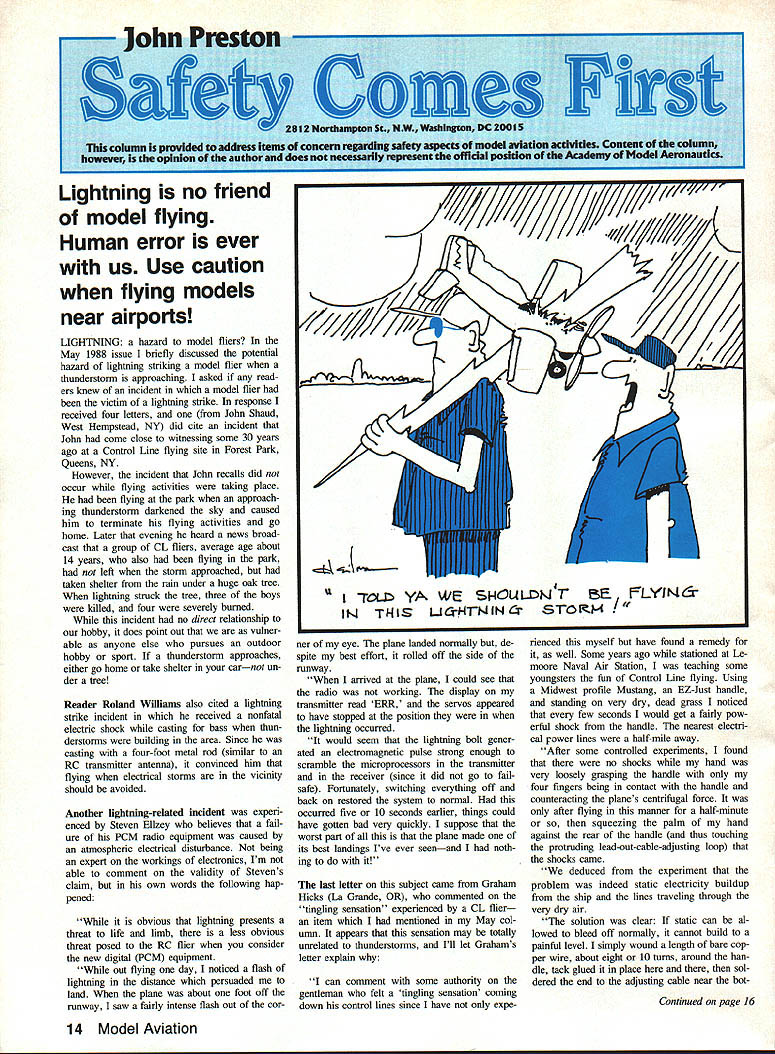
Lightning
Lightning is no friend of model flying. Human error is ever with us. Use caution when flying models near airports and never fly when thunderstorms are approaching.
- If a thunderstorm approaches, either go home or take shelter in your car — do not shelter under a tree.
- Avoid flying when electrical storms are in the vicinity.
Reader reports:
- John Shaud (West Hempstead, NY) recalled a Control Line (CL) flying site incident in Forest Park, Queens, NY. As a thunderstorm approached, some CL fliers (about 14 years old) sheltered under a large oak tree. Lightning struck the tree: three boys were killed and four severely burned. The incident highlights how vulnerable participants in outdoor hobbies can be during storms.
- Roland Williams reported receiving a nonfatal electric shock while casting for bass during thunderstorms; his metal rod was similar to an R/C transmitter antenna, reinforcing the danger of being outdoors with conductive rods during storms.
- Steven Elizey reported a suspected PCM radio malfunction caused by an atmospheric electrical disturbance. He landed because of distant lightning; a flash occurred as the model was about one foot off the runway. The transmitter displayed “ERR” and servos froze. Power-cycling the system restored normal operation. He believes an electromagnetic pulse scrambled microprocessors in the transmitter and receiver; had it happened slightly earlier, the outcome could have been much worse.
Static on Control-Line Handles
Graham Hicks (La Grande, OR) described the “tingling” or shock sensation some CL fliers experience on very dry days. He experienced shocks while standing on dead, dry grass and flying with a Midwest profile Mustang and an EZ-Just handle. Controlled experiments showed shocks occurred when his palm contacted the rear of the handle and the lead-out-cable adjusting loop.
- Cause: static electricity building on the airplane and lines in very dry air.
- Simple remedy: wind a length of bare copper wire (about 8–10 turns) around the handle, tack-glue it in place, and solder the end to the adjusting cable or the bottom of the adjusting slot. This electrically connects the handle to the lines so the charge can bleed off gradually and prevents painful static shocks.
Caveat: electrically bonding your body to the control lines increases the risk of electrocution if you contact or fly near power lines. Most CL electrocution incidents involve high-voltage power lines (often 10,000 volts or more). You cannot reasonably insulate a CL handle to protect against such voltages. The moral: NEVER FLY NEAR POWER LINES!
Frequency Conflict and Human Error
Human error and failure to follow frequency-control procedures still cause shoot-downs and crashes. Two important preventive measures at flying sites are:
- Use a frequency-control board.
- Ensure transmitters have the appropriate frequency flags.
These measures reduce the risk of becoming the victim or perpetrator of a frequency conflict, but they cannot eliminate human error entirely.
(Reports received also referenced incidents of model destruction and close calls resulting from frequency or human-error issues.)
Kites and Model Aircraft Near Airports
A newspaper reported a glider-type kite (about 12 ft wingspan) flown on 200-lb.-test nylon line roughly two miles from Palo Alto (CA) airport. A Rockwell Turbo Commander at about 800 ft struck the kite line. An eight-year-old girl flying the kite was dragged about 100 ft before letting go; she was not seriously injured. While this may be a rare event, it underscores the danger of flying kites or model aircraft where low-flying full-scale aircraft may be encountered.
FAA Model Aircraft Operating Standards (reminders):
- Do not fly higher than 400 ft above the surface.
- Do not operate closer than three miles from the boundary of an airport unless permitted by the appropriate air traffic control facility or airport manager.
Have a safe month.
Transcribed from original scans by AI. Minor OCR errors may remain.

