


Safety Comes First
2812 Northampton St., N.W., Washington, DC 20015
This column is provided to address items of concern regarding safety aspects of model aviation activities. Content of the column, however, is the opinion of the author and does not necessarily represent the official position of the Academy of Model Aeronautics.
Use extra caution when recharging Ni-Cd battery packs! Power panel hazard. Is there danger in overheating Super Glue joints?
Battery pack fires
In the June 1988 "Safety Comes First" column I mentioned a couple of incidents in which it was alleged that Ni-Cd batteries being recharged were the cause of fires that destroyed the houses of two modelers. In that column I asked if anyone else had experienced an incident in which a fire had resulted from Ni-Cds being charged. Several modelers responded with descriptions of incidents—none of which, fortunately, resulted in the loss of a home.
David Reagan, a modeler from Englewood, CO, sent a photograph of a receiver pack showing much charring of the heat-shrink covering on one end, together with the following letter:
"Enclosed is a picture of a battery pack that just 'happened' to take out of an airplane to recharge one evening. As I recall, I had used it for about a year, and it had performed without any problems. No 'modifications' or other changes had been made to it, and it was the standard battery pack that came with my radio and was being recharged on the charger supplied with the radio, a standard four-channel setup. Once it started burning—and it did burn—an open flame until the whole end was charred—it was impossible to extinguish, even though it was out in the open on my workbench.
"I hesitate to estimate the damage should this have occurred in the airplane! In checking the charger later, I found everything normal. I have since used the charger many times on other battery packs without incident.
"I do not consider myself 'inexperienced' in model aviation, since I have been building models for over 30 years, am a co-pilot for United Airlines, and have an A&P license. What I am saying is that I consider myself well qualified in the 'care and feeding' of batteries and mechanical contrivances. This incident caught me by surprise. As they say, 'If you ain't careful, you might learn something'... and I learned something from this one."
It is my guess that David's battery fire was the result of some kind of fault developing in the battery pack over its approximately one year of use. Since I'm a mechanical engineer rather than an electrical engineer, I'm not going to try and guess what the fault was, nor why it occurred. Like David, I can say that had the battery been in the model at the time of the incident, the results could have been very much more serious.
As is clear from the next letter from John Atherton (Stockton, CA), charger problems too can result in fires. In his own words, John's experience follows:
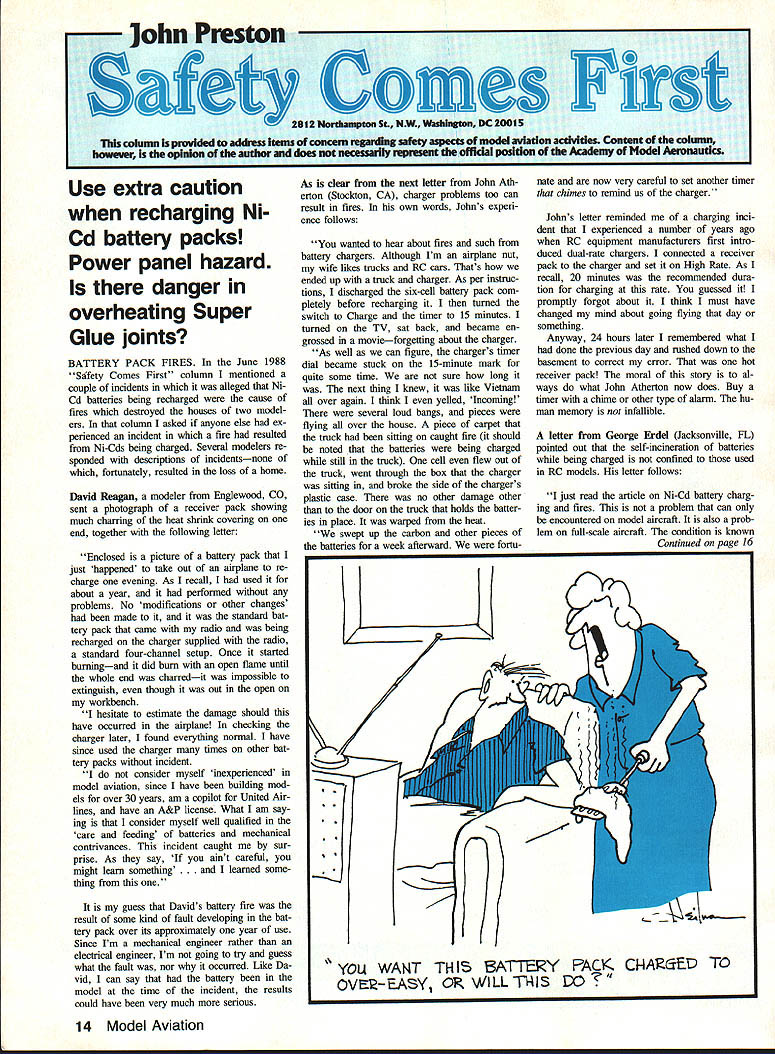
"You wanted to hear about fires and such from battery chargers. Although I'm an airplane nut, my wife likes trucks and RC cars. That's how we ended up with a truck and charger. As per instructions, I discharged the six-cell battery pack completely before recharging. I then turned the switch to Charge and the timer to 15 minutes. I turned on the TV, sat back, and became engrossed in a movie—forgetting about the charger.
"As well as we can figure, the charger's timer dial became stuck on the 15-minute mark for quite some time. We are not sure how long it was. The next thing I knew, it was like Vietnam all over again. I think I even yelled, 'Incoming!' There were several loud bangs, and pieces were flying all over the house. A piece of carpet that the truck had been sitting on caught fire (it should be noted that the batteries were being charged while still in the truck). One cell even flew out of the truck, went through the box that the charger was sitting in, and broke the side of the charger's plastic case. There was no other damage other than to the door on the truck that holds the batteries in place. It was warped from the heat.
"We swept up the carbon and other pieces of the batteries for a week afterward. We were fortunate and are now very careful to set another timer that chimes to remind us of the charger."
John's letter reminded me of a charging incident that I experienced a number of years ago when RC equipment manufacturers first introduced dual-rate chargers. I connected a receiver pack to the charger and set it on High Rate. As I recall, 20 minutes was the recommended duration for charging at this rate. You guessed it; I promptly forgot about it. I think I must have changed my mind about going flying that day or something.
Anyway, 24 hours later I remembered what I had done the previous day and rushed down to the basement to correct my error. That was one hot receiver pack! The moral of the story is: buy a timer that chimes to remind us of the charger.
A letter from George Erdel (Jacksonville, FL) pointed out that the self-incineration of batteries while being charged is not confined to those used in RC models. His letter follows. He described thermal runaway and the process this way:
"When a battery is charging, it naturally gets warm. With this rise in temperature you also get a corresponding rise in internal resistance. This in turn causes another rise in temperature, causing another increase in internal resistance. As you can see, this is a continuous cycle which will only end when the battery destroys itself by self-ignition.
"This is why it is important to monitor the charging process and assure that the maximum safe charging current is not exceeded. It may take longer to charge with the standard trickle charger that comes with the radio gear—but it is much safer. If the rapid charger is used, it should only be done with batteries that are approved by the manufacturer for fast charging.
"Thermal runaway can only occur during charging of a battery. Without the charging current being present the whole process comes to a halt. If the batteries feel hot to the touch during charging, they should be immediately disconnected from the charging source. I have taught my young fliers to periodically check the battery temperature when they are on the charger. They have felt a HOT Ni-Cd when it was fast-charging in a video camcorder battery. They have seen how hot they can get. Even my wife checks on them and has been properly instructed to disconnect if the temperature starts to rise.
"This problem has been the cause of several fatal accidents on turbine-powered aircraft. The aviation industry has installed temperature sensors in the batteries, and they are monitored from the cockpit by temperature gauges and annunciators. This is one example of yet another similarity between our scale models and their full-scale brothers."
While there may be a greater likelihood of a battery-related fire during charging operations, a letter from George Sommer, a Rock Hill, SC modeler, describes another type of fire that was caused by a model's battery pack.
"We were flying an electric-powered airplane on too windy a day, and a downwind turn just after takeoff resulted in an unscheduled and uncontrolled landing (that sounds better than 'crash'). The impact was severe enough to separate the receiver battery wires from the connector. The receiver pack (500 mAh) was fully charged, since this was the first flight of the day.
"We gathered all the pieces of balsa, foam, batteries, electric motor, etc. and put them into a paper bag. The bag was placed in the back of my pickup truck, and my wife and I went about our business of watching the other club members fly. I cannot tell you the exact time, but it was longer than 10 minutes when we noticed the paper bag was smoldering and about to burst into flames. We dumped the bag out and stepped on the smoking pieces and found the culprit. The wires which had pulled out of the connector plug on the receiver pack had touched and shorted the pack, creating enough heat to start the fire.
"I consider myself a conscientious person, but I either overlooked this shorting, or dismissed it in my own mind as not being anything serious. It did in fact turn out to have serious consequences, but I ponder on what could have happened if that bag had been put into the cab of my truck and we had left the flying field right after the crash. Also, I wonder what might have happened had the plane been gas-powered instead of electric-powered and I had put fuel-soaked foam and balsa in the bag!"
One final item. My wife and I operate a hobby store, and on more than one occasion we have had a youngster bring in a 7.2-volt car pack that had the shrink wrap melted off due to overcharging. I had never given this much thought until my fire. Now we try to explain the possible dangers of overcharging on the fast-chargers. If I get more information on fast-charging and its possible dangers, I'll get back to you.
Power-panel hazard (field box fire)
Another report of a fire that occurred at the flying field was described in a letter from Richard Kaye. Richard's incident involved his field box which, like those used by many of us, contained a battery and a power panel. In his own words, here's what happened:
"A few years ago I purchased a garden-variety power panel for my flight box from a major mail order firm. Despite the apparent dangers in its design, I see that similar units are still readily available.
"The panel has a glow plug driver with an ammeter and rheostat. I'm not well versed in electronics, but I believe it delivers 12 volts in a pulse so as not to burn out the glow plug. The ammeter is hooked up in parallel with a nichrome wire coil which serves as a resistor to calibrate the current and the current delivery. Until my accident, I never imagined that this uncovered wire could be a potential source of danger.
"At the time this all happened I was using alligator clips to attach the leads to the glow plug. The clips were attached to the power cord in a staggered fashion to avoid shorting, but as I have since learned, if the wire leads are sufficiently flexible a short may still result.
"The power panel was mounted in my box above a storage bin. When the clips shorted, the exposed nichrome wire was heated sufficiently to burn through and fall into some fuel-soaked paper toweling lying in the bin. When I finished my flight, I was amazed to find a smoky fire going on in my field box, and at the time I was at a total loss to explain how it got started."
Fuel fire
A report of an explosion and fire in a modeler's basement appeared in the May 3 issue of Newsday, a Long Island, NY newspaper. Hank Anholzer, a modeler from Valley Stream, NY, sent a clipping of this report to AMA HQ for my attention. According to the report, a modeler had been assembling a fuel-propelled model airplane while his wife and two children watched television in another area of the family's finished basement.
There was an explosion, and the modeler appeared in flames. He was knocked to the floor by the other family members and rolled in a blanket. Upon being taken to a hospital, he was listed in stable condition with burns on his hands, leg, and face. Fire officials believed the cause of the explosion was fumes "from a variety of fuels" in the basement. However, the ignition source was not reported.
It appears that the modeler is an AMA member, and I intend to follow up on this report to try and determine the ignition source. Meanwhile, I suggest you check your own workshop areas to see if any flammable liquids or materials are stored in a safe manner—away from likely ignition sources.
Super glue
"Super glue." This was the bold headline on a warning notice that appeared on a bulletin board at the plant of a major aircraft manufacturer where an old friend, Clarence Ehrlich, is employed. Clarence was not able to determine the origin of the warning which stated that super glues contain cyanoacrylate, and anything repaired with such a glue and subsequently heated will produce hydrogen cyanide gas. More specifically the notice stated that "At 525°F the gas will be 10 times the threshold limit and be fatal. This is particularly dangerous for kitchenware which has been repaired and is placed in the oven."
I discussed this statement with a co-worker who happens to work in the area of toxic materials. His opinion is that any hydrogen cyanide gas that may be released when a product repaired with cyanoacrylate glue is heated would be in such a small quantity that it would be unlikely to constitute a health hazard, let alone be fatal. If anyone reading this column has information that says otherwise, I'd like to hear from you.
As a postscript, if you do elect to drop me a line, please use my home address shown at the head of this column. White letters addressed to AMA HQ go forward; someone there has to take the time to perform this task.
Have a safe month, and be aware of the energy contained in your battery packs!
Transcribed from original scans by AI. Minor OCR errors may remain.

