

Safety Comes First
John Preston
2812 Northampton St., N.W., Washington, DC 20015
This column is provided to address items of concern regarding safety aspects of model aviation activities. The content of the column, however, is the opinion of the author and does not necessarily represent the official position of the Academy of Model Aeronautics.
Anyone had an in-flight structural failure? The fate of old, wideband radios in 1991. Let's keep risks to spectators in mind when we fly.
STRUCTURAL FAILURE
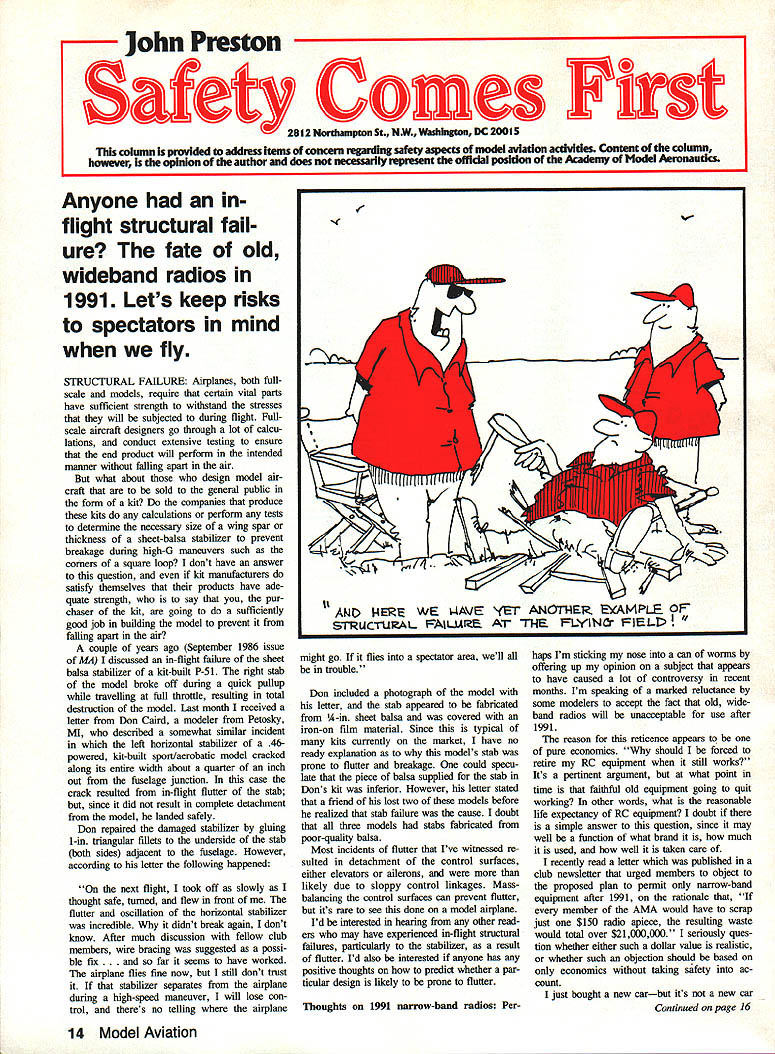
Airplanes, both full-scale and model, require certain vital parts to have sufficient strength to withstand the stresses they will be subjected to during flight. Full-scale aircraft designers go through extensive calculations and testing to ensure the end product will perform as intended and not fall apart in the air.
But what about model aircraft sold to the general public as kits? Do the companies that produce these kits perform calculations or tests to determine the necessary size of a wing spar or the thickness of a sheet-balsa stabilizer to prevent breakage during high-G maneuvers such as the corners of a square loop? I don't have a definitive answer. Even if kit manufacturers verify their products' strength, who can say that the purchaser will build the model well enough to prevent in-flight structural failure?
A couple of years ago (September 1986 issue of MA) I discussed an in-flight failure of the sheet-balsa stabilizer of a kit-built P-51. The right stabilizer broke off during a quick pull-up at full throttle, resulting in total destruction of the model. Last month I received a letter from Don Caird, a modeler from Petoskey, MI, who described a similar incident.
Don's .46-powered sport/aerobatic kit-built model developed a crack in the left horizontal stabilizer along its entire width about a quarter-inch from the fuselage. The crack resulted from in-flight flutter; because the stabilizer did not completely detach, he landed safely. He repaired the damage by gluing 1-in. triangular fillets to the underside of the stabilizer on both sides adjacent to the fuselage.
On the next flight, after taking off as slowly as he thought safe and flying in front of him, the horizontal stabilizer went into an incredible flutter and oscillation. Why it didn't break again, Don doesn't know. After much discussion with fellow club members, wire bracing was suggested as a possible fix, and so far it seems to have worked. The airplane flies fine now, but Don still doesn't trust it. If that stabilizer separates during a high-speed maneuver, he will lose control and there's no telling where the airplane might go. If it flies into a spectator area, everyone will be in trouble.
Don included a photograph with his letter; the stabilizer appeared to be fabricated from 1/8-in. sheet balsa covered with iron-on film. Since this is typical of many kits currently on the market, I have no ready explanation why some models' stabilizers are prone to flutter and breakage. One could speculate that the piece of balsa supplied in Don's kit was inferior. However, his letter also stated that a friend lost two models before realizing stabilizer failure was the cause. I doubt three separate models all had stabs made from poor-quality balsa.
Most incidents of flutter I've witnessed resulted from detachment of control surfaces—either elevators or ailerons—and were more than likely due to sloppy control linkages. Mass-balancing control surfaces can prevent flutter, but it is rare to see this done on model airplanes. I'd be interested in hearing from other readers who have experienced in-flight structural failures, particularly stabilizer failures due to flutter. I'd also welcome any positive thoughts on how to predict whether a particular design is likely to be prone to flutter.
1991 NARROW-BAND RADIOS
Perhaps I'm sticking my nose into a can of worms by offering my opinion on a subject that has caused a lot of controversy recently: the marked reluctance of some modelers to accept that old wideband radios will be unacceptable for use after 1991.
The reason for this reticence appears to be economic. "Why should I be forced to retire my R/C equipment that still works?" is a pertinent argument. But at what point in time is that faithful old equipment going to quit working? In other words, what reasonable life expectancy should be assigned to radios? There is no simple answer; it depends on how much the equipment was used and how well it was maintained.
Recently I read a letter published in a club newsletter urging members to object to the proposed plan to permit only narrow-band equipment after 1991. The rationale given was that AMA members would have to scrap just $150 radio apiece, and the resulting waste would total over $21,000,000. I seriously question whether either such dollar value is realistic, and whether an objection should be based on economics alone without taking safety into account.
SPECTATOR RISK AND LARGE MODELS
We should keep the risks to spectators in mind when we fly. If you are flying a small, light model in a country field miles from anywhere, the chance of hitting a pedestrian is extremely small and the overall risk is negligible. On the other hand, if you are flying a large, heavy model over or near many people, the risk of a serious accident is no longer negligible.
How often does something go so badly wrong with radio, model, or pilot that the model crashes in a totally uncontrolled way? Say one flight in a thousand, certainly no better. At 20 meetings or displays with 50 flights at each, at least one crash is pretty likely. If there are large numbers of people near or under the model, then a serious injury is also likely.
Scale modelers do much of the flying at displays and fly-ins where there are lots of spectators; we are also the builders of most of the giant models. I know a fast aerobatic model or pylon racer can do as much damage as a big scale model, but in general aerobatics and pylon racing are carried out away from spectators.
There has already been a serious accident this year when one of our best pilots lost control of his model at a display and a spectator was injured. The incident was not widely reported, but it should have been. If it can happen to the best pilots, it can happen to any of us, and we should face up to this.
If you are flying a big model, you must allow for the possibility of something going wrong and the model becoming uncontrollable. If there are spectators close to your flightpath who would be in danger if your model came down on them, you should not be flying where it could happen. The primary responsibility for safety rests with the pilot, not the meeting organizers or the insurance companies. If a model could become uncontrollable, then you should not be flying it where people might be harmed.
One obvious answer is that the AMA should require controlled boundary lines for models above a specified size or weight, or require models of a certain weight to be flown in designated areas only. Alternatively, narrow-band rules could be coupled with requirements for better fail-safe features or other safety improvements in newer radio sets in addition to frequency narrowing.
It just so happens that in two weeks I will be off to the Nats to cover the RC Scale events for Model Aviation. Bob and Dolly Wischer, who have covered these events for years, cannot make it this time. It will be interesting to see whether flight safety is foremost in the minds of U.S. scale competition fliers.
Till next month, have a safe one.
Transcribed from original scans by AI. Minor OCR errors may remain.

