

John Preston
Safety Comes First
2812 Northampton St., N.W., Washington, DC 20015
This column is provided to address items of concern regarding safety aspects of model aviation activities. Content of the column, however, is the opinion of the author and does not necessarily represent the official position of the Academy of Model Aeronautics.
Fatal Accident
In the June 1988 Safety column I mentioned a safety campaign launched by the Society of Model Aeronautical Engineers (SMAE), the British counterpart of the AMA. That campaign was prompted in part by two deaths during 1987 caused by R/C model flying activities. I described the first death (a collision between a slope soarer and a full-scale hang glider) in the February 1988 column. Until recently I knew little about the second incident; Henry Farrar, editor of the Long Island Drone Society newsletter, sent a copy of the July issue that included a fuller account, apparently drawn from Radio Control Models & Electronics (RCM&E).
The incident occurred November 1, 1987, at a club field in the southern suburbs of London. The all-grass field had runways defined by close-mown strips. Although the club had an appointed safety officer, he was not at the field that day. The victim (Flier A) was a club member who had not yet soloed and was flying under instruction from an experienced, club-designated instructor. Another member (Flier B) had a Mustang fun-fighter at the field, estimated to weigh about three pounds and powered by a .20-size two-stroke engine. After checking out his model, Flier B hand-launched it into the prevailing wind.
During the flying period, a change of runway was announced. After performing several maneuvers, Flier B noticed his engine had quit while the Mustang was at about 25 ft altitude. He called out "Dead-stick" and initiated a glide to land. Because of the low altitude and the positions of the pits and pilots, the Mustang's glide was toward the approach to the previously designated runway (the one from which it had been launched). Flier B had checked at the beginning of his approach and believed the runway was clear. He did not see Flier A and the instructor until a split second before the Mustang struck Flier A in the head.
Apparently Flier A and his instructor had crossed the runway to get into position to land their model on the newly designated runway. The accident occurred just as Flier A was rising after tying a shoelace; he was struck in the right temple. He died 24 days later from a depressed skull fracture that resulted in a fatal brain injury.
Testimony at the subsequent inquest stated the model had been well constructed, fitted with a spinner that conformed to SMAE recommendations, and was being flown in standard practice. The dead-stick model was estimated to have been traveling about 25 mph during its approach. The coroner summarized the accident as appearing to be a "one-in-a-million chance," and the verdict was Accidental Death.
The magazine account included suggestions to help prevent similar incidents. I agree with them:
- If a wind change necessitates a runway change during flying activities, make the change after all models have landed. In other words, when a runway change is agreed, no models should be permitted to take off on the new runway until models already in the air have landed. Any reorientation of pilot locations or pit areas can then be made safely without risking someone being struck by an incoming model.
- Locate pilot stations and pit areas so they will not be under the flight paths of models, regardless of which runway is in use. This minimizes the risk of someone being struck by a model.
- When feasible, have a buddy act as a copilot while you are flying to inform you of what is going on around you. Taking your eyes off your model to ensure the runway is clear may itself result in an accident, especially if several models are airborne simultaneously.
Please don't dismiss this accident because it happened in another country. From experience with safety in various fields, if it can happen in one country, it can happen elsewhere. Take a close look at your flying field layout and operating procedures and ask yourself: Could it happen here?
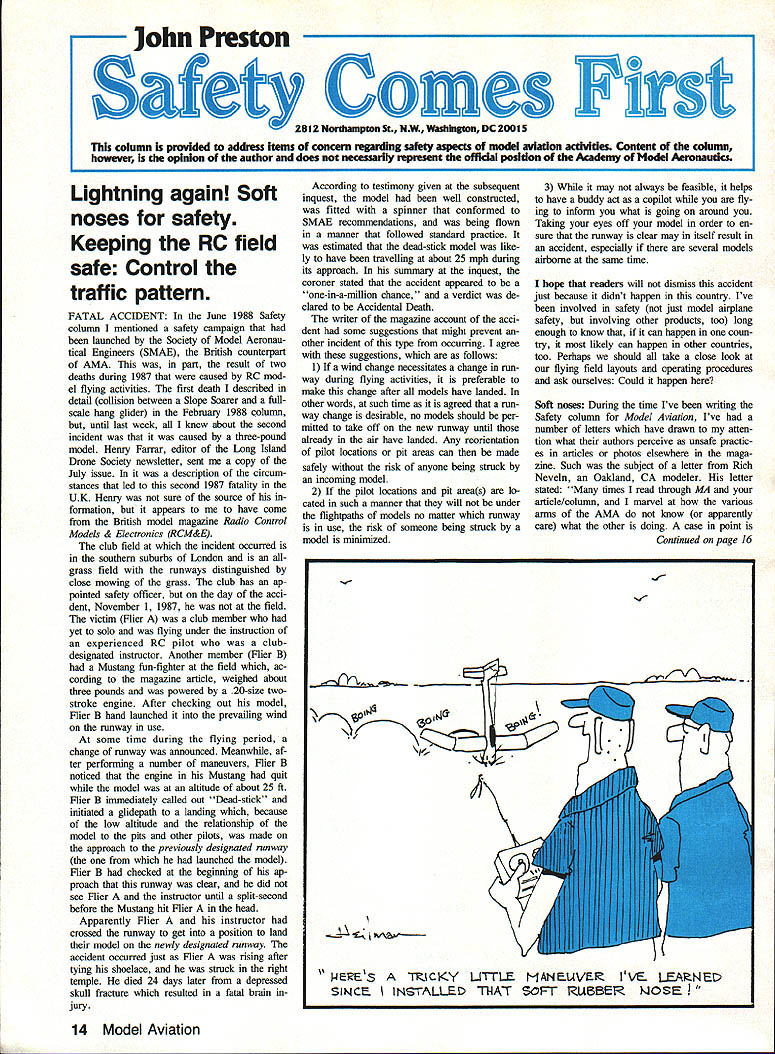
Soft Noses
Over the time I've written this column I've received letters pointing out perceived unsafe practices in articles and photos elsewhere in Model Aviation. One such letter, from Rich Neveln of Oakland, CA, protested the pointed nose shown in the June lead construction article on the Mariah sailplane. He noted that the Mariah's nose appeared too pointed to conform to the minimum radius-of-nose requirement (7.5 mm) in the F3B rules for thermal soaring models.
Rich wrote that in his six years of slope glider flying he had been hit about six times; three of those times caused pain and bruises. He and others flight acrobatic slope gliders but use rubber noses on most of them. These two-meter machines weigh 2½ to 3 lb; pointed noses, he said, are a potential cause of serious injury.
Rich described how his soft noses are fabricated:
- Blocks of latex foam are rubber-cemented onto the flat-fronted fuselage, with the blocks decreasing in size toward the tip and slightly undercut at the front face.
- The finished nose is given a smooth contour by covering the rubber blocks with a thin skin of rubber (colored or white) and smoothing it into shape with a wet finger.
- A final important step is drilling a 1/8-inch-diameter hole in each side of the finished nose.
After reviewing photographs of sailplanes in back issues, it appears pointy noses are common. Just how necessary such noses are for high performance is debatable. In my opinion (and I welcome criticism from sailplane enthusiasts), they probably are not necessary.
Lightning Revisited
In a recent Safety column I discussed the potential hazard of lightning striking the antenna of an R/C transmitter during an approaching thunderstorm and asked readers if they knew of any such incident. No one had responded until last week, when I received a letter from Thomas Ailes of Valencia, IN. He reported an unusual circumstance: "I read your article in the August 1988 MA about lightning. Back in 1963, my uncle and I had a new Orbit 10-channel transmitter hit..." The account he sent illustrates that unusual lightning-related incidents can and do occur.
Closing
I'm going to finish right here because tomorrow I leave for the AMA Nats, and when I return I will have to write a column on the R/C Scale events (which you can now turn to on page 42 in this issue).
Have another safe month.
Transcribed from original scans by AI. Minor OCR errors may remain.

