


Safety Comes First
John Preston 2812 Northampton St., N.W., Washington, DC 20015
This column addresses safety aspects of model aviation activities. The content is the opinion of the author and does not necessarily represent the official position of the Academy of Model Aeronautics.
Watch out: Some CyA glue debonders contain acetonitrile — can cause cyanide poisoning if ingested in sufficient quantity
WARNING: Some brands of cyanoacrylate (CyA) glue debonders contain acetonitrile (methyl cyanide). If ingested in sufficient quantity this substance can cause cyanide poisoning.
- Acetonitrile is also sold as a remover for false fingernails. I am aware of two incidents in which young children ingested acetonitrile sold under the brand name Supernail Liquid Nail Off. In one case a 16‑month‑old boy reportedly ingested one to two tablespoons; the dose proved fatal and the autopsy listed the cause of death as "cyanide intoxication." In the other case a two‑year‑old ingested as much as an ounce, developed severe metabolic acidosis, but recovered after immediate treatment for cyanide poisoning.
- Debonders sold for hobby use are generally packaged in eyedropper‑type bottles; with such bottles it is unlikely a child would ingest a lethal amount. I am told the false‑nail debonder responsible for the fatality was not packaged in such a bottle.
- DuPont, formerly the sole domestic producer of acetonitrile, ceased domestic production after learning of the fatality; acetonitrile still appears to be produced abroad and therefore may still be an active ingredient in some debonders.
- I understand debonders sold under the Satellite, City (Hot Stuff), and Sig labels do not contain acetonitrile; other manufacturers’ products may also be free of it.
If you have children in the house, check your work area and make sure glues, solvents, and other potentially harmful products are safely out of reach of curious toddlers.
In June 1988 the American Association of Poison Control Centers petitioned the U.S. Consumer Product Safety Commission (CPSC) to require products containing acetonitrile be sold only in containers with child‑resistant caps. Whether the CPSC will act remains to be seen.
More on stabilizer (stab) failures
My October 1988 Safety column discussed an in‑flight failure of the stabilizer (stab) on a kit‑built model. That article generated many letters on the subject — some critical.
One letter, postmarked Kansas City, MO and signed "Steve Jacobs" with no return address, accused me of being a "chicken" for not naming the model and manufacturer allegedly involved in three stabilizer breakoffs. He suggested renaming the column "Advertisers Come First" but ended by saying he enjoys the column even though he no longer respects me.
Because many readers are AMA members, I checked the AMA membership roster to find an address for Steve and was unable to locate anyone by that name in Kansas City. I wrote the following reply (which I could not mail on September 6, 1988):
Dear Steve:
Perhaps in your eyes I am a chicken‑s**t, but a single reader's allegation that a product is potentially unsafe is not, in my opinion, sufficient grounds to name the brand in the Safety column. For example, am I to assume the modelers who reported the failures were competent builders? Poor building technique could have induced the failures. From past experience, if a particular model truly had inadequate stab strength I would have expected multiple reports; although I did receive a number of letters on the subject of stab failure, none involved the same model.
There have been times I published a brand name when I had proof of a safety problem. Conversely, I have received letters from manufacturers alleging I said something derogatory about their products even though I had not mentioned them by name. In this sue‑happy society it would be foolish for any editor to publish an allegation that a product is unsafe unless accompanied by substantiated evidence — unless the editor enjoys being the defendant in libel suits. For the record, the manufacturer of the kit in question did not advertise in Model Aviation, so I'm not acting to protect advertisers.
I'm glad you enjoy the Safety column. I hope this letter restores your respect for me and my writings.
Sincerely, John Preston
A more technical response came from David Hall of Carlsbad, CA, a mechanical engineer. He related his son's RC model suffering an in‑flight wing failure (styrofoam wing) that destroyed the plane and engine; a letter to the manufacturer resulted in a stronger wing and a replacement engine. Regarding flutter, David explained:
- In full‑scale aircraft design, a rule of thumb is to have the center of gravity of the wing (not of the entire airplane) between the leading edge and 25% of the chord.
- Tail‑surface flutter is probably not a major problem because tail surfaces are small.
- Control‑surface flutter is usually the result of poor assembly and is not the same as wing flutter.
- Flutter can occur when structure has insufficient stiffness.
Other possible causes of in‑flight structural failure include:
- Undetected damage during handling.
- Defective materials and/or assembly.
- Structure unable to withstand high control‑surface forces imposed during maneuvers.
- Vibration (torsional, bending, or combined modes) excited by airflow, engine, or other sources.
David also discussed natural frequencies and included calculations for stabilizer frequencies; the bottom line is that flutter can occur in models if stiffness is inadequate.
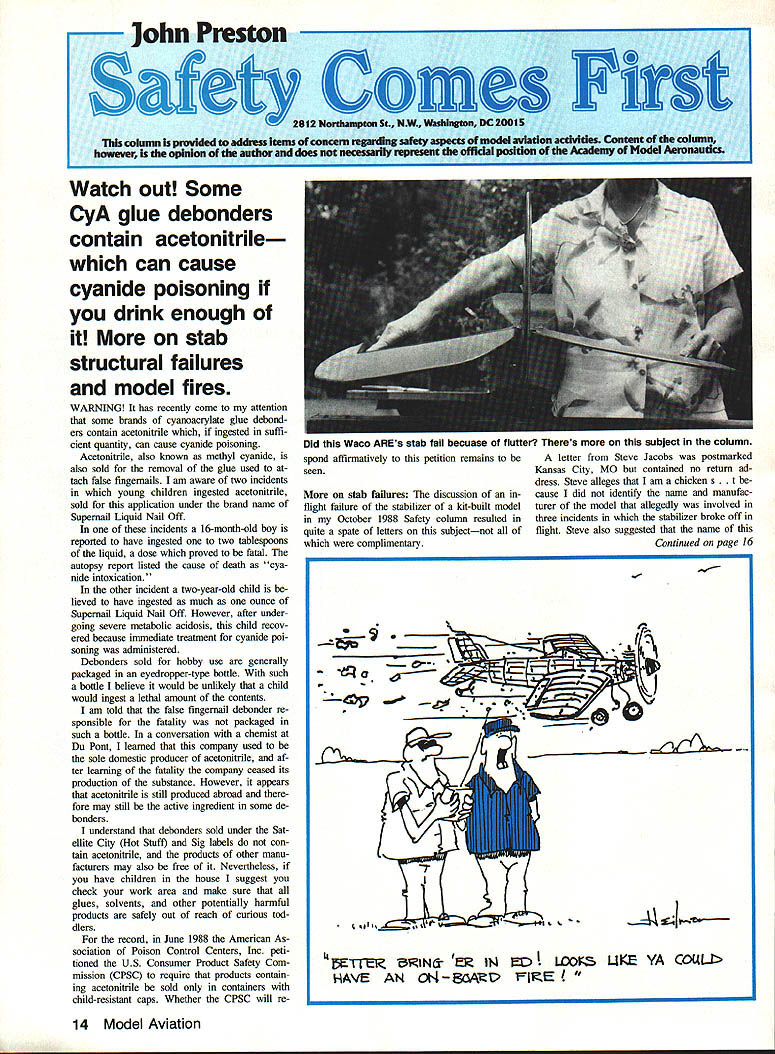
Charles (Chuck) Pyett of Palos Verdes Estates, CA, sent a photograph of the failed stabilizer of his 85‑in. span Waco A/E. He had lightened the structure to use an OS .120 four‑stroke rather than the heavier engine shown on the plans. On an early flight his 11‑year‑old grandson made a fast pass with a wide‑open dive; the stabilizer broke with a bang and violent flutter occurred until power was cut. The model was landed OK; Chuck is now beefing up the stab and may add brace wires.
Thanks also to Jeff Combs, Brian Conley, Bill Stodgell, L. Arata, and Sven Corsak, who wrote describing in‑flight stabilizer failures on different models. Sven even sent the detached portion of his vertical stab.
Fire: From in‑flight stab failure to in‑flight fire
Under "Crash & Burn" in my December 1988 column I told of a model catching fire after a crash. I previously thought in‑flight fires were rare, but the September 1988 issue of R/C Stuff (Green Bay R/C Club) reported a first‑time account of an in‑flight fire experienced by club president Gary Dooren.
In Gary's case the muffler came loose in flight and an on‑board spark ignited fuel or residual material, producing a fire that burned through the firewall (1/8‑inch aircraft plywood), burned foam around metal tanks, and melted the rubber from the tanks. The worst part was that there was no visible external damage; the cowl felt only a little warm after landing and the owner left the plane in the car overnight. The next morning, after removing the cowl to reattach the muffler, he discovered a large hole in the firewall.
The incident illustrates one hazard of flying large‑scale models with gas engines: a loose muffler or other fault can produce an onboard fire without obvious external signs.
Safety book
A reader, Frank Burchard of Carlsbad, NM, sent me a spiral‑bound book titled Safety Comes First that he compiled from past magazine articles (including my Safety columns) for use in club safety talks. Frank described his effort:
- He reduced a large stack of magazines by cutting out and looseleaf binding interesting plans and articles.
- He organized nine chapters of categorized safety material to use for club meeting safety talks.
- He suggests each RC club should have concise, categorized safety material as an ongoing safety program.
Frank also included articles and references from AMA Safety Committee publications. If any modelers or clubs have produced topical safety booklets for wider distribution, please write and tell me about them.
Have another safe month.
Transcribed from original scans by AI. Minor OCR errors may remain.

