
Safety Comes First
2812 Northampton St., N.W., Washington, DC 20015
This column addresses items of concern regarding safety aspects of model aviation activities. The content of the column is the opinion of the author and does not necessarily represent the official position of the Academy of Model Aeronautics.
ERRORS OF JUDGMENT
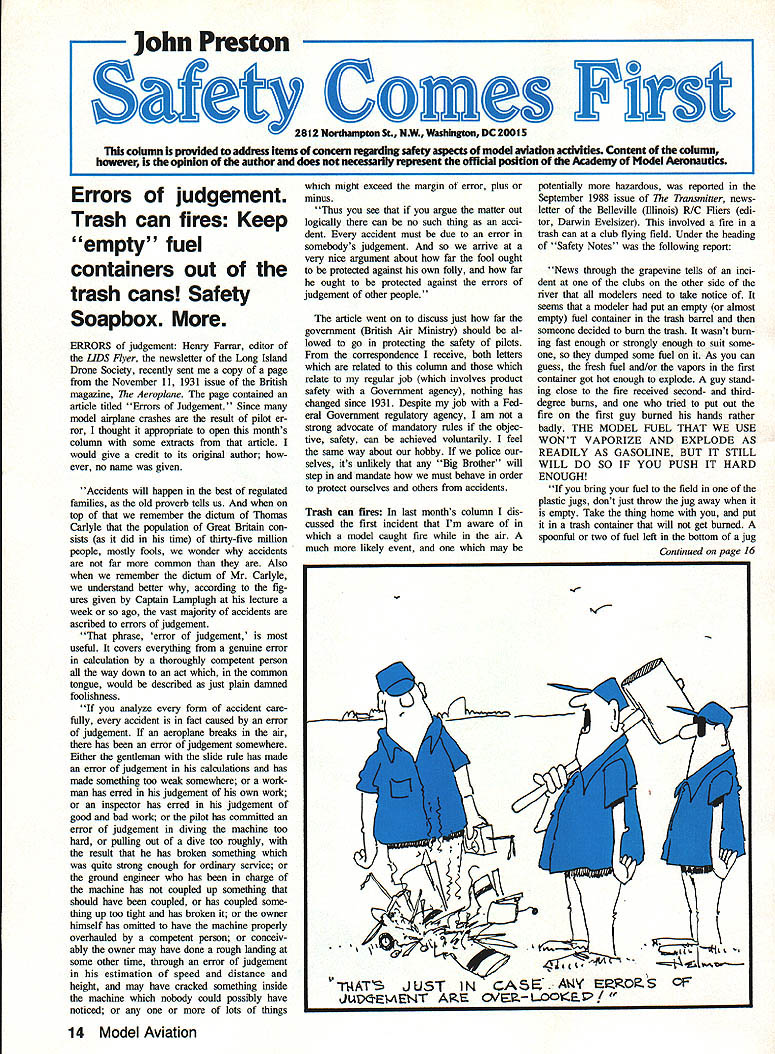
Henry Farrar, editor of the LIDS Flyer (newsletter of the Long Island Drone Society), recently sent a copy of a page from the November 11, 1931 issue of the British magazine The Aeroplane. The page contained an article titled "Errors of Judgement." Since many model airplane crashes are the result of pilot error, it seems appropriate to open this month's column with extracts from that article.
The article emphasized that most accidents can be traced to errors of judgment. It explained that the phrase "error of judgment" covers everything from genuine calculation mistakes by competent people to acts that are, in common terms, "just plain damned foolishness." If you analyze any accident carefully, the article argued, you will find an error of judgment somewhere. Examples include:
- A designer or engineer miscalculating strength (making something too weak).
- A workman erring in the execution of his work.
- An inspector failing to detect bad work.
- A pilot diving too hard or pulling out too roughly and overstressing a component.
- A ground engineer miscoupling or over-tightening something.
- An owner failing to have proper overhaul or causing an unnoticed crack in an earlier rough landing.
- Any number of other mistakes that exceed the margin for error.
Thus, the article concluded, there is no such thing as a pure "accident" — every accident is due to someone's error of judgment. This raises the question of how far authorities should protect people from their own folly or from the errors of others. The piece went on to discuss how far the British Air Ministry should intervene in pilot safety.
From the correspondence I receive — both letters related to this column and those related to my regular job in product safety with a government regulatory agency — nothing much has changed since 1931. Despite my work with a federal regulatory agency, I am not a strong advocate of mandatory rules when the objective of safety can be achieved voluntarily. The same holds for our hobby: if we police ourselves, it is unlikely that "Big Brother" will step in to mandate behavior to protect us from accidents.
TRASH-CAN FIRES
A more likely and potentially hazardous event than an in-air model fire is a trash-can fire at a club field. The September 1988 issue of The Transmitter (newsletter of the Belleville [Illinois] R/C Fliers, editor Darwin Evilsizer) reported an incident:
A modeler put an empty (or almost empty) fuel container in the trash barrel and someone later decided to burn the barrel. When the fire wasn't burning fast enough, someone dumped fuel on it. The fresh fuel and vapors in the first container heated and exploded. A man standing near the fire suffered second- and third-degree burns, and another man who tried to assist burned his hands badly. The newsletter warned: "The model fuel that we use won't vaporize and explode as readily as gasoline, but it still will do so if you push it hard enough!"
Common-sense precautions:
- If you bring fuel to the field in plastic jugs, don't throw the jug away at the field. Take it home and discard it with your household trash.
- Even a spoonful or two of fuel left in the bottom of a jug can produce significant vapor, especially in hot weather. A fire near such a jug can cause an explosion.
- Glass bottles mixed with trash can become dangerous shrapnel if an explosion occurs.
- Do not put aerosol cans or empty fuel cans in trash barrels that are to be burned. Aerosol cans can burst violently when heated.
A later issue of The Transmitter reported another incident: someone placed a full aerosol can of silver paint in the trash barrel; on a hot day it was set on fire and the can became hot enough that it could have exploded. The newsletter reiterated: DO NOT PUT AEROSOL CANS OR EMPTY FUEL CANS IN THE TRASH BARRELS.
BATTERIES CAN CAUSE BURNS
Sanford Hummel, Safety Officer for the Skyhawks R/C Club of Philipsburg, PA, reported learning the hard way that Ni-Cd battery packs can produce enough power to cause severe burns.
Examples he shared:
- Working on a computer backup power supply using six-volt batteries, his metal watchband contacted battery wiring and shorted the batteries. The watchband became red hot instantly and he received third-degree burns to his arm and thumb (the thumb was burned when he grabbed the watch to remove it).
- Another time his watchband shorted across the banana plug receptacles of the power panel on his flight box and caused burns.
- The writer of this column also experienced a brief bright short while working on a car; the arm jerked away and damage was limited to a singed watchband.
Precautions:
- Remove watches and rings when working with batteries or live wiring.
- Avoid leaving metal tools or jewelry where they can short battery terminals or connectors.
- Protect exposed terminals (insulate or cover) and be cautious around banana plugs and power panels.
SAFETY SOAPBOX
A letter from Bob Sexton (begun in May 1987 and mailed in October 1988) criticized an earlier column's treatment of chemicals in the eyes and urged stronger, clearer guidance.
Key points from his letter:
- Don't downplay the hazards of chemicals in the eyes. If any industrial, household, garden, or other chemical gets into your eyes, you must act immediately.
- The primary action is flushing: 15 minutes (repeat: 15 minutes) of continuous water flow over the eyeball and the exposed inner surfaces of the eyelids.
- Hold the eyelids apart while flushing to get water behind the lids; assistance from another person is invaluable because the victim often cannot hold eyelids open and control the water simultaneously.
- Use whatever water source is available (shower, garden hose, faucet) to keep water flowing for the full 15 minutes.
- After or during flushing, obtain medical assistance (industrial physician or ophthalmologist). Many cases of severe eye damage and blindness have resulted from victims not flushing for the required time before seeking help.
Practical advice: If you handle MEKP (catalyst for polyester resin), MEK (methyl ethyl ketone), solvents, or other chemicals, assume they may harm the eye and be prepared to flush immediately for 15 minutes and get professional medical evaluation.
- Flush immediately for 15 minutes, holding eyelids open.
- Get medical attention promptly.
- Have someone assist with flushing whenever possible.
Stay safe, think ahead, and remember that many accidents are preventable with careful judgment.
Transcribed from original scans by AI. Minor OCR errors may remain.

