


John Preston 2812 Northampton St., N.W., Washington, DC 20015
Safety Comes First
This column addresses items of concern regarding safety aspects of model aviation activities. The content is the opinion of the author and does not necessarily represent the official position of the Academy of Model Aeronautics.
- Odorless CyA glue
- Mounting plates on Zenoah G-38 engines
- More on flutter
- Hazardous activities
- Full-scale threat
ODORLESS CyA GLUE
Allergic reactions to the fumes emitted by cyanoacrylate (CyA) glue have been the subject of a number of previous Safety columns. Modelers who have developed a sensitivity have adopted various solutions ranging from use of a respirator (uncomfortable), to increasing workshop ventilation (not practical in winter), to discontinuing use of these products (unacceptable to many).
Bob and Bill Hunter of Satellite City, Inc. may have a solution. I received samples of two new products called User Friendly Odorless (UFO) instant glues: a thin, penetrating glue in a bottle with a red label, and a thicker gap-filling glue in a bottle with a green label. According to the information sheet that accompanied the samples, the UFO glues can be used directly on white foam without dissolving it — a useful feature.
I have not had respiratory problems with earlier CyA glues, so I have not personally tested these for allergic reaction. I intend to pass samples to a friend who has experienced such problems to see if they provide relief. The UFO glues are being shipped to dealers; if your local hobby shop does not yet stock them, you might request an order. Comments from readers who try these products are welcome.
Safety alert
Periodically I receive letters describing problems with modeling products. Lacking a testing lab or a budget for contractor tests, I face a dilemma: should I accept such reports at face value and pass them on, or should I remove brand names and leave readers uncertain whether they may have a hazardous product?
A letter forwarded to me by Larry Maynard described a potential problem with the stamped sheet-metal mounting plate used on the Zenoah G-38 engine. Larry asked that this safety information be made available to all users of G-38 engines. Since Larry is a professional engineer, I will accept his description and pass it on.
Mounting plate problem (from Larry Maynard)
"I am the owner of three Zenoah G-38 engines which I have mounted in (1) a Robinhood 99, (2) a Sig Morrissey Bravo, and (3) a low-wing aircraft derived from Bird's Big Bee. The engine in the Robinhood has the most time on it — probably three or four hours. Each engine is mounted on 1/4-in. birch plywood boxes reinforced at the corners with 3/4-in. blocks and through-bolted to the firewall.
"The stamped sheet-metal mounting plate on the engine in the Robinhood has developed cracks and must be replaced for safety reasons. I received a warning from the owner of a hobby store in Gardena, CA, which prompted a careful inspection of my mounting plates. Other G-38 owners have reported similar problems whenever the stamped steel mounting plate is used.
"As a professional engineer involved with safety design requirements for payloads flown on the Space Shuttle, I have seen hydrogen embrittlement of plated steel parts which, under cyclic (i.e., vibrational) loads, can result in cracking similar to that seen on these mounting plates. The appropriate solution is to bake plated parts at 325°F for no less than 2–3 hours to drive out hydrogen remaining from the plating process. For my purposes, I intend to replace the stamped plates with 1/4-in.-thick 6061 aluminum plates and see how that works out.
"I suggest that readers who have a model powered by a Zenoah G-38 installed with the stamped sheet-metal mounting plate should inspect the plate closely for any signs of cracking."
Thank you, Larry, for this safety alert.
FLUTTER
Although my training is in mechanical rather than aeronautical engineering, several readers correctly pointed out errors or oversimplifications in an earlier column about flutter. I appreciate the clarifications.
Letter from Charles Richard
Charles Richard of Lancaster, CA, objected to a statement in the January 1989 column that referred to the center of gravity of the wing. He writes that to minimize torsional flutter, the center-of-twist (elastic axis), not the center of gravity, should be ahead of the quarter-chord of each airfoil section. To maintain this location, it is important to preserve continuity of torsional-resistant structure throughout the span. A closed tube or torque box formed by structural sheeting between the front spar and the leading edge (a D-shaped closed cell) will ensure torsional stiffness and flutter resistance.
If Charles's point is correct, a practical solution to reduce the risk of in-flight failure of a sheet balsa stabilizer may be to equip it with a stiff hardwood leading edge to move the elastic axis forward of the quarter-chord.
Letter from Joel Chesler
Joel Chesler, a senior flutter analyst with Northrop Corporation, clarified the definition of flutter. He states:
"Flutter is an in-flight instability, usually caused by the coupling of two forms of vibration, one of which may (or may not) be torsional (the other typically is bending or control-surface rotation). It is velocity dependent and will not occur until a critical velocity is reached."
Control-surface flutter can be caused by the same mechanisms, depending on the relative stiffness of the associated pushrod and the inertial characteristics of the control surface.
I thank both Charles and Joel for taking the time to define flutter more precisely.
HAZARDOUS ACTIVITIES
Readers often send photos or clippings depicting hazardous practices. Two recent examples are worth noting.
- A Texas newspaper photo showed an RC pattern-type model cutting the ribbon to dedicate a new concrete runway. The ribbon ends were held by two club members standing on opposite sides of the runway. This is unsafe: radio interference or equipment failure can occur. If you stage a Limbo event or a ribbon-cutting with a model, support the ribbon ends on poles and keep people behind a safety line.
- A photo in Model Aviation showed three full-scale amphibians being towed on floats through the water at low height; the caption said an outboard motor was being used to taxi them. Since the towing model was not pictured, I do not know whether the pilot had a tether as a safeguard. If you feature taxiing models in a parade, I strongly urge that they be tethered to their pilots.
FULL-SCALE THREAT
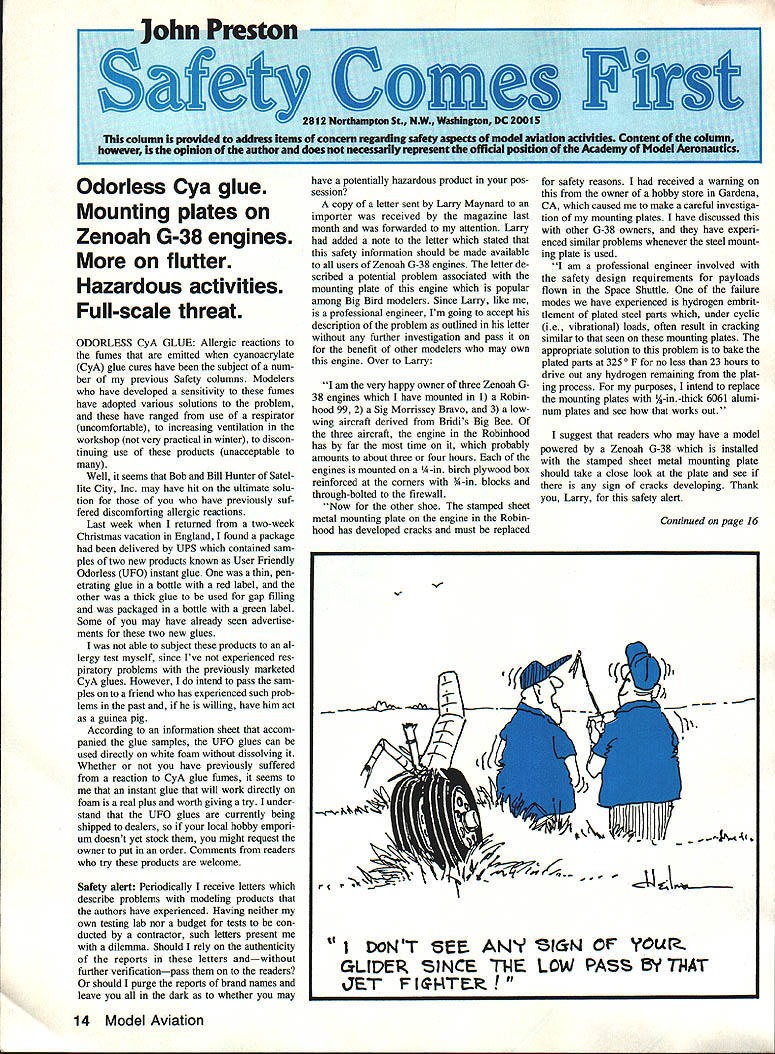
I spent Christmas visiting relatives in England and was in the town of Malton, near the North Yorkshire Moors — a designated low-flying area for Royal Air Force training. The aircraft there routinely fly very low (reportedly under 500 ft.), and their approaches can be startling.
A recent letter from Doug Inkley of Arlington, VA, recounted a similar experience in the U.S. He was flying a glider about seven miles from a local airport and unknowingly ended up slightly above a stadium where an Air Force Academy flyover was scheduled for halftime. Several fighters made a low-level pass; Doug's glider and the fighters were simultaneously in his field of vision. He was unnerved, lost control briefly, and landed safely thanks to a companion who brought him to his senses. He did not go back up, fearing another pass.
Having been buzzed by extremely low-flying aircraft, I echo Doug's closing advice: always be alert, careful, and attentive. You can't be too careful, and you should always be prepared for the unexpected.
Have another safe month.
Transcribed from original scans by AI. Minor OCR errors may remain.

