




Safety Comes First
2812 Northampton St., N.W., Washington, DC 20015
This column addresses items of concern regarding safety aspects of model aviation activities. The content of the column is the opinion of the author and does not necessarily represent the official position of the Academy of Model Aeronautics.
Topics in this column: BAARROOM!! (winch battery explosion), in-flight model fires, UFO (User Friendly Odorless) CYA glue reports, and public perception of big models.
Winch battery explosion (BAARROOM!!)
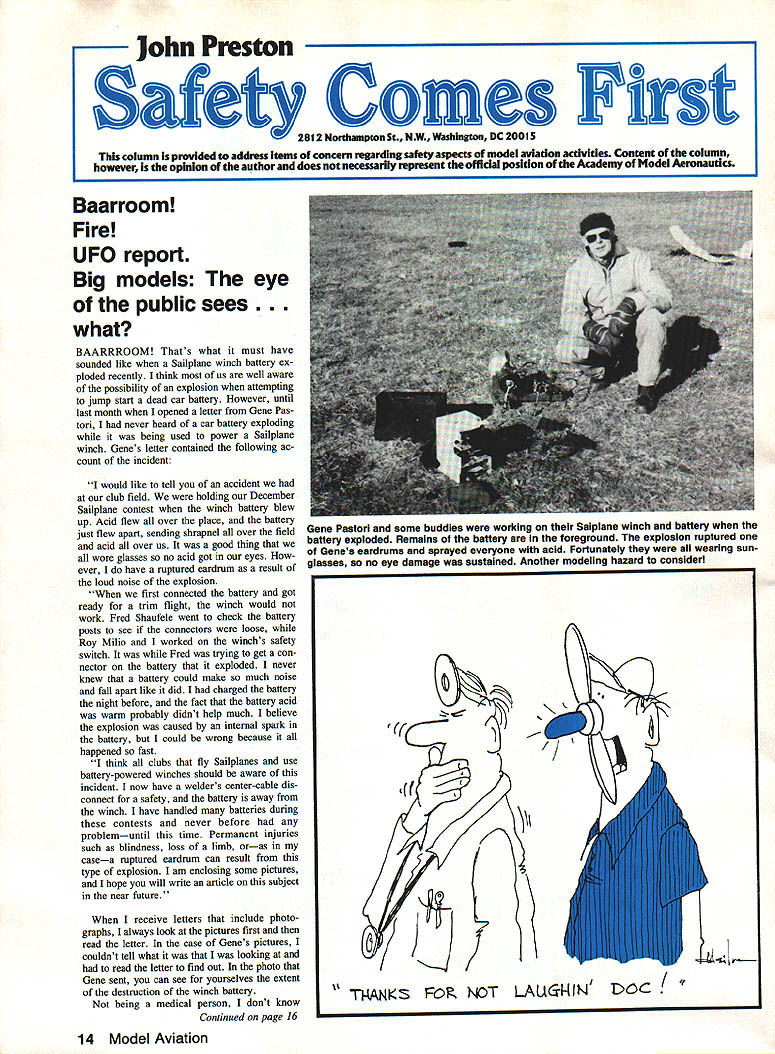
BAARROOM!! That's what it must have sounded like when a sailplane winch battery exploded recently. Many of us know a car battery can explode when jump-starting, but Gene Pastori sent an account of a battery exploding while powering a sailplane winch:
"I would like to tell you of an accident we had at our club field. We were holding our December sailplane contest when the winch battery blew up. Acid flew all over the place, and the battery just flew apart, sending shrapnel all over the field and acid all over us. It was a good thing that we all wore glasses so no acid got in our eyes. However, I do have a ruptured eardrum as a result of the loud noise of the explosion.
"When we first connected the battery and got ready for a trim flight, the winch would not work. Fred Shaufele went to check the battery posts to see if the connectors were loose. Roy Millo and I worked on the winch's safety switch. It was while Fred was trying to get a connector on the battery that it exploded. I never knew that a battery could make so much noise and fall apart like it did. I had charged the battery the night before, and the fact that the battery acid was warm probably didn't help much. I believe the explosion was caused by an internal spark in the battery, but I could be wrong because it all happened so fast.
"I think all clubs that fly sailplanes and use battery-powered winches should be aware of this incident. I now have a welder's center-cable disconnect for a safety, and the battery is away from the winch. I have handled many batteries during these contests and never before had any problem—until this time. Permanent injuries such as blindness, loss of a limb, or—as in my case—a ruptured eardrum can result from this type of explosion. I am enclosing some pictures, and I hope you will write an article on this subject in the near future."
Gene enclosed photographs showing extensive destruction to the winch battery. When working with batteries, consider the possibility of internal sparks and the added risk when the battery acid is warm.
Suggested precautions:
- Make sure the winch safety switch is open before making final battery connections.
- Keep hands, tools, and connectors away from battery posts when making the final connection.
- Use a heavy-duty disconnect (for example, a welder's center-cable disconnect) to quickly isolate the battery.
- Keep the battery physically separated from the winch equipment when possible.
- Wear eye protection when handling batteries.
I hope Gene's ruptured eardrum heals—I'd much rather lose some hearing than sight.
In-flight model fires
No smoke without a fire: Two letters arrived about in-flight model fires. One account stretches credulity but is plausible; the other is a clear lesson about heat from larger engines.
From Fred McClellan (Roswell, GA):
"Of course I always read your column. For me most of the safety issues appear to be common sense... The caveman discovered fire (rub two sticks together, etc.). Pretty soon he had to invent marshmallows. Some modelers—and model aircraft designers—appear to be less knowledgeable regarding fire than our distant ancestors.
"I observed a nicely done, high-wing, sport-type model flying along one fine summer day, and noticed that the aircraft had been fitted with a very efficient smoke system. Since the aircraft was pretty high, and the pilot appeared to be in complete control, I posed the question: 'What smoker system did you use?'
"'Smoker system?'
"'Yeah, the one making all that smoke!'
"'Nah. That's engine smoke.'
"'Nuh-uh! Wrong color smoke.'
"'Oh, yeah?'
"'Yup. Why don'tcha land that thing and let's look?'
"'OK.'
"Needless to say, the model did not have a smoker system. And the engine was just fine—at least as far as could be determined in the postmortem. You see, the wing departed said aircraft during the downwind leg. Exit fuselage, stage left, ballistic. Exit wing, stage down, flutter mode.
"This modeler had relearned the sick stick. The wing leading edge left-side hold-down dowel experienced single shear failure when the right-side dowel burned through. The right-side dowel must have reached charred temperatures, since the wing's center fiberglass, sheeting, and ribs were smoldering merrily along when we got to it. There was no fire damage to the fuselage other than an area of the plywood bulkhead adjacent to where the right-side dowel had been. The fuel system survived intact, and no fuel dispersal occurred.
"The modeler's initial conclusion was a fuel fire. He did not understand the potential of the dowel wick soot and how it pointed out the intact fuel system and lack of fire damage elsewhere. When I asked, he indicated that the wing leading edge hold-down dowels had been improperly fitted, such that the right-side dowel was not snug in the mating hole, and was actually placed at an angle to the hole. 'It was kinda loose, but it held the wing on.'
"The moral of the story is that if you take two pieces of wood and rub them together at a couple of hundred cycles per second, you can keep your airplane warm!"
From Allan Kass (Big Sky, MT), triggered by an earlier column:
"A year or so ago I was going to write and tell you about a fire I had in my quarter-scale Fleet biplane, and your article in the February MA reminded me. So I thought I'd relate my experience as a caution to those who may not realize how much heat is generated by the larger engines.
"My Fleet carried a Quadra .35 mounted on a 2-in. ply block attached to a 1/4-in. ply firewall. I lined the part of the block and firewall near the muffler with asbestos sheeting that had been covered with aluminum lath. The airplane had about 50 or 60 flights, and these had resulted in some slight char near the muffler, but I continued flying, dumb and happy.
"On about the 60th flight, my plane caught fire during taxi-out for takeoff. I had just finished my warm-up and was taxiing out when I noticed a yellow glow beneath the cowl. I then opened the throttle and observed flames lick the inside of the right cowling. I killed the engine and cut the glow plugs but it was past that. The cowl was burning; the fuel tank in the fuselage had been breached and the fuel had burned through. The fire was intense. I watched it burn until the fuselage was consumed to the servos and pushrods.
"When I arrived home and removed the engine to assess the extent of the damage, I was horrified to see that the firewall had burned completely through, and the 16-oz. gasoline tank had melted down but had not been punctured, perhaps because it was insulated by styrofoam packing (which had also melted).
"This was a lesson that let me off very easily. Since then, repairs have been made, all insulation was doubled, and there is no exposed wood near the exhaust. Subsequent flights have shown no problems."
My comment: include a fire extinguisher in the support equipment you bring to the flying field. Inspect hold-downs, dowels, and any wood or materials near hot exhausts. Insulate and protect as needed.
(Continued on page 22)
More on UFO (User Friendly Odorless) CYA glue
In the April Safety column I mentioned a new cyanoacrylate glue known as UFO (User Friendly Odorless) marketed by Satellite City. I suggested modelers who had respiratory problems with CYA might try it. Before the April issue reached readers I received letters from modelers who tried UFO and found it lived up to the claims.
Stan Sparks (Downey, CA) retired years ago because of severe, acute bronchial asthma. He wrote that he had been unable to use CYA for years because of severe attacks, but after using UFO he experienced no ill effects. He said:
"Now, along comes Hot Stuff UFO, changing my method of building completely. I can now build inside, without a mask—no odor at all. Yes, it costs a little more, but what a difference! My thanks to Bill and Bob Hunter at Satellite City. They have been very understanding and helpful."
Ron Fikes (Palo Alto, CA) had severe sinus problems after early CYA exposure and had to stop using it for a long time. After trying UFO he said:
"Well, to put it mildly, I'm thrilled! The claims are true. I can now build away to my heart's content WITH NO SINUS PROBLEMS! This goes to prove that technology CAN solve a problem that technology created in the first place."
Try it if you have had respiratory problems with other CYA glues.
Big models, big hazard?
Two letters addressed the perceived hazard of large models and, importantly, the public perception when an accident involves a big model.
Paul Beretta suggested that public reaction and media attention are often driven by publicity and perceived irresponsibility. He offered a hypothetical:
"A man in a fourth-floor apartment sets up a putting green to practice. He tries a chip shot, the ball crashes through a window, strikes a passerby on the head, and kills him. Now picture public reaction if, instead, the passerby had been killed by a golf ball driven from the 18th hole of a private country club. Either way someone is dead, there will be a lawsuit, and probably a substantial award. But which will receive national attention? Which will bring out the 'name' lawyers begging to take it? Who is more likely to be charged with criminal negligence? It would be the fellow who is more irresponsible. Fair or not, the media reaction is based more on the amount of publicity the incident receives."
He added that an incident involving a large radio-controlled model would likely get more sensational attention and possibly calls to ban or restrict the activity.
Walter Erbach (Lincoln, NE), an indoor flyer, included a newspaper clipping about a model air show that emphasized big models. He noted that free-flight and rubber modelers resent being lumped in and that large, carelessly flown R/C ships can raise insurance costs and negative publicity for all modelers.
My point: if you fly large models, follow the AMA Safety Code. No matter how skilled you are, don't fly R/C models over areas where people are present.
Have a safe month.
Transcribed from original scans by AI. Minor OCR errors may remain.

