
John Preston
Safety Comes First
2812 Northampton St., N.W., Washington, DC 20015
This column is provided to address items of concern regarding safety aspects of model aviation activities. Content of the column, however, is the opinion of the author and does not necessarily represent the official position of the Academy of Model Aeronautics.
Topics covered:
- Parade towing and crowd safety
- E-Z (easy) pushrod connectors
- Starter units turning on by themselves
- Radio/antenna frequency mix-ups
- In-flight fire caused by loose muffler bolts
Clarification (parade taxiing)
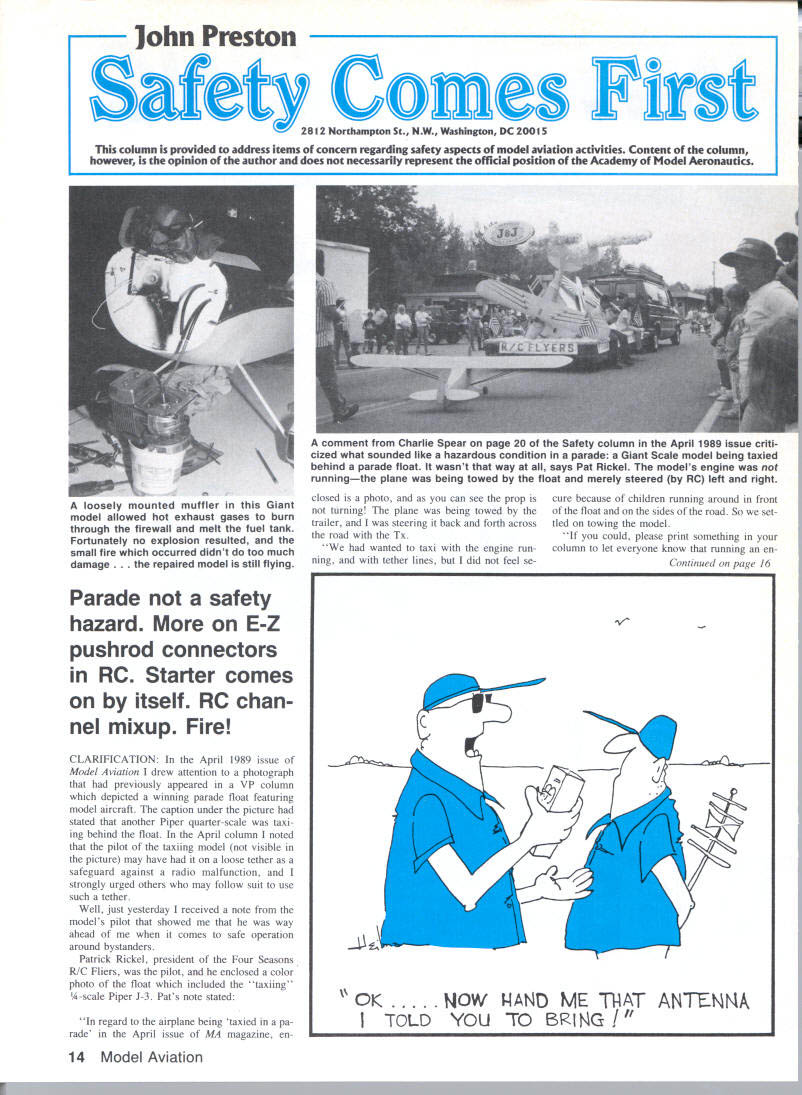
In the April 1989 issue of Model Aviation I called attention to a photograph that had previously appeared in a VP column showing a winning parade float featuring model aircraft. The caption under the picture had stated that another Piper quarter-scale was taxiing behind the float. In that column I noted that the pilot of the taxiing model (not visible in the picture) may have had it on a loose tether as a safeguard against a radio malfunction, and I strongly urged others who may follow suit to use such a tether.
Just yesterday I received a note from the model's pilot that showed he was ahead of me when it comes to safe operation around bystanders. Patrick Rickel, president of the Four Seasons R/C Fliers, was the pilot, and he enclosed a color photo of the float which included the "taxiing" 1/4-scale Piper J-3. Pat's note stated:
"In regard to the airplane being 'taxied in a parade' in the April issue of MA magazine, enclosed is a photo, and as you can see the prop is not turning! The plane was being towed by the trailer, and I was steering it back and forth across the road with the Tx.
"We had wanted to taxi with the engine running, and with ether lines, but I did not feel secure because of children running around in front of the float and on the sides of the road. So we settled on towing the model.
"If you could, please print something in your column to let everyone know that running an engine in a crowd of people is DUMB! Thank you."
Thank you, Pat. The accompanying photo shows the attractive display of models on the Four Seasons club float and what appears to be a floral airplane perched above the float.
E-Z (Easy) pushrod connectors
Background
- "E-Z connectors" (also called pushrod connectors by some manufacturers) are the type in which the pushrod passes through a hole in a cylindrical boss attached to the servo arm, and a setscrew is tightened to secure the pushrod.
- A reader reported being told he could not fly at a certain club field using that type of connector because they were "not safe." I asked readers for opinions and received many responses showing mixed experience.
Summary of reader advice and experience
- Several modelers will not use E-Z connectors on flight-control servos because of previous problems; others use them without issue and "swear by them."
- Chuck Spence (Lansing, MI) and Calvin Malinka (Rialto, CA) both suggested replacing the common slotted-head securing screw with a socket-head cap screw (Allen). Advantages:
- You can apply more torque without the screw head deforming.
- Hardened steel socket screws bite into the pushrod more effectively without crushing the boss.
- A socket-head screw has no protruding head that could bottom out on the connector body before securing the pushrod.
- Michael Wartman (Pensacola, FL) and others use E-Z connectors only for throttle and nose-gear steering. Michael recommends:
- Filing a flat on the pushrod wire.
- Using Loctite on the threads of the securing screw to prevent vibration from working it loose.
- One writer noted that hard piano wire pushrods may be more likely to slip than softer wire; the softer wire can allow the screw to get a better bite.
- Roy O'Neal (Sacramento, CA) reported nylon retaining washers falling off after exposure to freezing temperatures — something to consider for cold-weather flying.
Conclusions
- There is no clear-cut consensus on using E-Z connectors for primary flight controls.
- Good practices include using a socket-head cap screw and applying Loctite to the screw threads.
- If you have strong opinions or experiences (pro or con), please share them.
Note on balsa pushrods
- Two writers (Chuck Spence and Milton Peckover) also opposed the use of balsa-wood pushrods. I have used balsa pushrods on several RC models (up to .40 engine size) without problems. Comments are welcome.
Odd experience: starter turning on by itself (Dave Gilbert)
Dave Gilbert reported an incident involving a Sullivan starter with a self-contained Ni-Cd battery pack. The starter had been on a shelf in a closet, unused for about three months. The closet temperature was probably in the mid-thirties. Dave heard the starter turn on by itself — nothing was touching it — and it took about a minute to locate and another minute to stop it by wedging a screwdriver between the switch strap and the motor case.
Concerns raised
- The starter was stored on the same shelf as transmitters and containers of dope and thinner. A powerful starter starting by itself could entangle and pull things off the shelf, possibly rupture battery packs, or start a fire unattended.
- Dave suggested a safety alert bulletin and a failure mode effects analysis (FMEA).
My response and related incidents
- I heard of a somewhat similar incident in 1980: a modeler installed a new onboard starter powered by the onboard receiver batteries and forgot to turn off both the receiver and the starter switch. Overnight the receiver batteries were drained, servos moved to extremes, allegedly activating the starter and firing the engine; the model tore across the room and damaged a 1/4-scale Aeronca Champ.
- Another incident involved a new car whose starter engaged overnight due to a wire in the starter circuit shorting as temperatures fell. The car, left in first gear with no parking brake, started and smashed through a garage door. The manufacturer repaired the car but the repainted hood faded differently than the original paint.
Lesson: store and secure starter units and batteries so they cannot energize unintentionally; keep them away from combustible materials and check battery/switch positions before storage.
Wrong antenna (frequency mix-up)
A friend who owns two identical radios but on different frequencies has the habit of removing transmitter antennas for transport because the channel-identifying markers prevent the antennas from fully collapsing. A few weeks ago he took the wrong antenna to the flying field. At the field he selected the frequency pin that corresponded to the channel markers on the antenna and turned on his transmitter. That action caused another flier's model to be wrecked. The friend did not know he had caused the crash.
Later, his own model was lost when another flier turned on a transmitter on the same frequency as his. No one could figure out the cause until he returned home and discovered his transmitter's frequency did not match the channel markers on the antenna.
Lesson: when you own more than one transmitter of the same brand, always verify that the antenna/channel markers match the transmitter frequency before turning equipment on.
In-flight fire (Pogo with Zenoah G-38)
Greene, NY modeler Frank Williams sent photos and a note (via John Worth) of a 1/3-scale Pogo that suffered a near-disastrous in-flight fire. The model was powered by a Zenoah G-38. The muffler is secured to the rear of the cylinder by two bolts; apparently one or both bolts loosened in flight, allowing hot exhaust gases to impinge directly on the firewall.
Damage and outcome
- A hole was burned through the firewall and the gas tank was very melted (and appeared to have a burn-through).
- The model continued flying and Frank landed without being aware of the fire. He discovered the damage only when he attempted to refuel.
- Other photos (not included here) showed charring inside the fuselage and on the wing roots.
Aftermath
- Frank has since mounted a metal plate behind the muffler and locked the muffler's attaching bolts.
Lesson: ensure muffler attachment bolts are secure and consider a heat shield (metal plate) between the muffler and firewall or tank to prevent hot exhaust from damaging the airframe or fuel system.
Recommendations (summary of safety practices mentioned)
- Do not run an engine in a crowd of people — tow models through parades or other crowded situations.
- When using E-Z connectors:
- Consider replacing slotted-head screws with socket-head cap screws.
- File a flat on the pushrod where the setscrew contacts it.
- Use Loctite on securing screws and check for nylon parts that may be affected by cold.
- Consider avoiding E-Z connectors on primary flight controls if you prefer positive mechanical linkages.
- Store starter units and batteries so they cannot energize accidentally; keep them away from flammable materials and disconnect batteries when not in use.
- Always verify transmitter antenna/channel markers match the transmitter frequency before powering on, especially when you own multiple transmitters.
- Check muffler bolts and install heat shielding between mufflers and fuel tanks/firewalls.
If you have additional experiences or suggestions, please write in.
Transcribed from original scans by AI. Minor OCR errors may remain.

