
Safety Comes First
John Preston 2812 Northampton St., N.W., Washington, DC 20015
This column addresses items of concern regarding safety aspects of model aviation activities. The content is the opinion of the author and does not necessarily represent the official position of the Academy of Model Aeronautics.
- E‑Z pushrod connectors revisited
- Balsa pushrod cautions
- Soft engine mounts alert
- Zenoah G‑38 muffler fix (fireproof model)
- Friction starts fires (wing dowel burn)
- Runway barrier available
- Tall tales and starter hazards
E‑Z pushrod connectors revisited
The March 1989 Safety column discussed a letter from Alan Pinkstaff about a club safety officer who alleged that E‑Z connectors were unsafe for flight control functions. That column generated many responses reporting problems, endorsements, and suggested fixes.
Common suggested fixes
- Replace the slotted-head (straight-blade) setscrew with a socket-head cap screw (Allen screw). Socket-head screws are harder and bite better into the wire pushrod; you can also apply more torque with an Allen wrench.
- Du‑Bro now offers Heavy Duty E‑Z Connectors with a 4‑40 socket-head cap screw to lock the pushrod wire. Du‑Bro also has a version (Catalog #490) secured to the servo arm with a steel push nut that is intended to be permanent.
- F. J. Charavay and Lee Bernhardt suggested tapping the pushrod hole with a 2‑56 tap and using a threaded pushrod or a threaded coupler. If using flex cable, use Loctite to prevent rotation, or prevent rotation at the other end (Z‑bend or soldered clevis).
These measures reduce the risk of pushrods slipping in the older screwdriver‑setscrew style connectors.
Balsa pushrod cautions
Several readers commented on the use of balsa pushrods. Problems reported include wear and breakage where pushrods cross or rub, especially in models built or installed incorrectly.
Reported problems and advice
- Clyde Brothers reported two failures of 1/4‑in. square balsa pushrods on Eagle 63 models. In both cases the elevator pushrod wore where it crossed the fuselage and rubbed on the rudder pushrod. Proper routing and servo placement (e.g., rudder servo on the same side as the rudder pushrod exit) would likely have prevented the failures.
- Tom McNulty feels balsa pushrods are acceptable for .40‑size and smaller models but noted some supplied balsa was too soft or knotty; he had these replaced with denser wood. He recommends inspecting balsa pushrods after impacts or shocks and using a different material if pushrods cannot be inspected or removed easily.
Starter safety and tall tales
There have been several incidents of starters energizing unexpectedly:
- Self‑starting ground starters: a lightly brushed strip‑switch assembly can energize a starter and pinch fingers between the drive cone and motor case. Temperature extremes (very hot or very cold) may affect switch behavior.
- Onboard starters: at least one documented incident involved an onboard starter energizing in flight and starting the engine unexpectedly. That incident was observed and reported by a reader.
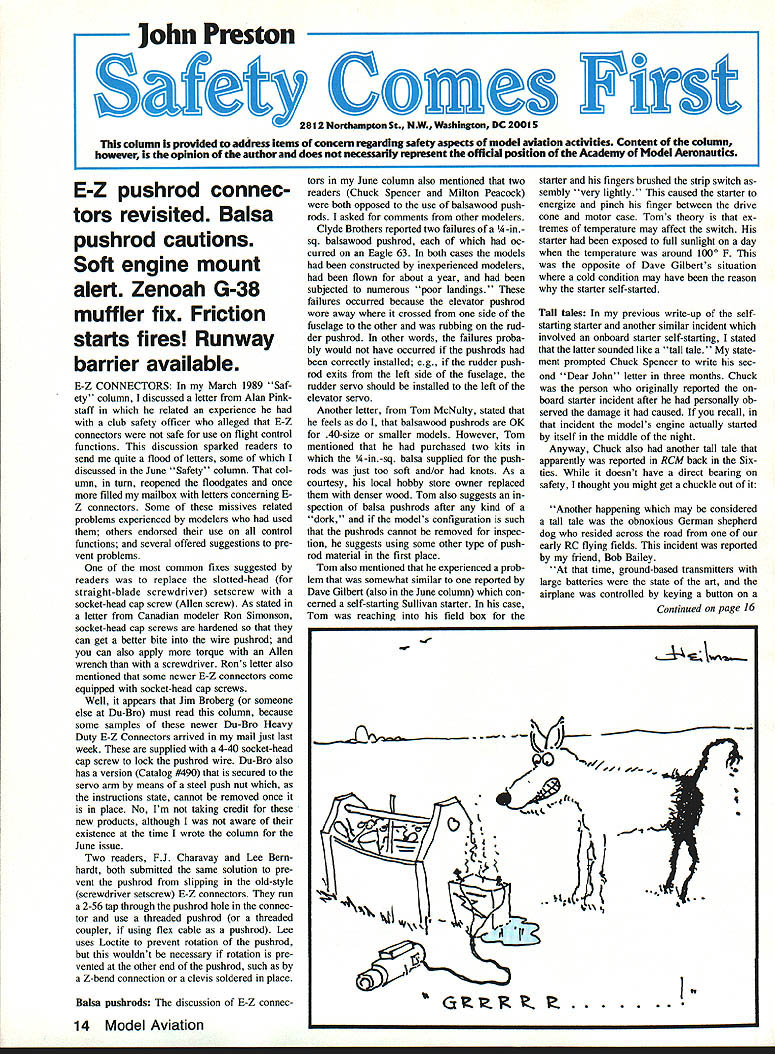
A lighter (but amusing) anecdote: a German shepherd allegedly sniffed and urinated on a large battery‑powered transmitter at an early RC field and received a shock that scared him off, ending his nuisance behavior.
Friction starts fires — wing dowel burn
A reader, Brian Malloy (Florissant, MO), reported a wing dowel burned nearly in half after a maiden flight with an unbalanced wooden prop on an Enya .40. Vibration backed the muffler securing screws out, the muffler beat against the fuselage, and subsequent flights showed the wing dowel heavily charred on one side. Brian repaired the dowel by epoxying a copper sleeve over the damaged portion, redrilling, and securing it; he hardened the area with thin CYA glue. His experience corroborates other reports that frictional heating from vibrating parts can cause serious damage.
Lesson: inspect critical wooden fittings (wing dowels, etc.) after flights with abnormal vibration; secure mufflers and use lock washers or Loctite on fittings.
Soft engine mounts — caution for large engines
Vibration can damage airframes and increase noise. Soft (vibration‑dampening) engine mounts are increasingly marketed and can reduce transmitted vibration, but use care:
- If your engine is over 6.0 cu. in. displacement, do not rely solely on soft mounts that use a rubber cylinder with bonded engine‑mounting studs. There are reports of such soft mounts failing, in one case after only a few minutes of running.
- Prefer designs where the vibration‑absorbing rubber is in compression and not relying on bonded metal/rubber joints (examples include some G&A Products designs).
- Don Lowe (RCM) described a system that has worked on a 3.7 cu. in. engine; larger engines require more robust consideration.
- A comparative test of soft‑mount brands using vibration‑measuring equipment would be a worthwhile project for someone with access to the necessary gear.
Zenoah G‑38 muffler fix (fireproof model)
Warren Spurgenson (Santa Barbara, CA) reported repeated problems with muffler bolts coming loose on G‑38 engines, especially when switching to Tattone or J'Tec mufflers that lack internal spacers. His recommendations:
- On Tattone or J'Tec mufflers, fit two spacers inside the muffler between the bolt holes to keep the halves from collapsing as the bolts are tightened. These spacers prevent the muffler casing from warping with thermal expansion and loosening the bolts.
- Use socket‑head Allen bolts and Loctite, but also use spacers—Spurgenson fitted spacers on all three of his G‑38s and eliminated the problem.
- For Giant aircraft: use engine mounts designed for the engine (not flat plate mounts) so there is an air gap behind the muffler for cooling. Gasoline engines run hot; leave clearance to prevent firewall fires.
Runway barrier available
Clubs have used tennis netting along the rear edge of runways to protect pits and spectators from out‑of‑control models. Another product sample, marketed as Runway Barrier by Gene Long (Houston, TX), was reviewed.
Specifications and availability of a similar safety barrier (from Twin Ridge Industries, Inc.)
- Fabricated from high‑density polyethylene with high strength
- Two feet high
- Rolls available in 50 or 100 ft
- Supplied with 42‑in. hardwood stakes on five‑foot centers
- Expected cost: about $1 per foot
- Contact: Jerry Juskiowich, General Sales Manager, 1‑412/539‑2307
Closing
Thanks to all readers who have written to describe mishaps and fixes — those letters make this "Safety" column possible. Stay observant, inspect critical parts after abnormal events, and have another safe month.
Transcribed from original scans by AI. Minor OCR errors may remain.

