


Safety Comes First
2812 Northampton St., N.W., Washington, DC 20015
This column addresses safety aspects of model aviation activities. The content is the opinion of the author and does not necessarily represent the official position of the Academy of Model Aeronautics.
Model propellers vs. human beings
There was a time when this Safety column routinely included at least one incident of someone feeding a finger through a rotating propeller. Reports had been rare for some time, but recently several firsthand accounts were received.
Fingers in the prop
Fingers in the prop: Mike Winter (Bealeton, VA)
- Mike has a Midwest Sweet & Low Stik powered by a Zenoah G-38 swinging an 18 x 8 Zinger prop. The model is a taildragger and the engine has a recoil starter to reduce finger-in-prop incidents.
- On the first start attempt he choked the engine and it did not start. While turning the prop backwards to wind the starter for a second attempt, the engine fired and the prop smacked the third finger on his left hand. Mike initially thought the finger had been severed, but all digits were present; a red welt developed.
- Since there was no bleeding to treat immediately and the engine was running, Mike elected to fly. About five minutes into the flight his engine developed a strange noise and then lost thrust. He made a dead-stick landing. Inspection later showed the 18-in. Zinger prop was missing about six inches from the tip of each blade and the hub was destroyed. Whether both blades struck his finger is unknown.
- The lesson: always stop the engine and examine the prop for damage if it strikes any object while running. Damaged blades can fail later in flight, and a departing blade on the ground is a severe hazard to people nearby.
A jewel of a story: Lee Dargue (Deltona, FL)
- Lee, editor of The Frequency Flag (Sanford Aero Modelers), related a painful incident that began five weeks after his hernia operation. To avoid heavy lifting they used Randy Hanson's airplane. Randy performed a preflight and was range-checking his radio system about 80–100 ft out.
- Randy positioned the model and gave the motor a flick-start. The plane jumped forward about two feet and the right wing contacted pavement or a small rock. This lifted the spinner and the propeller cut Lee’s little finger between the blade and the spinner. He was standing in front of the model with his hand near the spinner to keep the cowling from moving.
- Blood was profuse and he went to the local emergency room. The doctor stitched and bandaged the wound but could not do more at the time. Lee was shaken and decided to distance himself from model planes for a while.
Spinner/prop flew off: another firsthand account
- In a separate incident, a pilot was range-checking and preparing to start a model. He adopted a "Johnny Bench" squat, held the plane about a 45° angle, attached the glow clip, and engaged a Sullivan Tri-Torque electric starter on the metal spinner.
- Without warning, the spinner, prop nut, prop and backplate flew off. The right propeller, under high torque from the starter, literally flew off the crankshaft. A blade tip hit the ground, ricocheted up, and struck the man's groin. He described severe pain and swelling; after seeing his surgeon a few days later, ice and time were recommended and no permanent damage was found.
- The correspondent pointed out that props can and do fly off and become dangerous projectiles. He emphasized the need for respect for the unguarded swinging blade.
In previous issues this column has discussed ways to keep props from flying off during starting and tuning. Engine manufacturers are increasingly supplying self-locking prop nuts, cotter pins, or other means of preventing complete disengagement of the prop. It’s worth asking: who will be first to make complete disengagement impossible by design?
Eyewitness account (full-scale fly-in)
Two weeks ago I attended a full-scale antique airplane fly-in at Horn's Point on Maryland's Eastern Shore. After weeks of rain and cool temperatures, the weather was nearly perfect. Horn's Point is a grass field near where the Choptank River empties into the Chesapeake Bay. The annual event brings out many notable vintage and home-built aircraft, including:
- three de Havilland Tiger Moths (arriving in formation),
- a de Havilland Chipmunk with RAF markings and greenhouse canopy,
- a Brunner Winkle Bird,
- a Navy N3N-3,
- a Republic Sea Bee,
- a 7/8 full-size Nieuport 11,
- many PT-17s, -13s, Cubs, Cessna 140s, and others.
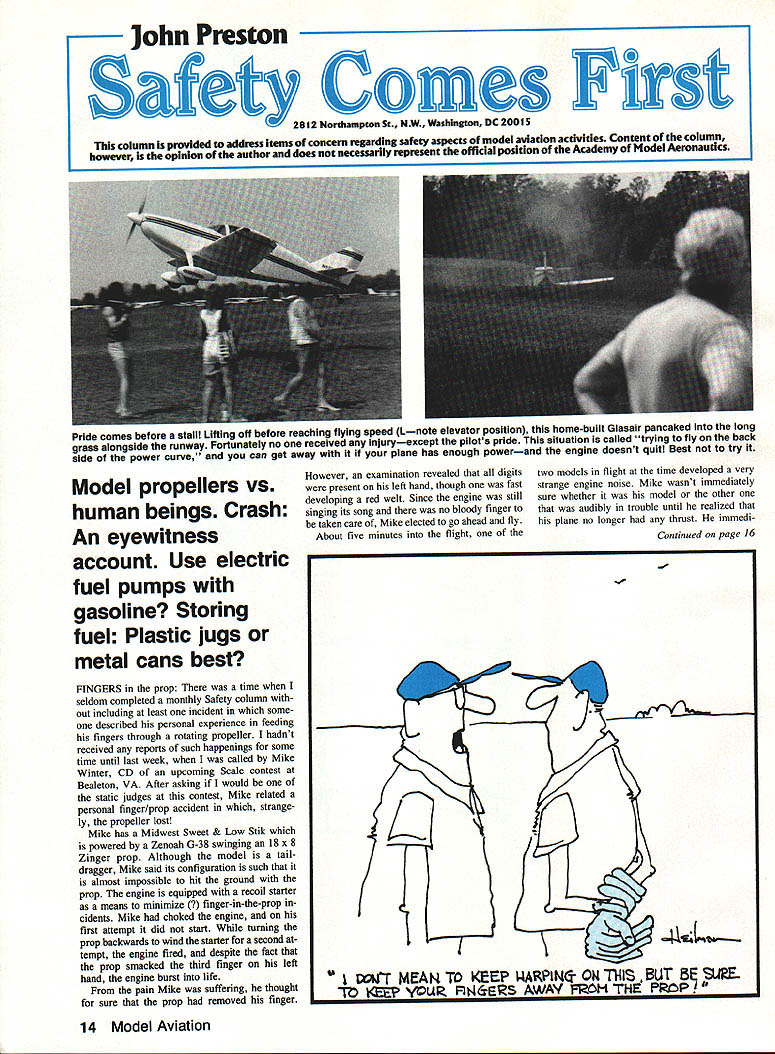
The field has two grass runways arranged in an X. Spectator control consisted largely of keeping pedestrians off the active runway during aircraft movement. A fairly strong southwest breeze gave some arrivals a ground-loop tendency. While talking to an old modeling buddy I watched a home-built (a Glasair, I think) lift off well before reaching the runway crossover point, pitch to an unusually high angle of attack, and stall into a ground strike about 100 ft off the north side of the active runway — uncomfortably close to spectators. The pilot exited uninjured but the aircraft and the pilot's ego were damaged.
- This incident underscores why we separate people and aircraft: errors in judgment or equipment failure can turn an airborne craft into a dangerous projectile.
Electric fuel pumps
Bill Cann (NVRCC) asked if it is acceptable to use an automotive electric fuel pump to fuel and defuel model aircraft that run on gasoline. He referenced an AC Delco unit and had heard electric pumps might be prohibited by AMA or IMFAA.
- I am not aware of any AMA or IMFAA prohibition against using electric pumps for gasoline model fuel. Automotive electric pumps are designed for gasoline; if they safely pump gas in cars, they should be suitable for dispensing gasoline for model engines when used properly.
- Ernest Razzano (A&E mechanic, 50 years’ experience) wrote in with photos of his setup: he uses an automotive fuel pump but locates the battery that powers the pump in a separate flight box (which also houses his electric starter). A phone jack on the battery box makes the electrical connection to the pump box. This separation reduces the hazard of having a battery and gasoline in the same container.
- I welcome letters pro and con about using electric pumps for dispensing gasoline to models. If you use an automotive pump, describe your setup and safety measures.
Fuel storage and fires
- Jim Baxter (Spokane, WA) sent a newspaper clipping headlined "Arson Suspected in Hobby Shop Fire." The article noted that 30 to 50 gallons of methanol-based model airplane fuel were stored in the building but did not explode. Jim commented that the fuel likely enhanced the intensity of the fire even if it did not explode.
- This raises the question of container safety: are aerosol (foam) cans safer than plastic jugs? My guess is that plastic jugs can melt and allow fuel to burn, while metal cans might rupture or explode when heated. I welcome opinions and experience from readers on the safety of metal versus plastic fuel storage containers.
If you have experience with electric fuel pumps, specific fuel-storage incidents, or propeller-related injuries or failures, please write in and describe your setup or the incident so others can learn.
Transcribed from original scans by AI. Minor OCR errors may remain.

