
John Preston
2812 Northampton St., N.W., Washington, DC 20015
Safety Comes First
This column addresses items of concern regarding safety aspects of model aviation activities. The content is the opinion of the author and does not necessarily represent the official position of the Academy of Model Aeromodeling (AMA).
Fingers-in-the-prop — a reminder
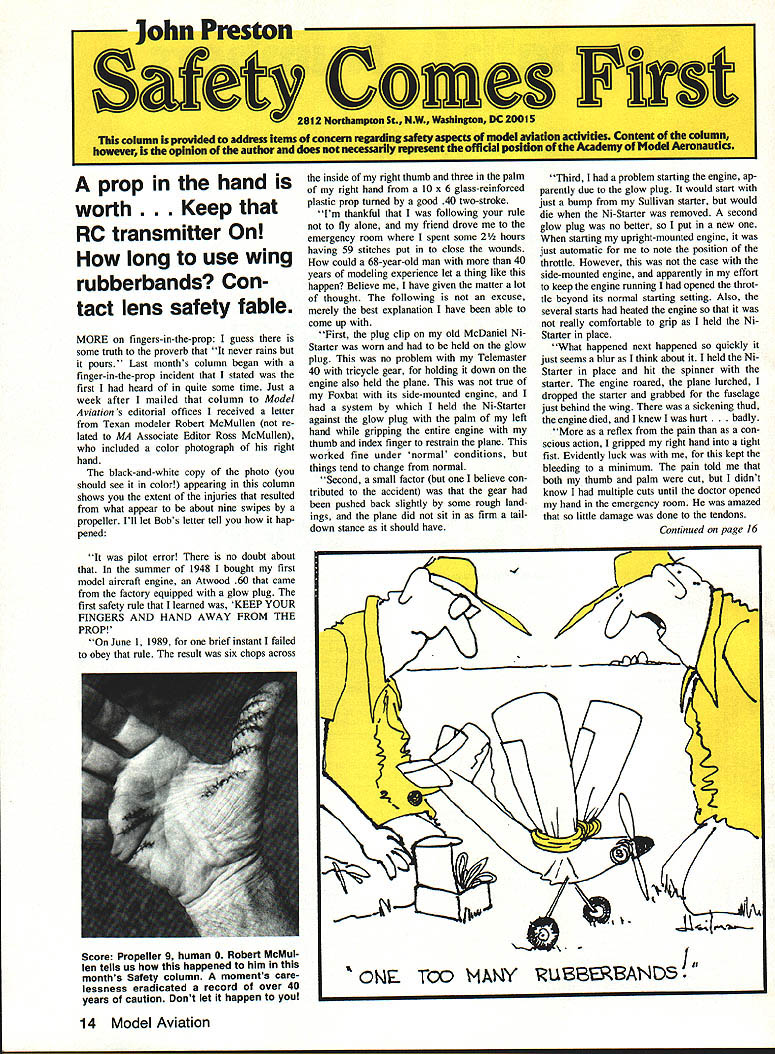
MORE on fingers-in-the-prop: I guess there is some truth to the proverb that "It never rains but it pours." Last month's column began with a finger-in-the-prop incident that I said was the first I had heard of in quite some time. Just a week after I mailed that column to Model Aviation's editorial offices I received a letter from Texan modeler Robert McMullen (not related to MA Associate Editor Ross McMullen), who included a color photograph of his right hand.
The black-and-white copy of the photo (you should see it in color!) shows the extent of the injuries that resulted from what appear to be about nine swipes by a propeller. Bob's letter tells how it happened:
"It was pilot error! There is no doubt about that. In the summer of 1948 I bought my first model aircraft engine, an Atwood .60 that came from the factory equipped with a glow plug. The first safety rule that I learned was, 'KEEP YOUR FINGERS AND HAND AWAY FROM THE PROP!'
"On June 1, 1989, for one brief instant I failed to obey that rule. The result was six chops across the inside of my right thumb and three in the palm of my right hand from a 10 x 6 glass-reinforced plastic prop turned by a good .40 two-stroke.
"I'm thankful that I was following your rule not to fly alone, and my friend drove me to the emergency room where I spent some 2 1/2 hours having 59 stitches put in to close the wounds. How could a 68-year-old man with more than 40 years of modeling experience let a thing like this happen? Believe me, I have given the matter a lot of thought. The following is not an excuse; it's merely the best explanation I have been able to come up with.
"First, the plug clip on my old McDaniel Ni-Starter was worn and had to be held on the glow plug. This was no problem with my Telemaster 40 with tricycle gear, for holding it down also held the plane. The Foxbat with its side-mounted engine system held the Ni-Starter against the glow plug with the palm of my left hand while gripping the entire engine with my thumb and index finger to restrain the plane. This worked fine under 'normal' conditions, but things tend to change from normal.
"Second, a small factor (but one I believe contributed to the accident) was that the gear had been pushed back slightly by some rough landings, and the plane did not sit in as firm a tail-down stance as it should have been.
"Third, I had a problem starting the engine, apparently due to the glow plug. I would start with just a bump from my Sullivan starter, but it would die when the Ni-Starter was removed. A second glow plug was no better, so I put in a new one. When starting my upright-mounted engine, it was automatic for me to note the position of the throttle. However, this was not the case with the side-mounted engine, and apparently in my effort to keep the engine running I had opened the throttle beyond its normal starting setting. Also, several starts had heated the engine and I was not comfortable gripping it as I held the Ni-Starter in place.
"What happened next happened so quickly it seems a blur as I think about it. I held the Ni-Starter in place and hit the spinner with the starter, the engine roared, the plane lurched and dropped the starter, and I grabbed the fuselage just behind the wing. There was a sickening thud and the engine died. I knew I was hurt, but by reflex and pain-conscious action I gripped my right hand into a fist. Evidently luck kept the bleeding to a minimum. The doctor told me that both my thumb and palm were cut, but I didn't know I had multiple cuts until the doctor opened my hand in the emergency room. He was amazed that so little damage was done to the tendons."
Pilot error, no doubt. Score: Propeller 9, human 0. Moments of carelessness are not erased from a record of over 40 years. Caution: don't let it happen to you.
Transmitter On/Off switches
A couple of weeks ago while helping to judge a Scale contest, I bumped into Bill Musser, who flies with the Howard County RC Club in Maryland and whose models usually have two engines. Bill related a recent incident involving a new programmable radio that he had just purchased. Since I have had no experience with programmable radios, I don't know whether they are all like the one Bill purchased, which, when the receiver loses the transmitter signal, centers all the servos. At least that's the factory setting unless you reprogram it.
Bill fired up the twin .40s on a scratch-built model and proceeded to make some engine idle adjustments. While he was doing this, his transmitter neck strap became entangled in the On/Off switch, and before he had time to react it flipped the switch to Off. All of the servos immediately centered themselves — including the throttle servo. If you've ever experienced the thrust of two .40s at half throttle, you will know that for a few seconds Bill had his hands full. Fortunately he managed to get things back under control without the model getting away from him.
The moral of this story is to reprogram your programmable radio as soon as you buy it so that the throttle servo moves to the fully closed position upon loss of transmitter signal.
Another incident involving a transmitter being inadvertently turned off was reported by Bob Bingham (Sunbury, PA). Bob had purchased a new Airtronics radio to control a Flying Quaker, a model he finally built after thinking about it for some 50 years. Bob described what happened:
"I chose the Airtronics Vanguard FM six-channel radio because it meets the 1991 RC equipment specifications for operation at 20 kHz frequency spacing. I didn't want to lose my Quaker to interference from other modelers. The Quaker flew beautifully, and the Vanguard radio worked flawlessly. However, on one flight I was using the throttle trim lever to control the engine in a slow flyby at an altitude of about 100 ft. Suddenly the Quaker made a sharp left turn and with its nose down it dove into the ground. No matter how hard I tried, I could not get it out of its dive. It landed about 50 ft from our flight line, and I was happy that it did not hit any other fliers.
As the Quaker lay on the ground, I thought I might just as well turn off the transmitter. But, to my surprise, I did not have to turn it off. It was already off! You guessed it. While I was using the throttle trim lever I inadvertently turned off the transmitter's power switch. No transmitter, no matter how good, will send out a signal if the power switch is in the Off position!"
Bob believes his transmitter should have been equipped with a guard around the power switch to prevent inadvertent operation. In the past some transmitters were fitted with a flip-up cover over the power switch. Consider adding a guard or relocating the switch away from front-panel controls.
Recommended precautions:
- Reprogram programmable radios to set throttle to fully closed (idle) on loss of transmitter signal.
- Use a guard or flip cover for the power switch or relocate the switch to a less exposed location.
- Be mindful of neck straps and other items that can catch on controls.
Rubberbands
An article in The Transmitter, newsletter of the Belleville RC Fliers, concerning rubberbands recently caught my eye. I thought it would be a good idea to reproduce the article here:
Quite a few of the airplanes at the field, especially the ARFs, use the tried-and-true method of securing the wing to the fuselage with rubberbands. Two questions then arise. How many rubberbands do you use on the plane, and what do you do with them after you are done flying?
"How many? Don't look for a specific number. Rubberbands vary too much in elasticity, size, and strength for one number to be right. Put several on each side, crossed or straight is equally OK, then attempt to pull the leading edge away from the fuselage as you would if you were trying to retrieve the plane. If you can do so with reasonable ease, you need more rubberbands. Put on what you think is enough, then add two for the wife, and one for each of the kids. One for grandma, and three for your girlfriend or mistress. You can also add one or two for Aunt Matilda, if you happen to like her!
"Postflight disposition? When you are done flying for the day, the best thing to do with the rubberbands is to remove them from the airplane, pick them up from the ground, and throw them away. If you absolutely insist on keeping them, take them home, squirt a little dish soap in your hands, and thoroughly massage the soap into all of the rubberbands. The next step is to rinse them thoroughly, and lay them out on a paper towel to dry. Use them a second time and then THROW THEM AWAY. Don't use them more than twice. If it is a hot, sunny day, throw them away after one use. The sun deteriorates rubber very quickly."
My tip for rubberband users: don't forget to reinforce the trailing edge of the wing at the root where the rubberbands pass over it. It doesn't take long for rubberbands to chew up a balsa trailing edge, especially if you catch a wing tip in a hard landing.
Contact lens warning
True or false? Although I didn't see it, apparently the May 1989 issue of the AMA National Newsletter contained a warning to contact lens users. I received a copy of this same warning over five years ago and, after checking it out, found it was not based on any actual incidents or facts. The warning stated that contact lenses can become fused to the cornea of the eye if the wearer looks at an electrical arc (for example, a welding arc).
John Worth recently forwarded to me a copy of a letter he received on this subject from Vincent King, O.D., Ph.D., a Professor of Optometry at Ferris State University of Optometry (Big Rapids, MI) with a Ph.D. in Visual Science. Dr. King stated:
"There is no basis for an injury to an eye wearing a contact lens caused by exposure to an electric arc. In fact, a contact lens will absorb a very small amount of radiation and it will therefore provide some slight (really inconsequential) degree of protection from radiation from the arc spark. A person wearing contact lenses has no greater risk for an eye injury by radiation from any source than a person not wearing contact lenses."
A newspaper clipping similarly debunking the contact lens warning was attached to Dr. King's letter. That story apparently first surfaced in 1967. So, if you happen to prefer assembling your model's components by arc welding rather than by gluing, and you also wear contact lenses, don't be alarmed if you see the warning in the National Newsletter. It's just not true.
Have another safe one.
Transcribed from original scans by AI. Minor OCR errors may remain.

