
John Preston
2812 Northampton St., N.W., Washington, DC 20015
This column is provided to address items of concern regarding safety aspects of model aviation activities. Content of the column, however, is the opinion of the author and does not necessarily represent the official position of the Academy of Model Aeronautics.
Safety Comes First
Fly models in proximity to full-scale aircraft? Never!
Conflicts between full-scale aircraft and model aircraft occur periodically — not frequently, thankfully — but I do receive reports from readers about models trying to share the same piece of sky as full-scale aircraft. The most recent report came from Bill Smith, a modeler in Oxnard, CA, who is also a U.S. Navy Command Safety Officer. He enclosed a newspaper clipping from the L.A. Life section of the Camarillo Daily News captioned "Unwelcome Visitor," which read:
Traffic reporters Jorge Jarrin (KABC-AM 790) and Dick Morgan (KFWB-AM 980) spotted an unusual and dangerous sight one recent morning. As their helicopter lifted off over Van Nuys, a bright yellow remote-controlled model airplane raced past them at about 1,300 ft. "It could have knocked us down if it had hit our rotor or tail rotor," Morgan said. "Usually remote-control model airplane users are pretty good. We've never had that problem before."
Usually the traffic copter flies a pattern high above the Sepulveda Dam Recreation Area, where there's a field designated for height-restricted remote-controlled model airplanes. The copters fly that direction to avoid houses and in accordance with noise-abatement measures. After takeoff the copter made a right-hand orbit at about 1,300 ft twice, and the model made passes at them from about 30 ft. Morgan said he notified the tower and Van Nuys airport police; airport police investigated and no arrests were made.
Bill commented: "This is just another example of the small, negligible percentage of RC hobbyists who are going to ruin it for everyone else. It's never the positive aspects of the hobby that get attention, but some idiot playing chicken with a full-size airplane or helicopter gets all the publicity. The average citizen doesn't know how safe we keep our hobby, only about the near-misses with full-scale aircraft. The reason behind the height restriction at Sepulveda Basin is that the model airport is right under the traffic pattern of Van Nuys Airport, which is one of the busiest airports in southern California. One midair with a lightplane would surely close the RC field at Sepulveda and maybe others around the country which are in close proximity to airports or airport traffic areas."
Bill also suggested developing a gauge, similar to those used in model rocketry, to estimate a model's height. After using such a gauge several times, an individual would be better able to judge altitude and keep within height restrictions.
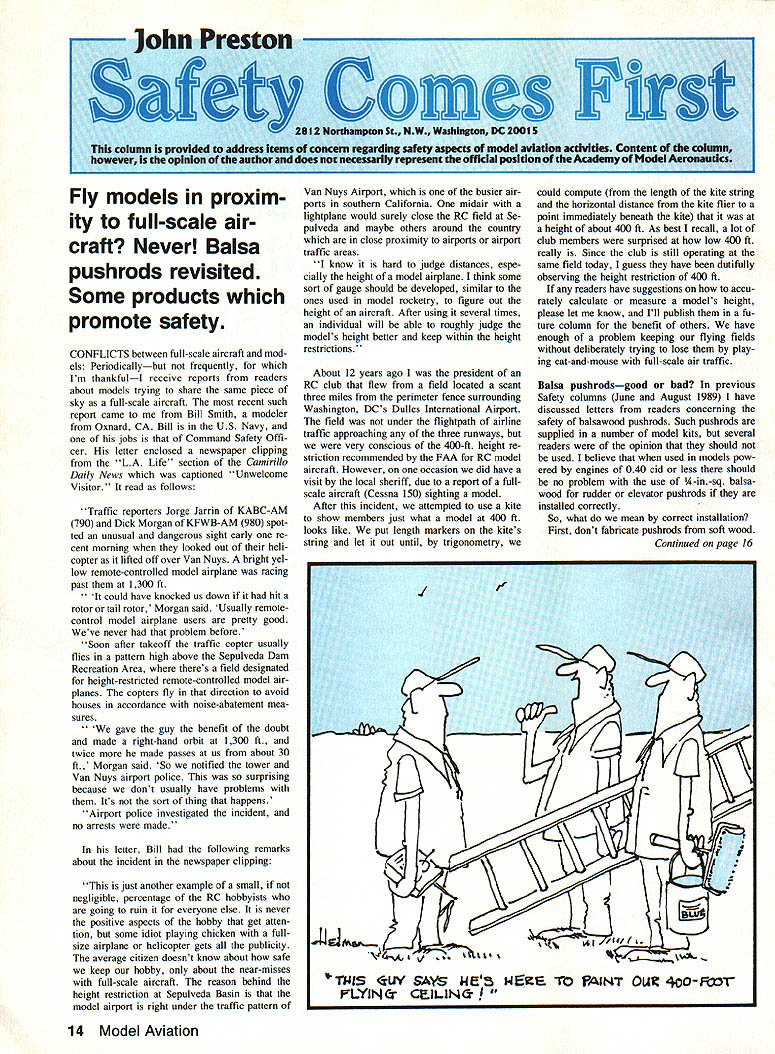
About 12 years ago I was president of an RC club that flew from a field located a scant three miles from the perimeter fence of Washington, D.C.'s Dulles International Airport. The field was not under the approach path of the runways, but we were very conscious of the FAA's recommended 400-ft. height restriction for RC model aircraft. Once, after a report of a Cessna 150 sighting a model, the local sheriff visited the field. To illustrate how low 400 ft. really is, we put length markers on a kite line and let it out until trigonometry showed the kite was at about 400 ft. Many club members were surprised at how low that was. The club is still operating at the same field, so I assume they’ve been dutifully observing the height restriction.
If any readers have suggestions on how to accurately calculate or measure a model's height, please let me know and I’ll publish them in a future column for the benefit of others. We have enough of a problem keeping our flying fields without deliberately trying to lose them by playing cat-and-mouse with full-scale air traffic.
Balsa pushrods — good or bad?
In previous Safety columns (June and August 1989) I discussed letters from readers about the safety of balsa-wood pushrods. Such pushrods are supplied with many model kits, and several readers feel they should not be used. My view is that when used in models powered by engines of 0.40 cu. in. or less, 3/32-in.-sq. balsa pushrods for rudder or elevator should be acceptable if installed correctly.
Correct installation includes the following points:
- Do not fabricate pushrods from soft, low-density balsa.
- Strengthen marginal balsa pushrods by adding doublers: glue four plywood strips (one on each face) made from 1/16- to 1/8-in. plywood, about 1/8 in. wide, and 1/8 to 1/4 the length of the pushrod. Epoxy them in place. This reduces warping and flexure.
- An alternate reinforcing method is to epoxy a strip of crinoline (a stiff cotton fabric available at fabric stores) along the full length of each face of a 1/8-in.-sq. balsa pushrod. In the past some have used silk covering material glued with Ambroid balsa cement; crinoline is a better choice.
- Ensure pushrods do not rub on other pushrods or internal structure (bulkheads). Several readers reported failures caused by chafing inside the fuselage.
- If possible, install pushrods before finishing the covering operation. For all-sheeted fuselages, leave the bottom open until servos, engine, and pushrods are installed so you can observe and verify free movement.
Before leaving the subject of pushrods, I must remind you of the importance of a preflight inspection. Two days ago I watched a videotape of a Piedmont (now U.S. Air) Boeing 737 making an emergency landing because a wheel chock had been left inside the wheel well, jamming the left main gear. Preflight checks of models are important too.
Albert Antholz recently sent me a metal clevis and a nylon control horn that had seen about six hours of operating time. The clevis pin was worn to less than 1/16 of its original diameter, and the hole in the horn was almost twice its original diameter. Like automobiles, model airplane components wear out. It pays to make frequent checks of all control linkages.
Product reviews: Some products which promote safety
Periodically manufacturers send product samples in hopes of free advertising. I don't plug items merely because I received them; I mention them when they genuinely minimize hazards. A few safety-related products I’ve examined recently:
- J-Pac Safe-Start engine tester stand: What sets this stand apart is a fitting on the rear of the base that accepts the socket of a Ni-Starter (or similar). A wire with an alligator clip attaches to the center connection; when starting an engine on the test stand you clip it to the glow plug so your hands never have to be near the propeller arc. The unit fits most engines and comes with a socket adapter. A similar product is marketed by L.D. Carlson Co. The Safe-Start retails for about $12.00; the Carlson version is about $8.00. Any product that minimizes the chance of a hand or object entering the prop arc is worthwhile.
- Remote glow-plug connector: I haven't seen a commercial version recently, but many scale modelers fabricate remote glow-plug connectors to avoid making a nonscale hole in the cowling. A remote connector is a safety device because it eliminates reaching close to the prop arc after starting. If anyone knows of a current commercial source, please write; I recall Model Products Corp. made such a device at one time.
- Disc-Lock prop washer (Performance Products Unlimited): Disc-Lock is a patented prop washer designed to prevent a propeller from being kicked off the crankshaft during a backfire. It uses two washers with inclined cams on one face and radial ridges on the other; arranged with the cam faces together, a backfire drives the cams to make the assembly thicker and tighten the grip on the prop. I haven't had the chance to test these on four-stroke engines (where backfiring is most common) and have passed samples to a friend for evaluation. If readers have experience with Disc-Locks, please share your opinion.
- Safety Plus wraparound sunglasses: Cheap sunglasses may not block harmful ultraviolet radiation, which can contribute to cataracts later in life. Safety Plus sunglasses filter UV radiation and conform to ANSI Z87.1 (shatter-resistance). I believe in wearing eye protection when starting and tuning model engines. AMA District IV VP Howard Crispin told me a prop shattered and broke his sunglasses a few years ago; he believes he might have lost sight in one eye had he not been wearing them. Quality sunglasses should be part of your model support equipment.
Have another safe month.
Transcribed from original scans by AI. Minor OCR errors may remain.

