

Safety Comes First
John Preston 2812 Northampton St., N.W., Washington, DC 20015
This column is provided to address items of concern regarding safety aspects of model aviation activities. Content of the column, however, is the opinion of the author and does not necessarily represent the official position of the Academy of Model Aeronautics.
- Use electric fuel pumps with gasoline?
- Powered models and pets don't mix!
- Fuel containers: Is metal or plastic best?
- Engine backfire fires
Dogs
LONG ago—in the January 1980 issue of this magazine—my first safety column appeared. So, when I finish this column, "Safety Comes First" will have finished its first decade in print. For those who are short on math skills, that’s 120 individual columns.
When Bill Winter (who was editor of Model Aviation at the time) asked me if I’d be willing to author a safety column, my first reaction was that I’d give it my best shot, but I doubted I could come up with enough safety-related topics to make it beyond a year. Fortunately, the readers of this column have responded with many letters, and some clubs supply me with their newsletters. Both readers and clubs have provided me with an invaluable source of material on which the column is based. To quote the popular commercial for a wine cooler beverage, "We thank you all for your support." Now, whether I can complete a second decade remains to be seen!
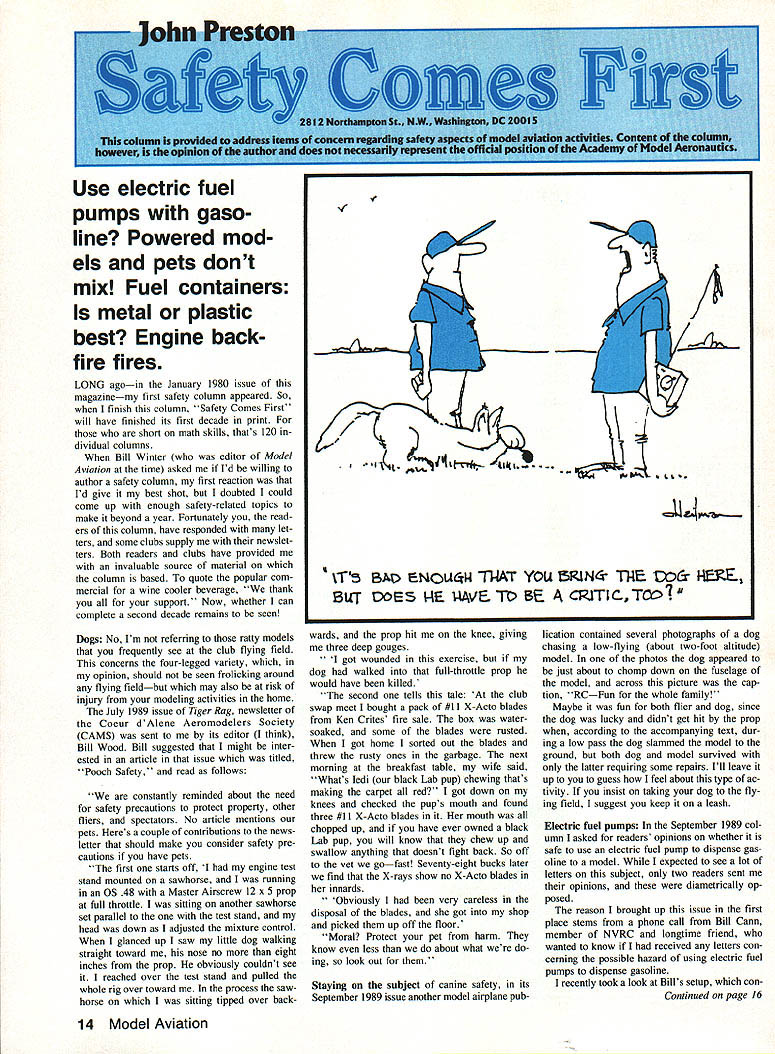
Dogs: No, I’m not referring to those ratty models that you frequently see at the club flying field. This concerns the four-legged variety, which, in my opinion, should not be seen frolicking around any flying field—but which may also be at risk of injury from your modeling activities in the home.
The July 1989 issue of Tiger Rag, newsletter of the Coeur d’Alene Aeromodelers Society (CAMS), was sent to me by its editor, Bill Wood. Bill suggested that I might be interested in an article in that issue titled "Pooch Safety," which read as follows:
"We are constantly reminded about the need for safety precautions to protect property, other fliers, and spectators. No article mentions our pets. Here’s a couple of contributions to the newsletter that should make you consider safety precautions if you have pets.
"The first one starts off, 'I had my engine test stand mounted on a sawhorse, and I was running an .05 .48 with a Master Airscrew 12 x 5 prop at full throttle. I was sitting on another sawhorse set parallel to the one with the test stand, and my head was down as I adjusted the mixture control. When I glanced up I saw my little dog walking straight toward me, his nose no more than eight inches from the prop. He obviously couldn’t see it. I reached over the test stand and pulled the whole rig over toward me. The sawhorse on which I was sitting tipped over backwards, and the prop hit me on the knee, giving me three deep gouges.
"'I got wounded in this exercise, but if my dog had walked into that full-throttle prop he would have been killed.'
"The second one tells this tale: 'At the club swap meet I bought a pack of #11 X-Acto blades from Ken Crites’ fire sale. The box was water-soaked, and some of the blades were rusted. When I got home I sorted out the blades and threw the rusty ones in the garbage. The next morning, at the breakfast table, my wife said, "What’s led to black Lab pup chewing that’s making the carpet red?" I got down on my knees and checked the pup’s mouth and found three #11 X-Acto blades in it. Her mouth was all chopped up, and if you have ever owned a black Lab pup, you will know that they chew up and swallow anything that doesn’t fight back. So off we went to get fast—Seventy-eight bucks later we found that the X-rays show no X-Acto blades in her innards.
"'Obviously I had been very careless in the disposal of the blades, and she got into my shop and picked them up off the floor.
"'Moral? Protect your pet from harm. They know even less than we do about what we’re doing, so look out for them.'"
Staying on the subject of canine safety, a September 1989 issue of another model airplane publication contained several photographs of a dog chasing a low-flying (about two-foot altitude) model. In one of the photos the dog appeared to be just about to chomp down on the fuselage of the model, and across the picture caption read "RC Fun—whole family!" Maybe it was fun for both flier and dog, since the dog was lucky it didn't get hit by the prop according to the accompanying text. During the low pass the dog slammed the model to the ground, but both dog and model survived, the latter requiring some repairs. I'll leave it up to you to decide how you feel about this type activity. If you insist on taking your dog to the flying field, I suggest you keep it on a leash.
Electric fuel pumps
In the September 1989 column I asked for readers’ opinions on whether it is safe to use an electric fuel pump to dispense gasoline into a model fuel tank. I expected to see a lot of letters on this subject; only two readers answered, and their opinions were diametrically opposed.
The reason I brought up this issue in the first place stems from a phone call from Bill Cann, member of NVRC and longtime friend, who wanted to know if I had received letters concerning the possible hazard in using electric fuel pumps to dispense gasoline. Bill's setup consists of an automobile fuel pump mounted in the top of a one-gallon metal fuel can. The pump body is inside the can. Electric power is supplied to the pump via wires about four feet long which are permanently attached to the pump terminals. Banana plugs at the other end of the wires connect the pump to the power panel in Bill's field box. It seemed like a pretty safe arrangement to me. However, in a recent letter, John Brassner appears to have a different opinion.
John is from La Mesa, CA and is concerned that a spark at the pump's on/off switch could ignite gasoline vapors. His letter stated:
"Many RCers use a power panel to control their electric fuel pumps. In my opinion, this would not be a safe practice with gasoline for at least two reasons.
"First, the power panel and fuel container are usually mounted in a flight box either right next to each other or within a few inches of each other. Clearly a spark from the power panel's pump switch could easily ignite gasoline vapors from the adjacent gas can.
"Second, even if some other switching device were used, it does not seem likely that it would be isolated at a safe distance from the gas can or the aircraft being fueled.
"In conclusion, it does seem that an automobile fuel pump itself would be safe for fueling model aircraft, but the danger of vapor ignition from arcing at the on/off switch is very high."
John also pointed out that the same hazard could be presented by an electric starter or any other electrical device if it is operated in the vicinity of gasoline. I cannot disagree with John's opinion: if an unsealed switch or motor is located very close to an open can containing gasoline, a spark could ignite vapors.
An opposite opinion was expressed in a letter from J.D. Tison of Bradley, Ill. J.D. and his son were involved in automobile drag racing for over 15 years and have an auto parts and speed equipment company called Engine Masters. J.D. has also been modeling for 56 years, and his prize possession is currently a scratch-built, 104-in. span PT-19.
A sketch of his flight box accompanied his letter, and it shows an electric fuel pump mounted at one end of the box and the power panel at the other. The gasoline can is not mounted in the flight box at all. It sits on the ground remote from the box, and pump-to-model flows through an automotive vacuum hose. J.D. reports no problems with this arrangement.
It seems to me that you can safely use an electric pump to dispense gasoline to your model if you keep your fuel can and the model being fueled well away from sources of electrical arcs.
However, for those of you who don't want to redesign your flight box, I suggest that you take a look at the new Du-Bro Model F/P #491, a hand-operated, plunger-type fuel pump which mounts neatly to the cap of either a plastic or metal fuel can. Only the plunger and fuel outlet are exposed. According to Du-Bro, one stroke of the pump will dispense one ounce of fuel. The pump is claimed to work well with either glow, diesel, or gasoline fuels.
Fuel containers
Continuing on the subject of fueling systems, let's turn from electric pumps to fuel containers. Which type of container is safer, metal or plastic? This was the question I posed in the September column, and Ellis McGaughy was one who responded. Ellis is a chemical engineer employed by a Charleston, WV chemical company. He has been into modeling for some 15 years. He had the following to say:
"Up front, let me say that I have come to the conclusion that metal is safer ... although plastic has its virtues.
"Methanol (as well as gasoline) must be treated with respect. Methanol has two key characteristics to remember. One is good, while the other is bad.
"Methanol is electrically conductive; therefore, it cannot build or hold a static charge which could provide a source of ignition. This property only holds true for the liquid and has nothing to do with the container in which the liquid is stored. If the container is electrically nonconductive, it can cause a spark due to static electricity. The bad property of methanol is related to the fuel/air mixture generated at room temperature.
"The worst possible explosion occurs when a flammable vapor is present in stoichiometric proportions with oxygen. This simply means that only the exact amount of air required to burn the fuel is present (not too lean, and not too rich). The vapor pressure of methanol is such that it very nearly creates this proper mixture at room temperature. Therefore, an extremely explosive mixture exists in our fuel containers, and the controllable factor which prevents an explosion is the absence of an ignition source. Industry uses nitrogen inerting and extensive equipment grounding to ensure that an explosion doesn't occur ... but nitrogen inerting is not practical for our purposes.
"At work, safety standards do not allow storage of flammable materials in plastic containers larger than one gallon. This restriction is because plastic is nonconductive and can therefore cause a static electrical discharge. In addition, metal containers larger than one gallon should be grounded prior to filling or emptying. Most people do not realize the importance of grounding because of the absence of a visible grounding wire while filling one's automobile with gasoline. Actually there is a grounding wire inside the gasoline nozzle which prevents the possibility of arcing.
"The electrical insulating property of plastic allows static to develop, but it also reduces the probability of accidentally shorting out batteries. I feel that if the field box is properly designed (i.e., batteries located away from the fuel container) and if the wiring is in good condition, this hazard is small. I have installed a 'kill' switch near my 12-volt battery, and it is tripped (off) whenever the field box is not in use. The switch is mounted in a location such that it cannot be accidentally bumped, and it would be very difficult for a young child to operate it. Not only does this safeguard help prevent fuel fires, but it also prevents all accidents related to the various electrical components we use.
"Since most of us keep fuel in containers having capacities of one gallon or less, static charge may be a primary consideration in making the decision on whether to use a metal can or a plastic bottle. However, there are other considerations. A localized hot spot (like a misplaced soldering iron or cigarette) will quickly cause failure of a plastic bottle. If a plastic container is in contact with a retaining strap or other sharp object, it is more likely to fail than a metal can would be.
"In summary, I prefer metal fuel containers due to their durability and inability to create static charges. Ideally, the container should be a 'safety can' listed by Underwriters Laboratories, Inc., or approved by Factory Mutual Engineering Corporation. These cans utilize a spring-loaded lid designed to relieve internal pressure safely when subjected to fire exposure. Even if this type of safety container is not used, I feel the advantages of metal outweigh the explosion hazard due to fire exposure. Metal containers help prevent the fire from starting in the first place."
Since Ellis seems to have covered the metal-versus-plastic issue in some depth, I don't believe it is necessary for me to add any further comments.
Engine backfire fire
Jessie Aronstein of Poughkeepsie, NY sent me a page from Flight-Line, the newsletter of the Mid-Hudson RC Club, editor Donald Roy. It contained a report of an incident experienced by Mike Tebolt — the backfire fire. Read on:
"While trying to get the .049 engine started on his sailplane, his primer fuel had run down the power pod and all over the plane. When the engine sputtered and backfired, the spilled fuel caught fire.
"Now, for those of you who don't know, an alcohol fire is so tough to see that you don't know what part of the plane to hold the marshmallow over to get it properly cooked.
"Mike was able to see the parts of the plane that were burning, because the MonoKote tightened up, then too much, then developed holes of increasing size.
"Although there were no fire extinguishers at the field, all were not lost — there were enough members at the field who were full of hot air and managed to put out the flames. There was no structural damage, and all Mike had to do was make some repairs to the covering."
Transcribed from original scans by AI. Minor OCR errors may remain.

