


John Preston
Safety Comes First
2812 Northampton St., N.W., Washington, DC 20015
This column addresses items of concern regarding safety aspects of model aviation activities. The content is the opinion of the author and does not necessarily represent the official position of the Academy of Model Aeronautics.
Watch out for
- Propellers
- Transmitter power switches
- Servo‑reversing switches left in the wrong position
- Receiver connectors with poor contact
- Children at the flying field
Propellers
BEWARE of props! One picture is worth a thousand words. I don't have pictures for this month's Safety Column, but a photo that appeared in October 1989 showing Bob McMullen's hand after repair (59 stitches) resulted in many letters from readers.
Several people said Bob's accident convinced them it isn't wise to fly alone. Others still resist that safety message. Bill Hawks is not one of those people.
Bill was recently flying with his 20‑year‑old grandson when he became a victim of the fingers‑in‑the‑prop syndrome. He wrote, "One look and I knew my next stop would be at the hospital emergency room for stitches." After the accident, Bill's grandson disassembled the two large models they had brought, loaded them in a station wagon, opened the combination lock on the gate and relocked it after driving through. As Bill reported, if he had been alone it would have been very unhandy to tear down those planes, store everything in the wagon, and then deal with the combination padlock and steel gate.
In addition to not flying alone, Bill says he will not use wooden or sharp plastic props that might cut a finger completely off. He also wears a leather glove on his left hand (the hand that holds the model), which he feels is most likely to contact the prop.
Model‑holding device
A simple device for securing the model while starting the engine was described by Lon Muehlenbeck and Mike Cribbins of Birch Run, MI. Fabricate it from a length of 1/4‑inch diameter steel rod bent in the shape of a horseshoe (an inverted "U"), similar to a croquet hoop. The two legs are spaced about 5–6 inches apart, and the central portion is covered with rubber tubing (1/4‑inch automotive vacuum hose). Place the two legs over the rear fuselage, in front of the horizontal stab, and push it into the ground (assuming a grass pit area) to hold the model.
You can bend the rod in a vise or wrap it around a metal clothesline pole. Lon and Mike both have such devices and frequently loan them to other modelers.
Prop incidents and hub strength
Sidney Sharp of Hanford, CA, described an incident with a 14 x 6 plastic prop installed on a YS .120 four‑stroke engine. While running at full throttle (8,000–10,000 rpm) both blades let loose. Fortunately Sid was not injured, but his workbench has a hole in it. Sid had only removed sharp flashing from the blades and bored the hub to fit the 8 mm shaft of the engine.
Would enlarging the mounting hole exonerate a prop manufacturer in a lawsuit after an injury? How much can you enlarge the hole before compromising hub strength? I don't have definitive answers, but props—wood or plastic—should have sufficient "meat" in the hub area to ensure adequate strength when bored out to fit the largest shaft for the engine displacement for which the prop is intended.
Vise‑held engine accident
Bill Spathias of Dallas, TX, sent this account:
"I was working on my son's Hot Fox .50 and wanted to run a short burst to dry it out for primer. My shop vise was handy, so I thought I would use it to hold the engine. I snugged the engine in the vise between two pieces of pine, primed it, and flipped the prop. It started on the first try, wound up like a B‑29, and took off like it was the wing. The 'thing' actually flew the two short feet between the vise and my stomach, straight as an arrow. There was no time to move, and it cut me, causing three lacerations—one took eight stitches. My wife thought I had been shot; there was blood everywhere.
"Luck was not all bad: I had noticed the fiberglass propeller was as sharp as a knife and had sanded all edges smooth. I shudder to think how bad it would have been had I not done this. I hope this will help keep other modelers from trying this stunt."
Prop‑kicking and locknuts
It's been a while since I've had reports of props being kicked off shafts of four‑stroke engines. Perhaps modelers are better at adjusting mixture to prevent backfires, or more are using locknuts. Eloy Marez, service manager for Futaba Corporation (importer of the YS .120), enclosed instructions noting the engine comes with double locknuts for safety; to their knowledge this has largely eliminated the prop‑kicking problem.
Eloy's letter also raised the growing appearance of model‑size gas turbine engine ads. The AMA Safety Committee has been asked to develop criteria for acceptability of turbojets at AMA events. If you plan to use a gas turbine, contact the Safety Committee for guidance.
Transmitter power switches
My October 1989 column described a crash of Bob Bingaman's Flying Quaker when his transmitter was inadvertently turned off after he mistook the on/off switch for the throttle trim lever. I asked for feedback on transmitter switch design; Frank Cudworth (North Dakota) reported a similar experience with a Futaba SUPA PCM transmitter.
Andrea Beik of Sacramento, CA, offered a practical solution for Airtronics Vanguard users: the on/off switch actuator on the front of the Vanguard can be removed to reveal a recessed switch in the case. Leaving the external actuator off prevents accidentally switching off the transmitter. Perhaps other manufacturers provide—or should provide—similar recessed or guarded switches. I ask radio manufacturers and importers to give serious consideration to on/off switch type and location to reduce accidental shutoff.
Connectors and preflight checks
Bjorn Hammarskjold (returning to Sweden) reported corrosion of servo and battery contacts after 1½ years of intermittent use, causing intermittent servo signals. His solution: add a male 15‑pin D‑sub connector in parallel to the receiver contacts and solder servos in the model to a female 15‑pin D‑sub connector. These gold‑plated connectors resist corrosion and provide one polarized plug to disconnect when changing receivers or planes. He still performs a preflight check to ensure all wires are connected.
A preflight check must include verifying control direction. Doug Macbrien of Granby, MA, told this cautionary tale: he used the aileron servo‑reversing switch when rigging a model, forgot to return it to normal, and performed a hurried preflight where he wiggled the sticks but did not confirm correct control movement. On takeoff the Giant went into a right‑hand spiral and was a write‑off. The moral: always check the direction of control surface movement and proper operation during your preflight check.
If you've never flown with reversed ailerons, you won't appreciate how difficult it is to recover. With transmitters that include servo‑reversing switches, it is vital to check controls for proper direction before every flight.
Receiver connectors and contamination
As Bjorn's experience shows, poor connector contact—due to corrosion, dirt, or intermittent connection—can cause loss of control. Use quality, corrosion‑resistant connectors, perform regular inspections, and include connector checks in your preflight routine.
Children at the flying field
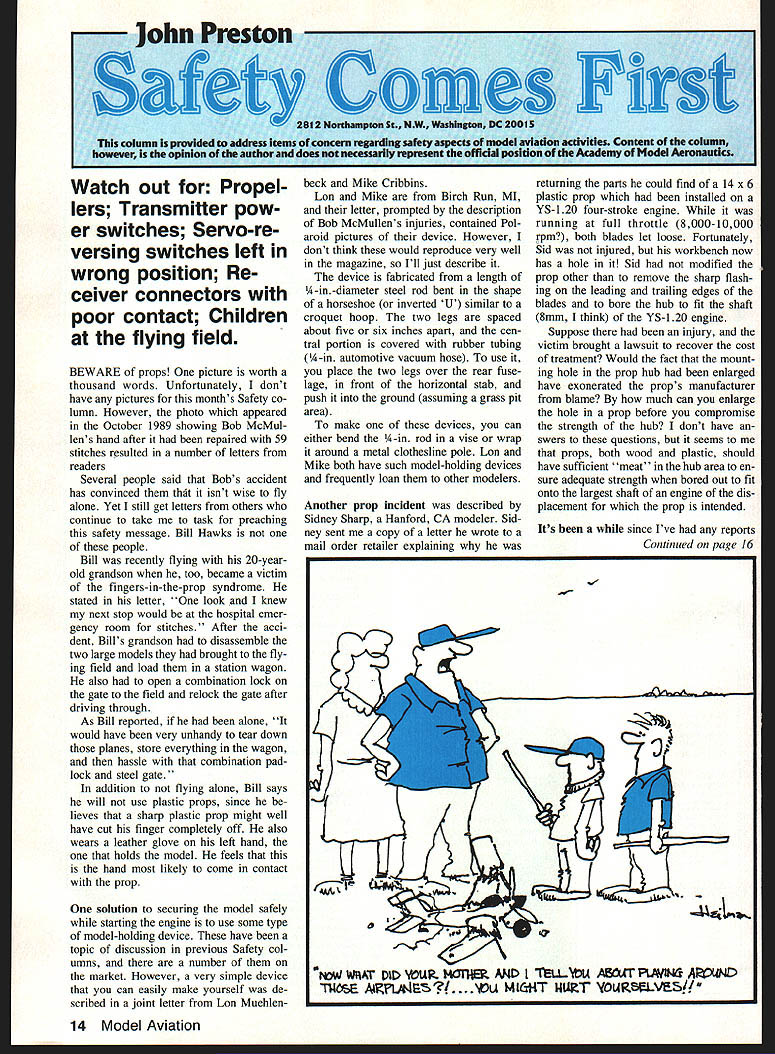
An anonymous club member wrote about children roaming unsupervised around the flight line and pit area. One child picked up a transmitter and changed several trim levers, threatening a pilot on the next takeoff. The child's parent (a club officer) argued the kids were safer by his side on the flight line. Many members disagreed.
Back in my May 1980 Safety column I published a list of flying field rules compiled from many clubs; clubs should select those that apply to their operations. Two rules applicable to children are:
- Rule #11: Spectators are welcome but must remain in the designated area. This should include young children unless escorted by a parent who is a club member. The designated spectator area does not include the pit area or flight line.
- Rule #21: Pilots must stand only in the marked pilot's box. Only pilots, instructors, and spotters are permitted to stand in the pilot's box.
In short: I support family participation in our hobby, but for their own protection do not let children roam unsupervised near the pits or flight line. Accidents happen—let's not have the victims be children.
Closing
Always perform a thorough preflight check, guard against inadvertent transmitter shutoff, ensure connectors and hubs are sound, secure the model when starting engines, avoid flying alone if possible, and keep children safely in designated spectator areas. I encourage letters with differing viewpoints on any of these issues. Meanwhile, let's all have a safe month.
Transcribed from original scans by AI. Minor OCR errors may remain.

