
Safety Comes First
John Preston
This column is provided to address items of concern regarding safety aspects of model aviation activities. Content of the column, however, is the opinion of the author and does not necessarily represent the official position of the Academy of Model Aeronautics.
Safety column undesirable? How safe is our hobby?
An RC flier endangers a full-scale helicopter—or did he? The other side of the story.
QUESTION
Is this column undesirable? Those of you who follow "RC Sport/Aerobatics," Ron Van Putte's column in this magazine, may recall that in the January 1990 issue Ron featured a letter from John Krekelberg, president of the Twin City Radio Controllers. As a postscript to the letter Ron stated, "I'm sure John Preston will have some comments to make." Correct, Ron. Here they are.
In case you didn't see Ron's January column and have thrown away that issue of Model Aviation (MA), first let me summarize John Krekelberg's letter.
Mr. Krekelberg's club was attempting to obtain a site for a new flying field. At a meeting before the local planning commission, the club was faced with over 100 people opposed to a proposal to locate the flying field in their rural area. To quote from the letter:
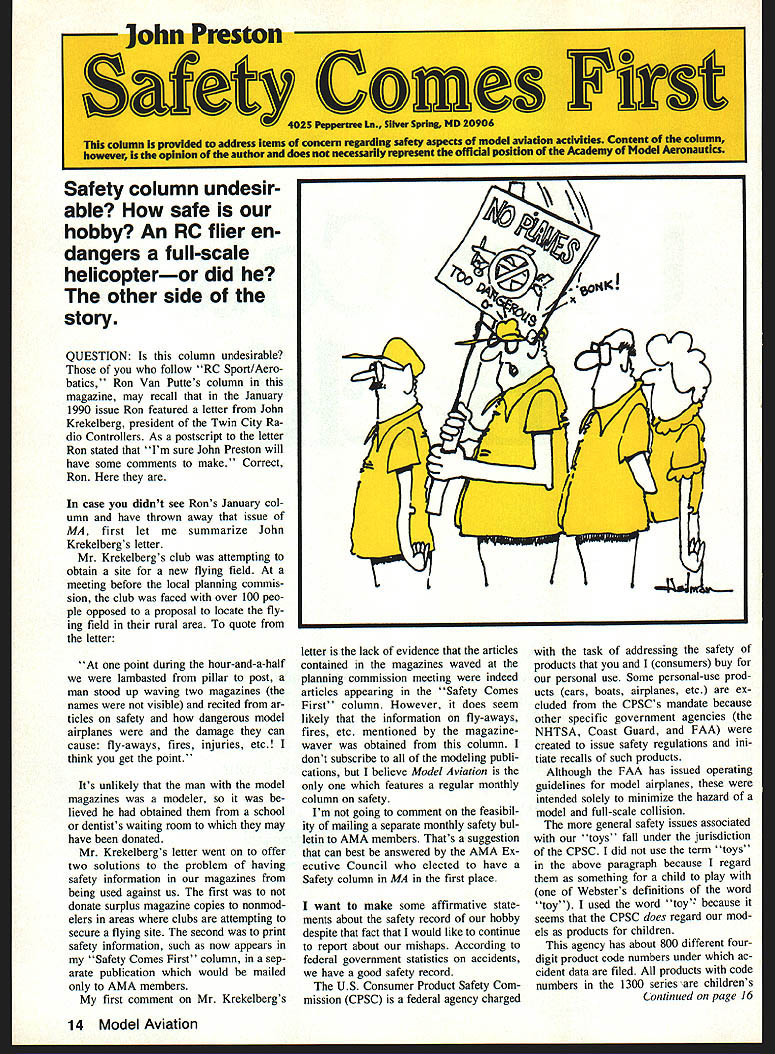
"At one point during the hour-and-a-half we were lambasted from pillar to post, a man stood up waving two magazines (the names were not visible) and recited from articles on safety and how dangerous model airplanes were and the damage they can cause: fly-aways, fires, injuries, etc. I think you get the point."
It's unlikely that the man with the model magazines was a modeler, so it was believed he had obtained them from a school or dentist's waiting room to which they may have been donated.
Mr. Krekelberg's letter went on to offer two solutions to the problem of having safety information in our magazines used against us:
- Do not donate surplus magazine copies to nonmodelers in areas where clubs are attempting to secure a flying site.
- Print safety information, such as now appears in my "Safety Comes First" column, in a separate publication that would be mailed only to AMA members.
My first comment on Mr. Krekelberg's letter is the lack of evidence that the articles contained in the magazines waved at the planning commission meeting were indeed articles appearing in the "Safety Comes First" column. However, it does seem likely that the information about fly-aways, fires, etc., mentioned by the magazine-waver was obtained from this column. I don't subscribe to all of the modeling publications, but I believe Model Aviation is the only one which features a regular monthly column on safety.
I'm not going to comment on the feasibility of mailing a separate monthly safety bulletin to AMA members. That's a suggestion that can best be answered by the AMA Executive Council, who elected to have a Safety column in MA in the first place.
I want to make some affirmative statements about the safety record of our hobby despite the fact that I would like to continue to report about our mishaps. According to federal government statistics on accidents, we have a good safety record.
CPSC jurisdiction and product coding
The U.S. Consumer Product Safety Commission (CPSC) is a federal agency charged with the task of addressing the safety of products that you and I (consumers) buy for our personal use. Some personal-use products (cars, boats, airplanes, etc.) are excluded from the CPSC's mandate because other specific government agencies (the NHTSA, Coast Guard, and FAA) were created to issue safety regulations and initiate recalls of such products.
Although the FAA has issued operating guidelines for model airplanes, these were intended solely to minimize the hazard of a model and full-scale collision.
The more general safety issues associated with our "toys" fall under the jurisdiction of the CPSC. I did not use the term "toys" above because I regard models as something for a child to play with (one of Webster's definitions of the word "toy"). I used the word "toy" because it seems that the CPSC does regard our models as products for children.
This agency has about 800 different four-digit product code numbers under which accident data are filed. All products with code numbers in the 1300 series are children's products. Accidents and complaints associated with models are coded by the CPSC under number 1306, a code described as Gasoline/Other Fuel Powered Models. I am aware that the code would be used for incidents involving boats and cars powered by gasoline and other fuels as well as model aircraft.
Under the Freedom of Information Act a citizen of the United States is entitled to unclassified government documents. Such documents compiled by the CPSC's epidemiologists and specialists in disease and injury data are available. The Annual Product Summary Report contains tabulations of nationwide estimates of injuries requiring hospital emergency room treatment associated with about 800 products falling within the jurisdiction of the CPSC. It also provides the percentages of victims in each of five age ranges, and percentages of victims who were treated and released, hospitalized, or DOA (dead on arrival—Ed.).
Before you rush to order your copy, let me say that the 1988 report (the most recent available) does not provide an estimate for code 1306 "Gasoline or Other Fuel Powered Models." Why not? Because of the small number of injuries that were treated in the emergency rooms of hospitals which provide data electronically to CPSC to enable the nationwide estimates to be computed.
The smaller the number of estimated injuries concerning a specific product, the larger the relative sampling error. If the injury estimate drops below a certain value, the CPSC does not include a nationwide estimate of injuries for that product. The uncertainty of the estimate would render it meaningless. Such is the case for #1306. Our hobby was apparently not sufficiently hazardous to have caused enough injuries requiring emergency room treatment, and thus did not appear as a separate item in the 1988 CPSC Annual Product Summary Report.
In one of my early Safety columns (during 1980, I believe) I used CPSC data to compare injuries associated with our hobby to those related to golf. If you just look at the raw numbers, it seemed as if golfers were much more likely to seek emergency room treatment for injuries than were modelers. However, I now believe this was an unfair comparison, since I'll venture to say that there are many more man-and-woman-hours spent on the golf course than at the flying field. In order to make valid comparisons of the likelihood of injury you have to know the number of people who are at risk (i.e., how many are playing the game?). In the case of golfers and modelers, I have no information on the numbers of people who participate.
Let me finish this discussion by stating that one of the highest-risk products, according to the CPSC Annual Product Summary Report, is bicycles. Even though it is estimated that there are about 64 million bicycle owners/riders in the U.S., the 1988 estimate of emergency-room-treated injuries associated with bicycles was over 500,000, and the annual fatalities are about 1,200.
Even accounting for the difference in the number of bicycle owners/riders and model airplane builders/fliers, it seems you are clearly more at risk riding a bicycle than flying a model airplane.
The other side of the coin
In the November Safety column I reprinted a newspaper account of an incident in which it was alleged that an RC model airplane made several close passes at a helicopter carrying traffic reporters which was flying at 1,300 feet.
The reader who sent me the clipping stated that he believed this incident was just another example of a small percentage of RC hobbyists who are going to ruin it for everyone else. In other words, it was assumed that the owner of the model airplane was at fault. The above incident occurred over the Sepulveda Dam Recreation Area near Van Nuys, CA.
Last month I received a letter from Howard Reed, who flies RC models at that site. His letter presents another viewpoint on the reported helicopter/model conflict:
"Like many news items, the complete facts or picture are never presented. Nothing was said about the pilot of the helicopter. He has been observed, many times, flying low over the model area. Before the article was printed, he had been turned in to the FAA for low flying over this area. Was this his way of getting even? The article was not printed in the news section of the paper, but in a TV commentary column.
"Pilots following the established takeoff pattern will not fly over our area. The newspaper stated, 'Soon after takeoff, the traffic copter usually flies in a pattern high above the Sepulveda Dam Recreation Area.' High above is not his sometimes altitude of 500 ft. He stated he used that path to avoid houses, for noise abatement purposes. Another misleading statement. The normal takeoff pattern from the airport is over a golf course, the Los Angeles River, and a freeway.
"The newspaper account continued, 'We gave the guy the benefit of the doubt and made a right-hand orbit at about 1,300 ft., and twice more he made passes at us from about 30 ft.'
"First, the helicopter pilot stayed in a hazardous area — a right-hand orbit. Any pilot concerned about safety would have tried to get away from the area. He only compounded the problem.
"Second, a model flying at 1,300 ft. would be very difficult to control visually in order to make consecutive passes at the helicopter. Could the model have had radio or mechanical problems?
"Third, if the close passes were at 30 ft., the turbulence from the helicopter's main rotor would have blown the model apart or at least made control impossible.
"Safety, as you all know, is a two-way street. Everyone has to be concerned, and we have to look out for each other.
"Many attempts have been made by modelers to establish a better relationship with the airport. It would seem that the outcome of our efforts is indifference and unconcern. Model activity has been going on for over 25 years in this general area. During that time there have been many crashes and forced landings by full-size aircraft. So far none have been caused by a model airplane."
So there you have it—the other side of the coin. I have to agree with the opening statement in Howard's letter that many news items do not print the complete facts of a story. As far as this column is concerned, I'm always willing to add more facts to a previously published story if you, the readers, will send them to me.
Have a safe month.
SAFE FLYING IS NO ACCIDENT
Transcribed from original scans by AI. Minor OCR errors may remain.

