
Safety Comes First
John Preston 4025 Peppertree Ln., Silver Spring, MD 20906
This column is provided to address items of concern regarding safety aspects of model aviation activities. The content of the column is the opinion of the author and does not necessarily represent the official position of the Academy of Model Aeronautics.
Good manners—safe flying! Statistics and prop danger. Safe starter. Tips on CL line clips. Three unusual safety tips.
Manners and safety
In my opinion, polite flying is directly related to safe flying. This opinion was reinforced by an incident described in a recent letter from a Texas modeler, whose name and club I'm withholding to avoid creating bad feelings within the club.
The members of this club are required to fly in accordance with the AMA Safety Code and to observe certain flying-field rules. Some important rules require that pilots announce their intentions to other fliers, such as calling out “Taking off,” “Landing,” and “Dead-stick” prior to executing these functions. If it is necessary for a flier to enter onto or cross the runway, this also must be announced and acknowledged by the other pilots. The letter writer stated that once in a while infractions do occur, and penalties may be assessed which could result in removal from the club. The particular incident was described in the letter writer's own words:
"One evening I was flying my standard-size sailplane while another member was flying his pattern plane, making low, high-speed passes over the runway. When I concluded my last flight, my towline had landed diagonally across the runway. As I began its retrieval, I advised the other flier that I would be crossing the active runway, and to please keep clear. I said if he had to land, to let me know and I would clear the runway. He responded affirmatively.
"I had reached about the middle of the runway when I heard the howl of an approaching model. Looking up, I saw it pass overhead at about 20 ft. altitude and traveling at about 70 to 90 mph.
"I continued my towline retrieval when again I heard the howl of the approaching pattern plane. Before I could move, the model passed 10 to 15 ft. overhead in a descending path, clipped some tall grass beyond the runway, and proceeded to zoom up and shred itself by passing through some power lines beyond the boundary of the field. The now wingless fuselage and tail assembly, with engine still at full power, described a ballistic arc and impacted close to a nearby light industrial area. Before I got back to the pit area, the pattern pilot had departed to salvage his wreckage.
"At the next club meeting, I reviewed the incident with the club officers and members present. I recommended that 1) We ban low passes over the runway, and 2) We refocus the members' attention to the existing club rules on runway/flying conflict. I pointed out to those present that in my more than 30 years of modeling I've witnessed several injuries and one death resulting from RC model activities, and I do not wish to see others.
"Furthermore, under the conditions of the incident, had the pilot of the model lost control earlier I would not have had time to evade the oncoming model were I its specific target. I also informed the officers that any such accident would not only cause all of us great trauma, but could also result in the permanent loss of our field.
"I noted that some two years ago, due to safety infractions, the use of the field had been suspended for three months while four of us worked very long and hard to develop stronger safety and conduct rules and a better field layout in order to once again secure permission to use the field.
"The outcome of this meeting was: 1) A decision to send the offender a 'citation/warning' letter; 2) Make a request that fliers make low passes beyond the runway; 3) Admonish all members to pay better attention to the club rules; and 4) Ask for more active control by the safety officer(s). While I was not thoroughly satisfied by these measures, I accepted the majority rule."
The preceding account reminded me of an incident involving thoughtlessness that occurred many years ago at a field I used to fly from in Virginia. It had a grass runway, and every spring we used to have a field day, in which those willing to work would attempt to repair the ravages of winter.
On this particular occasion the field was closed for flying, and a member was operating a rented power roller on the runway to try and smooth out the bumps. Apparently one member didn't get the message about the field being closed and showed up to fly. He ignored the fact that a roller was operating on the runway, took off, and proceeded to make low passes over the roller and its operator. Needless to say, the roller operator quickly put an end to this discourteous and dangerous activity by threatening to perform dire deeds to the flier of the model.
When I used to live in Virginia, every morning as I drove to my job in Maryland I would pass a sign on the bridge crossing the Potomac River which stated: "Entering Maryland. Please Drive Gently." Perhaps we should adopt the same slogan for our RC flying activities: "Please Fly Gently."
Propellers revisited
As long as we continue to use propellers on our models to provide propulsive force, I will continue to warn about these exposed potential finger lacerators.
During the last month my mail brought letters reporting four more incidents of propeller blades parting company with the hub. You will recall the incident I mentioned in the January 1990 Safety column that was described by Sidney Sharp. Sidney was running a 14 x 6 prop on a .120-cu.-in., four-stroke engine when both blades let loose. Fortunately, no injury resulted. Sidney had some suggestions which I didn't use in the January column, but the additional reports of prop failures lead me to believe I should pass them on.
Sidney suggested the following:
- Encourage readers to write the vendor and the manufacturer with incidents such as this, with a copy to AMA HQ.
- If AMA kept a file of these reports, then if there were a number of incidents for a product, the manufacturer and seller could not claim ignorance of a defect or product limitation.
I endorse Sidney's suggestion that modelers experiencing a product failure — whether it be of a prop or other item — should be encouraged to write to the vendor and to AMA HQ. To whom at AMA HQ should they write? There is an AMA Safety Committee, but it doesn't appear to be very active at present.
My suggestion would be to contact AMA Technical Director Bob Underwood. Bob probably won't like me for suggesting him as the recipient of letters of complaint, but I doubt that he's going to be inundated with such letters. From my past experience in writing this column, most modelers (and nonmodelers) have to have strong motivation before committing pen to paper. However, I do urge you to draft a short letter to the distributor and to AMA if you experience an incident you believe was caused by a defective product.
Good manners = safe flying
(See "Manners and safety" above for the full Texas-club account and resulting recommendations.)
At the club meeting following the incident the officers and members recommended:
- Ban low passes over the runway.
- Refocus members' attention on existing club rules regarding runway/flying conflicts.
- Make a request that fliers make low passes beyond the runway.
- Admonish members to pay better attention to club rules.
- Ask safety officers to take more active control.
Again, thoughtlessness can lead to injuries, death, trauma, and even permanent loss of a field. Keep announcements clear, acknowledge them, and respect safety rules.
Safe starter
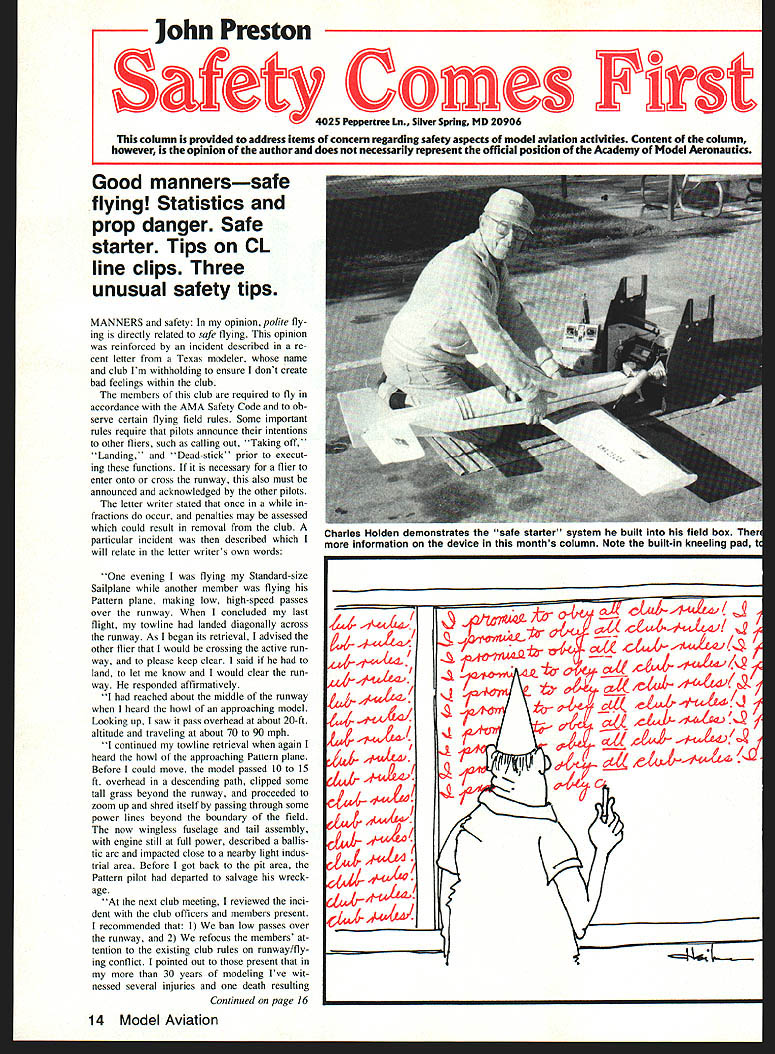
Charles Holden joined the ranks of RCers just two years ago but has already built several models and a field box that minimizes engine-starting/propeller accidents.
The field box contains what appears to be a Sullivan starter mounted so that a slight pressure of the prop spinner against the starter cone energizes the motor. This type of starting arrangement has been used by a number of CL Speed fliers for several years. Since you are behind the prop during the entire starting operation, the chances of contacting it are minimized.
Charles has equipped his flight box with a cover which unfolds and becomes a kneeling pad to prevent the box from moving during the starting operation and also keeps the user's knees out of the mud. Charles concluded his letter by stating: "If inquiries are made for plans, kits, etc., I can be reached at 13750 DeFoe Ave., Sylmar, CA 91342 (phone 1-818/362-2459). If you are interested, I suggest you drop him a line or give him a call."
Remote glow plug connector
My November 1989 Safety column mentioned an engine test stand that had provision for attaching a self-contained Ni-Cd glow plug igniter (Ni-Starter), or other brand, remote from the engine. In that column I suggested that a remote connection for a self-contained Ni-Cd starter on the model itself would be a good idea since it keeps your fingers away from the prop arc. I also stated that I wasn't aware of such a product.
Lloyd Zink wrote to inform me that McDaniel R/C, Inc. has such a product, and Floyd Yovanovitch told me he uses one marketed by Thunder Tiger. I also spoke with Bob McDaniel, who suggested that readers be warned not to leave a Ni-Starter attached to the plug after the engine starts. Although the Ni-Starter locks in place, the weight of the battery under the vibration of a running engine can produce large stresses. Remove the starter after the engine fires up, or use a remote attachment if you want to keep battery power on the plug.
Safety notes
George Wilson sent copies of part of the text from a recent issue of the Discovery Flying RC Club newsletter. Three safety tips follow:
- Mark Massoni's .60-size engine started without the battery being connected. He was lucky—only a bruised finger. It could have been a major accident. This type of start has been reported in the AMA Safety column. If you do not read this column, you are doing yourself a big disservice. Be careful!
- Dick Meehan's receiver crystal fell out. His big Sopwith Pup was on the ground at the time. The possibilities of what might have happened had it been in the air are awesome. In my opinion, this is a design defect. The receiver had the crystal accessible from the outside, thereby inviting frequency changes without retuning. Crystals should not be changed without retuning the receiver (this is also true of transmitters). If your receiver has a plug-in crystal, tape it in.
- George Wilson's Littlest (a derivative of Balsa USA's Stick 40 Plus) was doing radical recoveries from dives and loops (sometimes two loops in a row without asking for the second one). It turned out the problem was caused by too few rubber bands holding the wing down. The wing was lifting off the fuselage and changing the angle of attack. Make sure you use enough bands to assure that the wing will not lift.
Russ Petersen added a comment on how many rubber bands should be used: he was taught to use one rubber band in good condition on each side of the wing for every pound of weight. This would mean that an eight-pound airplane would have 16 rubber bands to hold it together.
Control Line flying wire clips
It's not often I get letters concerning CL activities. A recent one from Joe Wagner related an experience by his friend Don Benson, who had his Fox .35-powered Sig Chipmunk transition from control-line to free flight when the clip-type wire connectors failed. Joe wrote:
"I'm referring to those dumbbell-shaped clips that everyone uses to hook their control lines to the lead-outs and the handle. The particular ones that failed were almost as soft and easy to bend as copper wire! The airplane involved was no tail-puller, and because Don was braking his engine he had the needle set very rich. When the lines failed, the Chipmunk was flying rather slowly. Yet the line connectors straightened and pulled apart under the light load."
Every CL flier should immediately check his connectors to see if any of them are softies. I checked my own, and they were OK—but all are of old-time make. The ones that failed for Don were just bought recently, and I believe were of recent manufacture. Joe's letter clearly shows the importance of performing a pull test on the lines before flying CL models.
Till next month, have a safe one!
Transcribed from original scans by AI. Minor OCR errors may remain.

