

John Preston 4025 Peppertree Ln., Silver Spring, MD 20906
Safety Comes First
This column addresses safety concerns in model aviation activities. The content reflects the author's opinion and does not necessarily represent the official position of the Academy of Model Aeronautics.
Topics
- Accidental transmitter shutoff
- Children at the flying field: pros and cons
- Model fuel explosion
"STUPID COLUMN!"
I receive many complimentary letters about this column, but occasionally someone objects. One such letter, in response to the January Safety column (which discussed transmitter power switches being inadvertently turned off during flight), came from Morrisville, PA modeler Joe McCamley:
"I read your column and find it to have some good things, but I think a good bit of it is really stupid. How can anybody turn off a transmitter switch thinking that they were moving one of the trim levers? Are they beginners, or what? In 15 years of modeling I can't believe this could happen. Also on four-strokes, I have never had props come loose. I use a wrench to tighten my prop nuts—not a glow plug wrench. I use both wood and plastic props and do not have any trouble with either kind. Anybody who puts a motor in a vice and starts it at full throttle has to be stupid."
Joe added a P.S.: "But I still like your 'Safety Comes First' column."
Thank you, Joe. I agree some suggestions may seem overly cautious, but I have received many letters from people who have inadvertently turned off their transmitters. I don't regard this as stupidity on their part; perhaps transmitter design deserves scrutiny.
Accidental transmitter shutoff — reader solutions
Several readers offered practical fixes.
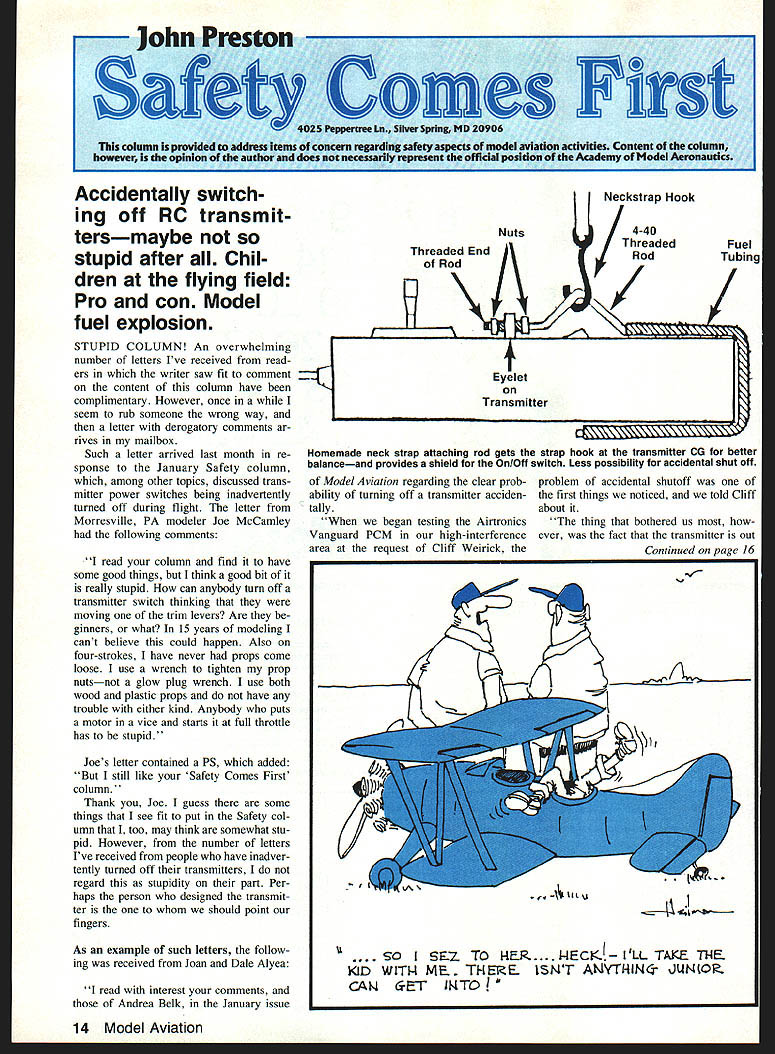
- Joan and Dale Alyea (and Andrea Belk) described a simple homemade fix: a neck-strap attaching rod (a 4-40 rod) positioned at the transmitter center of gravity to balance the set and to shield the On/Off switch, greatly reducing accidental shutoffs. They included an article from High Flight showing the device and a sketch. Joan credited Al Couture with the idea. The device is simple and easily adapted to most brands and trims; it helped prevent accidental shutoff and improved trim awareness.
(Caption from the original article: Homemade neck-strap attaching rod gets the strap hook at the transmitter CG for better balance—and provides a shield for the On/Off switch. Less possibility for accidental shut off. Use of the neck strap made for some extremely wild landings until a solution was found.)
- Jack McDermott (Riverview Machine Co., Hudson, NH) made a rectangular plastic switch guard (~3/4 x 1 1/4 in.) that provides a raised barrier around the switch. His package instructions read: "Help prevent accidental shutoff while trimming. Directions: Clean surfaces, apply thin coating of clear rubber silicone sealant, affix guard, let dry 24 hrs." Jack reported seeing switches shut off three times — twice while trimming and once when handing a transmitter back to an instructor (the neck-strap clip hit the switch). No injuries occurred. He suggested manufacturers should redesign switch placement and height. If interested in his guard, contact Riverview Machine Company, 10 Radcliffe Dr., Hudson, NH 03051.
- Tom Cater (Grand Rapids, MI) recommended that manufacturers consider locking toggle switches that mechanically lock in both "on" and "off" positions and require pulling out the handle to move. He included specs for Augat Alco Model MTL-106D, a single-pole, double-throw switch that locks in both positions. Tom retrofitted his transmitter years ago and said it works well. He suggested that any transmitter function not used while flying should use this type of switch.
Children at the flying field
I rarely receive mail from women about the Safety column; this month I received two letters from ladies (Joan Alyea and an anonymous writer from Arlington, TX). I liked the anonymous letter and reprint it here in full:
"Your Safety column in the January issue of Model Aviation really grabbed my attention, and I don't even fly RC airplanes. My husband does. The problem of children at the flying field is a very valid concern. When my daughter was a toddler, my husband had the mistaken notion that he, too, could supervise her while flying. However, after much discussion, it was agreed he would not.
"I have seen children climbing on tractors, or playing in parked cars with the doors left open (so the kids can climb in and go to sleep), or exploring storage rooms that contain rat bait, wormers, and repellents. They then wander behind horses.
"Just like the fellow who mentioned to the mother that he didn't come out to the flying field to babysit. I don't go out to ride to babysit, either. But in good conscience, I can't turn my back on a kid who is getting into trouble because mom is off riding somewhere.
"The basic misconception applicable to both situations is that the parent is primarily concerned with his/her interests (whether it be flying or riding). Unfortunately, the safety of the kids becomes secondary, as hazards at the site are minimized so the parent can do what he/she wants to do without guilt. The attitude, 'Well, there are others around who'll help keep an eye on Junior,' or, 'There isn't anything Junior can get into' takes over. This unspoken reliance on communal babysitting deprives all members of the chance to enjoy their hobby. Plus, everybody assumes somebody else is watching the kid (this is the sort of thinking that leads to many drownings).
"I often wonder how parents, who would never consider leaving a child at home alone, unattended for even a few minutes (because of the danger he could get into), can expose the unsupervised child to countless new hazards at the flying field or barn!
"I would not go so far as to say a club should ban children outright, but I think a club has the privilege to go so far as saying 'No toddlers unless accompanied by a nonflying person,' or to mandate (if you have acquired two warnings about your kids roaming around unsupervised) a fine or prohibition from bringing them for a couple of months. At a stable the policy is set by the owners, who may not mention anything about roaming kids for fear of 'stepping on toes' and having their paying boarders leave for elsewhere.
"I don't think anyone can honestly misunderstand your intentions. You are looking after the welfare of children whose parents have put aside common sense in order to temporarily pursue their own interests. Thank you for addressing this problem."
This disregard for children's safety while parents lose themselves in a hobby is not limited to RC. I ride horses and have the same complaint about caretakers who leave toddlers to roam unsupervised at the barn. I would go flying alone or go to watch at the field, but I would not allow a child to be left unmonitored where hazards exist.
Another thoughtful response came from Reverend Benny Vickrey, Sr. (High Point, NC), an RC and full-scale flier who began modeling in the mid-1950s and took up RC in 1974. He wrote:
"I'll be the first to admit that from 1974 to 1982 it bothered me also to see children at the flying site. I knew the danger they were in and also the 'dollar damage' they could do. But in 1982 my son was born to us after 13 years of marriage. The joy I have had in sharing with him full-scale flying, in which he has over 600 hours in the air, and the thrill for the last year and a half of teaching him to fly RC have been more satisfying than anything I've ever done in my life. Lee, Jr. is now seven and a licensed AMA member. He recently participated in his first contest—and I don't know who was more excited, dad or son.
"What I'm trying to say, I guess, is this: When I had no children, all children posed danger at the flying site, and I had very little sympathy for their curiosity or excitement to watch planes and be a part of their family. As my son has come along I have always taught safety first, and I must add that he is someone who is familiar with this hobby who will keep his or her child under constant control, and if they don't, I suspect they are either new to the hobby or they are slack as parents in other duties, too.
"Children are the hope we have in keeping this hobby alive. They are the designers, the plan makers and kit producers of our future. I say to parents, be responsible. It's not the child who is being a menace at the flying site, but the adult who brought the child and doesn't watch him. My son has more respect for model aircraft and radios than he does for a lot of the new high-tech toys. Never have I seen him try to pick up or bother anyone's planes at our site."
Since my full-time occupation involves safety of children's products, I echo Reverend Vickrey's observations. In many accident reports I see, I wonder where the parents were and why the child was left unattended.
Fuel explosion
Two Florida modelers, Clifford Hiatt and Paul Gauger, sent the same Orlando Sentinel clipping headlined: "Boy with Lighter Checks Toy's Fuel—Tank Explodes."
The accident occurred on December 16 and was reported on December 17. An 11-year-old boy, unsure whether his model airplane's fuel tank was full, "lit a disposable lighter to see into the engine." The resulting explosion caused second- and third-degree burns to his face, neck, chest, hands, and left leg. The boy was reportedly not supposed to handle the model without supervision.
A follow-up story (December 18) stated the boy had been playing in the garage and "lit a disposable lighter to melt a fuel tube for his model." The lighter ignited fumes from a nearby fuel can and caused the explosion.
The newspaper did not identify the model; Paul Gauger believed it was an RTF control-line plane. This incident is a stark example of how not to introduce a child to our hobby.
Have a safe month.
—John Preston
Transcribed from original scans by AI. Minor OCR errors may remain.

