

Safety Comes First
John Preston 4025 Peppertree Ln., Silver Spring, MD 20906
This column is provided to address items of concern regarding safety aspects of model aviation activities. Content of the column, however, is the opinion of the author and does not necessarily represent the official position of the Academy of Model Aeronautics.
- More on inadvertently shutting off RC transmitter switches.
- Over‑revving props can be dangerous.
- Unsafe: launching rockets from RC models.
- Loose transmitter antennas can cause crashes.
The other side of the coin
If I write something in this column that prompts letters all opposed to my position, I must be doing something wrong. The discussion on transmitter power switches being inadvertently turned off (April safety column) produced letters almost equally divided on whether to blame pilot error or transmitter design.
Following is a letter from Jefferson City, MO modeler William Stodgell that expresses the opposing viewpoint very well:
"This is the second time I've written to you. The first was in regard to an in‑flight stab failure, and I suppose you could classify this letter as a complaint. I do want to stress that I enjoy your column very much and think it should be continued by all means.
"However, I resent the space you devoted to publishing someone's criticism of the Airtronics Vanguard transmitter. I agree that anyone turning the transmitter off while trying to adjust the trim has committed a stupid mistake. I also feel that just because several fliers have done this, it does not point the finger of stupidity at the manufacturer; rather it points to the fact that we can all make stupid mistakes. The only perfect person to walk this earth was crucified. If anyone is afraid of making this mistake, the simple fix is to remove the plastic switch. This recesses the actual switch enough so that it is impossible to turn it off by accident.
"Probably many people have been killed because someone pressed the gas pedal when they thought they were pressing the brake pedal. But does anyone call the auto manufacturers stupid, or try to get them to move the gas feed up onto the steering column, like the old Model A Ford, or someplace else so this can't happen? Then why call the radio manufacturer stupid and try to get him to redesign the transmitter? In order to operate an RC airplane—or safely drive a car—you have to have a little common sense, and you have to pay a little attention to what you are doing.
"Also, so the eyelet for the neck strap is not on the CG of the transmitter. So what! I thought you were supposed to hold onto the transmitter, even with a neck strap. If someone thinks they have to wrap their entire fists around the sticks, like a two‑year‑old might, then they should purchase a transmitter tray. Besides, in all my 30‑plus years in RC, I have never used, or seen anyone else use, a neck strap."
"So, instead of nit‑picking, fault‑finding criticism, I think Airtronics deserves only the highest praise. With the Vanguard FM transmitter they have given us a radio that will enable us to fly safely in high‑interference areas where most others will not—even many of the new radios advertised as being ready for 1991."
Transmitter design, battery management, and my response
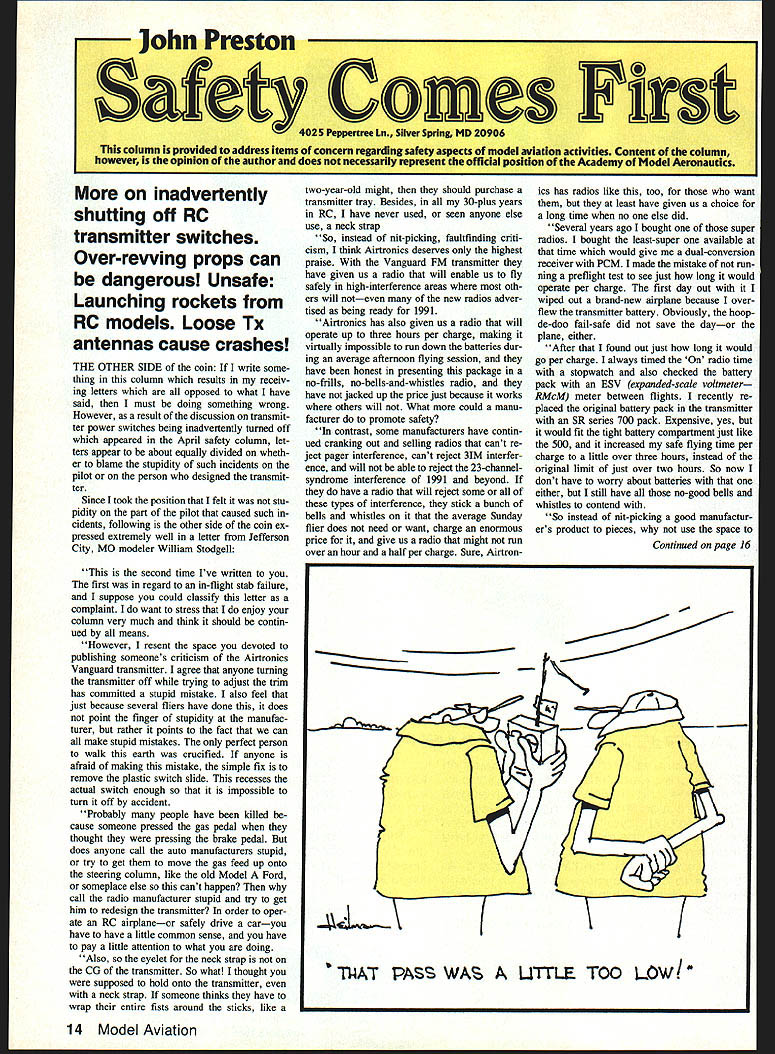
It was not my intention in the April column to single out the Airtronics Vanguard. Other brands have been involved in inadvertent switch‑turnoff incidents. The purpose of this column is to publicize what is happening in modeldom so we can learn from others’ experiences and perhaps avoid accidents.
That said, Mr. Stodgell makes valid points about pilot responsibility and simple fixes (for example, modifying or recessing a switch). He also praises Airtronics for producing a no‑frills radio that operates in high‑interference areas and offers long battery life without excessive cost or unnecessary features.
In contrast, some manufacturers continue to sell radios that:
- cannot reject pager interference,
- cannot reject 31‑MHz interference,
- may not be ready for the predicted 23‑channel interference problems.
If a radio rejects interference but is laden with expensive bells and whistles and has poor battery life, the average Sunday flier ends up with features he neither needs nor wants. Airtronics has at least provided a practical choice.
A personal note: several years ago I bought one of the "super" radios (dual‑conversion receiver with PCM). On the first day I overflew the transmitter battery and crashed a new airplane. After that I timed "on" radio time with a stopwatch and checked the battery pack with an expanded‑scale voltmeter between flights. Recently I replaced the original battery pack with an SR‑series 700 pack. Expensive, yes, but it fits the tight compartment and increased safe flying time per charge to a little over three hours (vs. just over two hours originally). That change removed battery‑life worry from routine flying.
Should I list inferior brands and models?
Some readers have suggested I name brands and models I consider inferior. I think that would be a mistake. I don't have the means to conduct controlled comparative tests like Consumers Union, and it would be hard to draw a fair line between inferior and superior. I can only hope the AMA's "RC Equipment Certified" list (published in the AMA News section) will help establish standards of acceptability.
More on propellers
Propeller failure was discussed in my January and March 1990 Safety columns. A letter from Tennessee modeler Jim Prillaman suggests some incidents may not be due to defective props but to poor judgment by the modeler. Jim wrote:
"In my opinion, formed by 10 years of modeling and four years of racing in the Quarter‑Scale Pylon Racing Association, where 1.20‑cu.‑in. four‑stroke engines are run to their limit, anyone who puts a 1 × 6 plastic prop on a YS‑120 is operating from a position of gross ignorance.
"Our standard racing engines are not nearly as powerful as the YS and use 14 × 10 wood props which turn at 9,000 rpm plus. The OS Surpass, still not as strong as the YS, is required to use a 15 × 10. Check page 39 in your March issue and you will see a YS in a Pattern ship with a 14 × 14! With a 14 × 6 plastic prop on that engine, it was probably running well in excess of 13,000–14,000 rpm and was an accident waiting to happen.
"So let's put some reason back into your column, and remind modelers that they must exercise common sense and care in this sport. I'd hate to see the all‑too‑common practice of using everyone in our society as scapegoats for negligence become established in modeling as it has in other areas of our society."
Back in 1986 I discussed a warning that accompanied Graupner glass‑fiber‑reinforced nylon props. A concerned modeler had purchased such a prop only to find the warning was printed in German and thus inadequate for U.S. customers. I had it translated and subsequently received copies of the same warning in English from other modelers.
Graupner's warning specified a maximum safe rpm for their props calculated as 135,000 divided by the prop diameter in inches. That formula yields a maximum rpm of about 9,600 for a 14‑in. prop (135,000 ÷ 14 ≈ 9,643). I'm not advocating that this formula applies to other brands, but it does suggest that a 14 × 6 prop reaching 13,000–14,000 rpm could be beyond safe limits. Do other manufacturers provide information on safe maximum rpm for their props? I still recommend durable printed warnings on prop packs and notices at retail displays to inform buyers of hazards.
Unsafe product? RC AeroMissile
Dan Snow of Maynard, MA brought to my attention an advertisement for an "RC AeroMissile" (from an April 1990 issue of another model magazine). The ad described a device that enables launching solid rocket missiles from an RC model—apparently while in flight. From a safety standpoint this is disturbing.
The Official AMA Safety Code has been changed so that models must be under control at all times, and launching any projectiles where spectators might be present would be a violation. The right course is to bring such products to the attention of the AMA and have them rule on the matter.
For the benefit of those who cannot find a copy of the Official AMA Safety Code, here is the relevant section on pyrotechnic devices:
"8. I will not operate models with pyrotechnics (any device that explodes, burns, or propels a projectile of any kind) including, but not limited to, rockets, explosive bombs dropped from models, smoke bombs, all explosive gases (such as hydrogen‑filled balloons), ground‑mounted devices launching a projectile. The only exceptions permitted are rockets flown in accordance with the Safety Code of the National Association of Rocketry or those permanently attached (as per JATO use); also those items authorized for Air Show Team use as defined by AST Advisory Committee (document available from AMA HQ)."
"NOTE: A model aircraft is defined as an aircraft with or without engine, not able to carry a human being."
If any readers have purchased such a device to fire rockets from their models, be aware you would be operating outside the Official AMA Safety Code and would not have AMA liability protection.
Loose transmitter antenna
Frankfort, OH modeler Steve Bohm described an incident that could happen to anyone and can be prevented by a quick equipment check:
"I had taken my plane out to the field for its flight. The preflight check was flawless; ground check good with antenna collapsed, engine running fine, batteries fully charged. Takeoff and the first few minutes of flight were without incident. Then the plane started behaving erratically, and soon I only had sporadic control of it. It flew off, and despite several thorough searches, was never to be seen again.
"I assumed the trouble was not caused by interference, as I was the only one at the field that morning and had never experienced any problems before. This would have been the end of the story but for one unlucky happenstance. For that particular transmitter I had a second tuned receiver in my Glider.
"The following week, I was out with the Glider and ready to fly. Once again the preflight was fine; fully charged batteries and good range with the antenna collapsed. I extended the antenna, hooked up the Glider, and stretched the hi‑start.
"As I was walking the Glider back to the launching area, I happened to glance at the field‑strength meter on the transmitter. It was reading wildly, with each step I took! Somehow, and at some time, the antenna had worked loose inside the transmitter case. As long as the antenna was collapsed for a ground check, everything was fine. But with the antenna extended, it would make and break contact. I instantly realized the cause of my first plane's loss. After tightening down the antenna, I have had no further problems, but I now check this prior to every flight. If you pass this along, maybe it will save someone else some grief."
I have personally experienced the same loose‑antenna problem. Fortunately I noticed it before flight. Check your antennas—or you too might lose a plane.
Have another safe month.
Transcribed from original scans by AI. Minor OCR errors may remain.

