
Safety Comes First
John Preston 4025 Peppertree Ln., Silver Spring, MD 20906
This column is provided to address items of concern regarding safety aspects of model aviation activities. The content of the column, however, is the opinion of the author and does not necessarily represent the official position of the Academy of Model Aeronautics.
Watch out! Any Ni-Cd battery pack can cause a serious fire if shorted out. CyA glue accelerators can be hazardous if misused. Rotating finger-slicers are still at it!
Electrifying experience
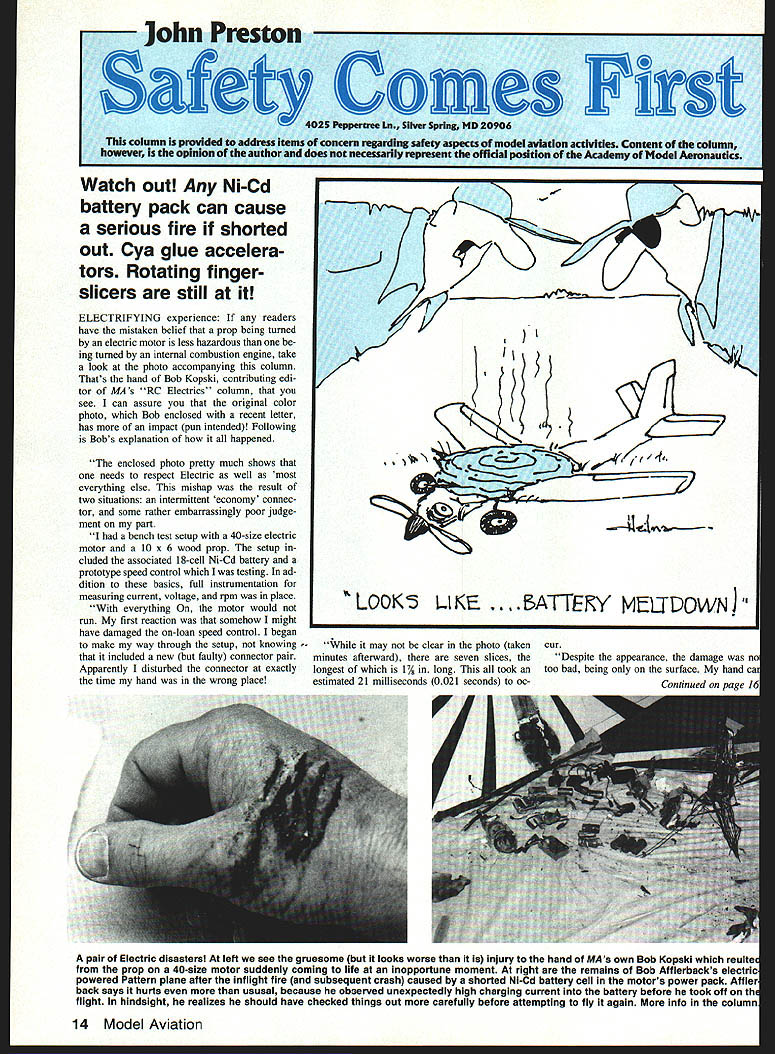
If any readers have the mistaken belief that a prop being turned by an electric motor is less hazardous than one being turned by an internal combustion engine, take a look at the photo accompanying this column. That's the hand of Bob Kopski, contributing editor of MA's "RC Electrics" column. The original color photo, which Bob enclosed with a recent letter, has even more impact. Following is Bob's explanation of how it all happened.
"The enclosed photo pretty much shows that one needs to respect Electrics as well as most everything else. This mishap was the result of two situations: an intermittent 'economy' connector, and some rather embarrassingly poor judgement on my part.
"I had a bench test setup with a 40-size electric motor and a 10 x 6 wood prop. The setup included the associated 18-cell Ni-Cd battery and a prototype speed control which I was testing. In addition to these basics, full instrumentation for measuring current, voltage, and rpm was in place.
"With everything On, the motor would not run. My first reaction was that somehow I might have damaged the on-loan speed control. I began to make my way through the setup, not knowing that it included a new (but faulty) connector pair. Apparently I disturbed the connector at exactly the time my hand was in the wrong place!
"While it may not be clear in the photo (taken minutes afterward), there are seven slices, the longest of which is 1½ inches long. This all took an estimated 21 milliseconds (0.021 seconds) to occur.
"Despite the appearance, the damage was not too bad, being only on the surface. My hand can still handle the aileron/elevator stick on my transmitter—and a mug—almost as well as before! But such might very well have not been the case.
"So, for what it's worth to you and your readers, if you choose to share this, I'm strongly advising everyone to be respectful of and careful with Electrics. Think a little better than I did, and be sure to use quality connectors!"
I had always thought that Electrics were less likely to cause prop accidents simply because they eliminate prop flipping and needle valve tweaking. On the other hand, the fact that Electrics are quiet and are regarded by some as having little power compared to internal combustion engines may lull us into a false sense of security. An accidental flip of a switch can result in maximum rpm in a split second, so their potential for causing a prop-related injury may equal that of a glow engine. If you are a "volts-and-amps" modeler, be very careful when the battery pack is charged and connected.
Battery pack fires
All RC models require batteries. Electrics require more—and generally bigger—batteries than models powered by glow engines. Ni-Cads are favored because they can be charged and discharged at high current rates without damage, but they have limitations. The following incidents illustrate the fire risk when packs overheat or short.
Robert Afflerback enclosed three color pictures that dramatically illustrated what happened to his model when the battery pack overheated in flight due to shorted cells.
"From time to time you have discussed small fires that have occurred in model airplanes. Enclosed are pictures of the remains of my .40-powered Electric Pattern plane. The one thing you will notice is that this fire was anything but small! I know the magazine doesn't like to use color pictures, but I felt that black and white wouldn't do this mess justice. (Sorry about that, but B&W is all we can give in — RDM)
The incident occurred on March 3. I had flown the airplane about four times and was considering calling it a day. As I was taxiing in, a prospective Electric flier asked to see the airplane fly. So I dragged out the charger, connected the airplane, and we stood and shot the breeze for about 20 minutes. This is where I made my first mistake.
When I returned to disconnect the battery charger, I noticed the unit's ammeter was indicating a charge rate of about four amps. With 28 cells in the airplane, I had never previously been able to charge higher than three amps. I checked the fuselage sides thinking that the 1/16" balsa would show any excessive heat, and I ran the motor to check the state of charge. When everything seemed OK, I pulled out and took off.
Shortly after takeoff, on a downwind pass, the motor just quit. Thinking I had blown a fuse, I cut the throttle (force of habit) and started a turn back to the runway. About halfway around my turn, to my surprise, I saw smoke coming from the bottom of the fuselage, then the radio went into fail-safe (we later learned that the fire had burned off the receiver antenna). From this point on it was just a matter of waiting for the airplane to crash. The model crashed behind a rise just off the end of the runway and out of sight of the field. As everybody started walking to the crash site, someone shouted, "We've got a fire at the field." Luckily, one of the other club members had a fire extinguisher. The pictures show what I have left.
"The postmortem indicated that the entire incident should be filed under stupidity. My biggest mistake was flying the airplane after the charger showed an unexpected increase in the charge rate. Being new to Electric flight, this increased rate didn't strike me as a big problem. Also, I didn't own a digital voltmeter. The charge rate and time of charge were arrived at mathematically.
"It wasn't until after the fire that I discovered that the ammeter on my charger read almost 3½ amps low. So when I thought I was charging at three amps for 25 minutes, I was really charging at almost four amps. This amounts to a seven-minute overcharge, or about 1.7 amp-hours going into 1.2-amp-hour cells. This excessive charge shorted out two cells, and when I started to pull the normal 25 amps through the shorted cells, they overheated.
"Did I learn anything from this? You bet I did. I now own a good digital voltmeter. All the meters on my chargers have been checked, and at the time anything looks funny I will take the airplane home and check it out. I hope my experience will save some other Electric fliers a lot of grief."
Electric fliers aren't the only ones who can experience a fire caused by an overheated battery pack. I received two other letters last month from non-Electric modelers who experienced fires due to battery packs shorting.
David Burgess described an incident involving a cordless drill battery pack he discarded in a 30-gallon plastic trash can in his workshop. He replaced the pack with fresh sub-C Ni-Cds and threw the old pack in the can, assuming it was dead. Later, while rummaging, he moved the can's contents and may have nudged an aluminum soft drink can into contact with the discarded battery terminals. A few hours later he returned to find his finished, heated, air-conditioned 560-sq.-ft. shop filled with thick gray smoke. The trash can had burned, leaving ashes and melted plastic. Luckily, the building and nearby fuel remained unignited, but he lost hundreds or possibly thousands of dollars in ruined kits, balsa, plans, tools, and equipment. PVC plastic burning had released hydrochloric acid into the air and caused rusting on tools.
His lesson: do not discard batteries in the trash can where metallic debris can short their terminals.
Sam Blaga reported a receiver battery pack fire that luckily caused no property damage. He cycled his son's Futaba transmitter and receiver batteries, then put them on charge for 17 hours. He rolled up the connector wiring, tied it with a paper-insulated metal tie, and put the receiver batteries, receiver, and charger back in a paper bag. Five days later the batteries started to smoke. By the time he discovered the burning, the leads were melted and the batteries hot. He suspected a short at a solder joint where the Rx connector had been spliced to new batteries.
These incidents remind us that a Ni-Cd battery pack is capable of generating enough heat to start a fire if it becomes shorted. It's not reasonable to suggest removing batteries from models every time you return from a flying session, but be careful with packs you think are dead and when you discard them.
CyA glue accelerators
In the May '90 Safety column I mentioned a letter from Albert Perdon who drew attention to the fact that some CyA accelerators contain chlorofluorocarbons (CFCs), which are linked to ozone depletion and the greenhouse effect. I also mentioned that a number of modelers have had respiratory problems from CyA accelerators and asked if anyone knew of a nonflammable accelerator.
Several readers suggested a simple, inexpensive alternative: baking soda. Baking soda mixed with water can be used as an accelerator and is unlikely to cause respiratory problems.
- Jim Wolff and another reader (Charlie from Staunton, VA) both use a mixture of baking soda and water as an accelerator. Neither specified proportions. Jim advised: "mix a small amount in water and put it in your empty accelerator bottle or any spray bottle with a fine sprayer." Charlie reminds us to shake the container vigorously before each use.
- Arizona modeler Doug Huntley enclosed a clipping suggesting the use of a nasal aspirator to blow dry baking soda onto a CyA glue joint. Nasal aspirators for babies can be obtained from a variety store for about $1.50.
- Harold Melson, who also uses baking soda, cautioned that fresh CyA and fresh baking soda can both burn on contact with one another, so don't get these on your body parts. He also stated that baking soda works best with thin CyA but does a respectable job on thick varieties.
If anyone suggests a different application method, I'll include it in the next column.
More fingers in the prop
A letter from Manuel Ornelas, treasurer of the East Bay Radio Controllers, should be noted by those who operate Enya four-stroke engines. Manuel wrote:
"Without a doubt Enya engines are some of the better ones developed for RC. However, the four-stroke ones do have a drawback. Due to the location of the glow plug, one of our members almost lost the tip of his index finger. After starting the engine, he went to pull the plug connector from the plug and accidentally put his index finger through the prop. He didn't realize what had happened until the blood started running down his hand. After close examination, he found about an inch of his index finger was about to fall off. He and his helper determined that if they didn't apply a tourniquet right away and head for the hospital, he might bleed to death. It was a nasty cut.
"Five stitches and two hours later they returned to the field to pick up their gear and plane. Everyone at the field moaned and groaned about the engine and the location of the plug. There ought to be a law against such a design."
For those unfamiliar with the Enya four-stroke in question, the glow plug is located on the forward side of the cylinder head and is angled toward the prop. I don't know that I'd subscribe to the suggestion that there should be a law against such a design; however, I would strongly recommend the use of a remote-type glow plug connector, which Manuel's letter suggested the manufacturer might want to consider including with each engine.
Transcribed from original scans by AI. Minor OCR errors may remain.

