
Safety Comes First
John Preston 4025 Peppertree Ln., Silver Spring, MD 20906
This column addresses items of concern regarding safety aspects of model aviation activities. The content is the opinion of the author and does not necessarily represent the official position of the Academy of Model Aeronautics.
- Is our hobby safe?
- Never mix Control Line flying and electric power cables!
- Comments concerning standardizing RC transmitter designs and using stooges to hold models. More.
QUESTION: How safe is our hobby?
A few issues back this column discussed the safety record of our hobby and compared it to other leisure activities. A recent letter from Joe Wagner included additional statistics on the comparative safety of model flying versus hunting which you may find interesting. Joe stated:
"Last week I received a professional inquiry about the safety of model airplane flying from a man completely unfamiliar with our hobby/sport. In order to give him a comparison with a spare-time activity that he does know something about, I did some fast research into hunting's safety record. I acquired some interesting data:
"The year 1989 was Pennsylvania's safest hunting season on record with only 120 serious accidents. These included eight gunshot deaths (two hunters killed by their own guns, and six people shot by others).
"New York's record from 1940 to 1987 shows a total of 5,911 serious hunting accidents, which include 586 fatalities. The year 1989 was New York's safest with 78 serious accidents and six deaths.
"In Georgia between 1979 and 1989, 214 serious injuries and deaths occurred to hunters just from falling out of deer-hunting 'tree stands'! Most of the survivors ended up as paraplegics!
"Now for the shocker. None of these three states requires hunters to carry liability insurance! All that's necessary to qualify for a hunting license is a minimum age (12 years in Pennsylvania) and the passing of a brief hunter safety course.
"I also told the guy who asked about the safety record of model flying the following: In the entire history of model aviation, fewer than six innocent bystanders worldwide have been killed by a model aircraft. This, of course, was a guesstimate on my part, but I've been active in this game more or less continuously since 1935. Also, I have subscribed to just about all the English-language model publications since then, and I still have them. As you know, deaths and serious injuries from model flying are rare enough to get mentioned in print rather promptly when they occur.
"I'm only aware of a single death to a nonparticipant due to a model flying accident. This was the one that occurred during a flying demonstration in a football stadium. Do you know of others?"
In response to Joe's question, my answer is, "No." I wasn't born in 1935, and I really didn't become active in modeling until about 1950.
It wasn't until I began writing this column in 1980 that I first learned that people have been fatally injured when struck by a model airplane. I guess the largest number of deaths to modelers while pursuing their hobby have been electrocutions which resulted when Control Line (U-Control) models were flown too close to power lines.
According to my file titled "Electrocutions," a 1980 newspaper clipping stated that there were 43 electrocution deaths of Control Line fliers during the period 1945–1980.
Another letter from Joe happened to include a discussion on this very subject.
"My local RC club, along with several others that I know of all around the U.S.A., is getting more and more involved with U-Control. We installed a Control Line circle adjacent to the RC flying area last summer. About half the members now have flyable ukie airplanes, with more on the way for the upcoming season.
"Only a couple of our members had any previous experience with U-Control. The others know how to fly RC, but as I recently learned from talking with them, they don't fully understand the great danger of flying near power lines.
"Our club field's location is safe enough, but some of the guys I know fly from random fields closer to home than our club's out-of-the-way RC flying area.
"The plans for uke models all carry a warning: 'NEVER FLY NEAR HIGH-TENSION WIRES.' That seems clear enough. But no club member I talked with could say for sure how near is 'near'—nor how to positively identify 'high-tension wires.'"
Thus I made up a rule of thumb that I think is adequate for just about any Control Line flier: IF YOU'RE CLOSE ENOUGH TO ANY ELEVATED WIRES SO YOU CAN SEE THEIR INSULATORS PLAINLY WITH THE NAKED EYE, YOU'RE TOO CLOSE. DON'T FLY.
Joe's rule of thumb is good advice. You don't have to have contact between the control lines and high-tension wires before there is a risk of electrocution.
Control Line electrocution hazard
You can be at risk without actual contact between lines and wires. Be mindful when flying U-Control models in locations where power lines might be nearby, and err on the side of caution when you can clearly see insulators or other wire hardware.
Hazardous activity
Over the years I've received a number of letters critical of photographs appearing in Model Aviation or other model magazines because—for one reason or another—a hazardous activity was depicted. Three recent letters, from Al Schmadtke, Chuck Watson, and Don Clark, all pointed to the same photograph which appeared in both the April and May issues of Model Aviation.
The photograph appeared in an advertisement for fuel and depicted a well-known helicopter pilot hovering his model inverted, with the rotor blades just inches from the ground. The model appeared to be only a few feet from the pilot and from two other parked helicopters. All the letter-writers believed this was an unsafe practice and didn't think the photograph should have appeared "in our own magazine."
"I have mixed feelings about the appropriateness of such pictorials in the magazine," wrote Al. "I have always considered your magazine to be the voice of reason on matters concerning model aviation safety. This particular picture shows a high degree of non-safety."
If in fact the model was just a few feet from its pilot, then I agree that this activity is potentially hazardous. However, it is possible the camera was equipped with a telephoto lens which could have foreshortened the distance. We will probably never know for sure.
Transmitter impounds
A couple of months ago I was called by Bob Penko, a modeler who was seeking my opinion on a situation. The situation was this: who is responsible if a person in charge of the transmitter impound at a contest fails to observe that one of the entrants is left on and an accident results? My apologies to Bob for taking so long to answer this issue—I'd made notes of our conversation on the back of an envelope and only today rediscovered them.
Not being a lawyer, I'm not going to guess who is legally responsible in such an incident. Is it the contestant, the impound official, the contest director, or someone else? Does anyone care to comment on this?
Stooges
No, I'm not talking about the three comedians, but rather about the device, common among Control Line fliers, that holds a model in place with its engine running and allows the pilot to pull a line to release the model for takeoff.
In the past I've advocated the use of a simple stooge to secure an RC model while starting and tuning the engine. However, most of the designs of such devices that I've seen only prevent forward motion of the model. This could be a shortcoming if the model's engine starts and runs backwards, which, as we will see, can and does happen.
A letter from Dave Hockaday enclosed several copies of newsletters he edits for the Wilson RC Modelers Association in Wilson, NC. One newsletter described the following accident, which occurred to a Raleigh/Durham RC club member and was originally reported in the RDRC club newsletter by George Abbott:
"Two Sundays ago (March 11), George Loy got his hand caught in the prop of the big banger on his Maule. The injury was quite serious, actually breaking the bone just behind the fingernail on his second finger. And all this through a heavy leather glove! Al Faraldi had to take him off to the hospital, and they didn't get back till nearly dark. Jim Cates and Richard Patterson loaded up George's gear into his car so it was ready for him when he got back to the field.
"There are several lessons here. One was the way the accident happened: the engine started backwards, pushing the airplane back. Then it began to run the right way, moving the model forward and biting George. Although Al was holding the plane, he was expecting it to pull forward, not push back! The plane got some slack, then charged ahead. The lesson? The plane must be really restrained both ways!
"Second lesson: Don't fly alone. It is very doubtful that George could have managed to pack his stuff and get to the hospital by himself. He might not have been able to get to the hospital even if he had left his planes and gear behind. And if he did, he probably would not have felt much like driving back to the field to get the stuff he left behind.
"Third lesson: Find out where to go in an emergency. I don't have all the details, but apparently they went to an urgent care place in Wake Forest only to be sent from there to Wake Memorial in Raleigh."
Standardizing RC transmitters
I continue to receive letters concerning the previously discussed subject of modelers who inadvertently turned off their transmitters when they mistook the power switch for one of the trim levers.
One such letter, from Milt Peacock, had some strong comments about the "ding-a-ling incompetents who seem proud of their inability to learn how to use their radios." Milt pointed out that the first task in becoming an accomplished typist is learning the keyboard; in short, he believes to be an accomplished RC pilot you first have to "learn" your transmitter. Others have written with different views. The pros and cons have been previously discussed.
Milt also suggested that, because many current radios have a lot of knobs and switches in addition to the primary flight controls, perhaps there should be a standardized layout for all these auxiliary functions. He asked: "Wouldn't it be something if an auto manufacturer decided to swap locations of controls on every car model?"
That reminded me of a car a friend owned when we were in college in England. I believe it was a 1932 Alvis Firefly and it had no synchromesh on the gears. This made shifting gears a real art. It also had a nonstandard layout for the foot pedals; as best I recall, the accelerator and brake were reversed (accelerator in the middle). I hated that car!
Another nonstandard layout I remember was the P-N-D-L-R automatic transmission shift pattern on the first car I owned (a 1953 Buick Special). I believe P-R-N-D-L didn't become standard until the mid to late Sixties.
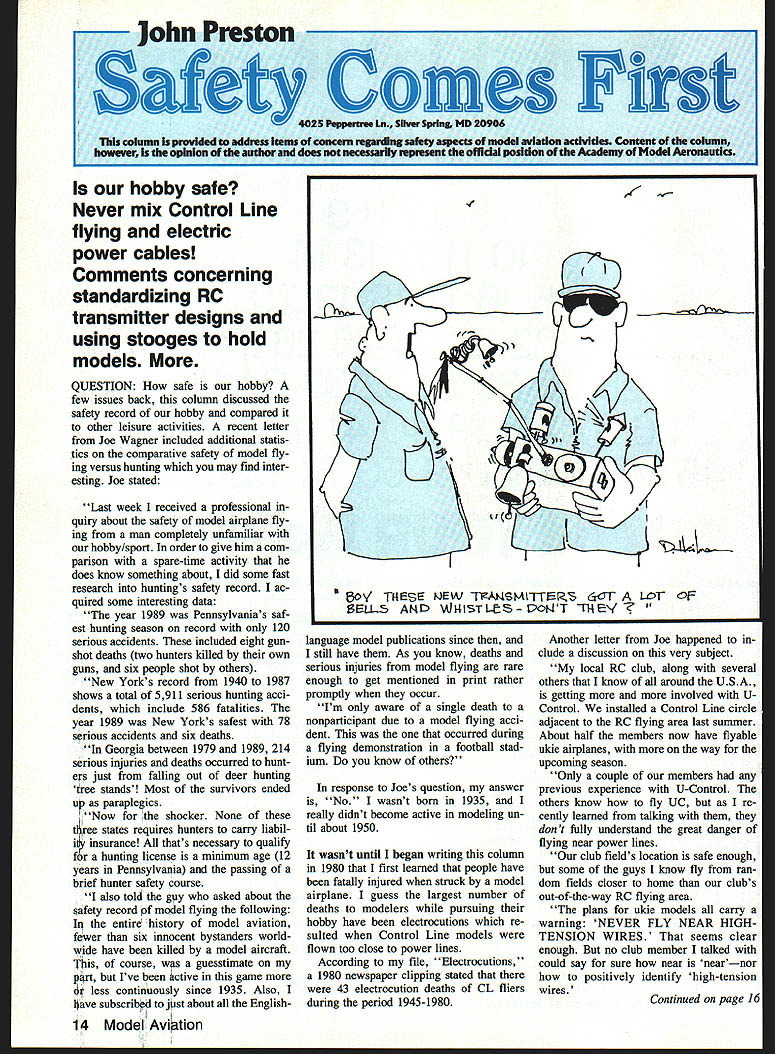
Anyway, back to the real issue: is it desirable and/or feasible to standardize the layout for the "whistles and bells" controls on an RC transmitter? Your comments are welcomed.
Model crash causes pyromania
One thing I enjoy as the writer of the column is opening my mail. I never know what it will bring. A recent letter from Dr. Ken Kronick included a clipping from the L.A. Times titled "Package Explodes, Injuring Man Involved in Dispute With Neighbor."
The newspaper clipping stated that the dispute began when an RC model crashed in Mr. A's backyard. Somehow the crash sparked a dispute with Mr. B, a neighbor, despite the fact that the model's pilot was another neighbor, not Mr. B.
To cut a long story short, the dispute became so heated that Mr. B left a package containing an explosive device on Mr. A's front porch. Fortunately, the injuries sustained by Mr. A when he attempted to open the package were treatable.
On that note I'm going to end and wish you another safe month. It's certainly a strange world we live in!
SAFE FLYING IS NO ACCIDENT
Transcribed from original scans by AI. Minor OCR errors may remain.

