

Safety Comes First
John Preston 4025 Peppertree Ln., Silver Spring, MD 20906
This column is provided to address items of concern regarding safety aspects of model aviation activities. Content of the column, however, is the opinion of the author and does not necessarily represent the official position of the Academy of Model Aeronautics.
Hazards in painting; accelerators for CYA glues; electrical hazards. Some bugs have legs! What about renegade RC fliers?
HAZARDS of painting: Jim Moynihan of Williamsville, NY is a pilot of both full-scale and model airplanes. Jim sent me a page from the May 1990 issue of the EAA Experimenter magazine which reported the death of a full-scale pilot due to breathing the fumes from the paint he was using. The paint was DuPont Imron, a multicomponent polyurethane paint containing polyisocyanates, which some modelers use to achieve "the perfect finish." The account of the death in EAA Experimenter is as follows:
"If you've been following Dick Cavin's 'Tin Bender' column the past few months, you're aware that he's been discussing painting metal aircraft, and that he recently included a caution about the dangers of working with paints, etc.
"Unfortunately, the aerobatic community has recently suffered a real-life reminder of how dangerous paint chemicals can be. Scott Finnigan, the chief aerobatics instructor for American Winds (an aerobatics school in Vero Beach, FL), died from complications of inhaling paint fumes. Finnigan was apparently working in a small paint booth, largely unventilated, and without protective breathing equipment, using Imron. This paint is quite lethal, and the fumes apparently attacked his lungs, causing incurable damage, resulting in his death.
"The lesson to be learned is to be sure to use protective equipment whenever it is required, and to follow manufacturer's guidelines very closely. Many of the new materials used are not like the butyrate dope or enamels previously used."
In a DuPont brochure concerning Imron polyurethane enamel, they call the finish "The wet look that lasts." Having seen models finished with such paint, I have to agree that it does produce a superior finish, and the cured coating is impervious to just about everything. However, I wouldn't use the stuff because of the hazard of breathing the fumes during application.
In case you think it would be OK to spray your model outdoors, beware: I know of a case where a modeler did just that, but he brought the still-wet model into the house and placed it in a bathroom to let the paint dry. The entire family suffered ill effects (although not fatal) when the furnace fan circulated the paint fumes throughout the house.
I don't know what cautionary statements are carried on cans of Imron paints, but in my opinion the written materials describing this paint appear to underemphasize the hazard of using it. Sure, they do suggest using an air-line-equipped respirator, but the safety precautions do not state that the consequences of not doing so can be fatal. The statement: "Vapor and spray mist are harmful, may cause lung irritation and allergic respiratory reaction" could apply to a number of products we use in our hobby which, to the best of my knowledge, have not caused fatalities.
The only hint that Imron may cause death is the use of the signal word "DANGER!" in front of the above warnings. There is an ANSI voluntary standard for product warning labels which recommends different signal words according to the severity of the injury that may result if you ignore the warning. "DANGER" is reserved for products which may cause death if you don't observe the manufacturer's warning statements.
The ANSI standard also requires that the label state the consequences of ignoring the warning. In my opinion the words "harmful, lung irritating, and allergic respiratory reaction" fall short of stating the real consequences.
Jim enclosed a note with the EAA Experimenter article in which he pointed out that there are other brands of multicomponent polyurethane paints besides Imron. Because Imron appears to command the biggest share of the market for such paints, it has become almost a generic term. Jim also had the following to say:
"One of the locals sprayed a Cessna 172 in an open hangar while wearing a mask and was too dizzy to fly for over a week. It wasn't an approved mask, but one that most guys normally buy. To be safe you should use an approved carbon cartridge mask or preferably an outside air source akin to a space helmet with an airhose."
"Safety Comes First" has an even better suggestion for modelers—DON'T USE THE STUFF!
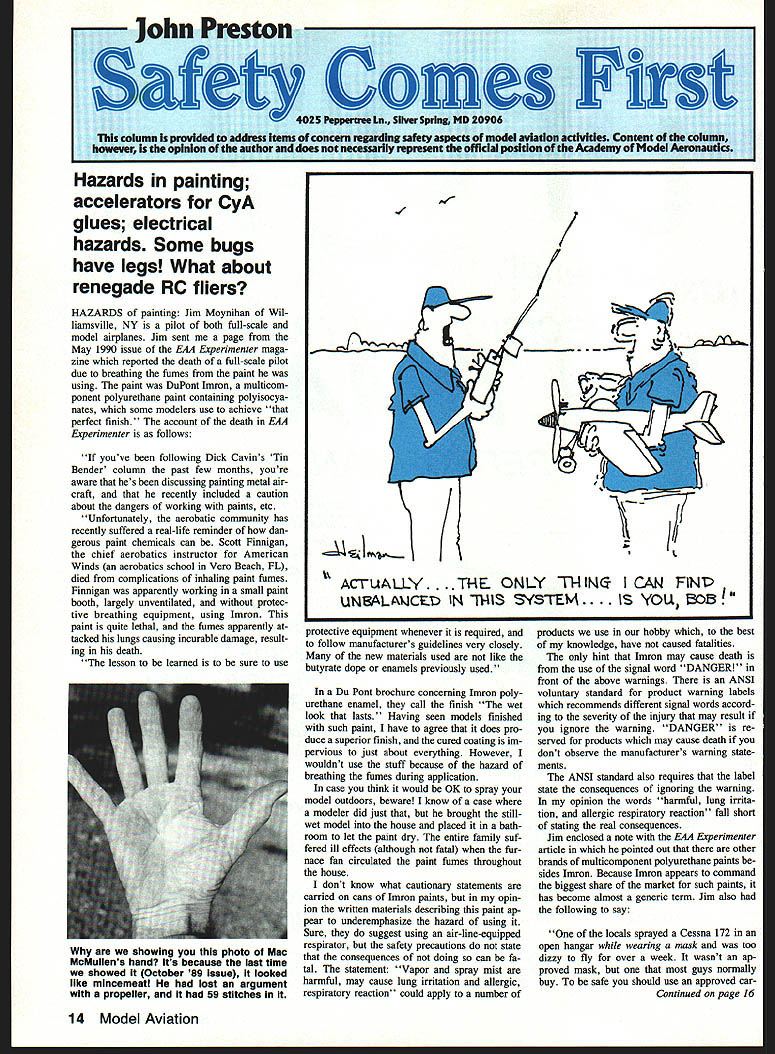
Hand-in-the-prop follow-up
Contrast the photograph of the hand in this month's Safety column with the one that was included in the October 1989 column. Believe it or not, it's the same hand, and it belongs to Robert ("Mac") McMullen.
The photo of Mac's hand which appeared in the October '89 column clearly showed that it had received about nine snips from a 10x6 glass-filled plastic propeller that was being turned by a .40 Fox on his Foxbat CL model. The hand required 59 stitches to close the lacerations. In his follow-up letter, Mac said that the doctor who sewed him up is in family practice and is not a specialist in reconstruction; however, he did have some nerve damage in his thumb, and cannot return to flying.
Despite the fact that most modelers who receive prop-hand injuries generally recover completely, I'm urging all of you to be extra careful with props when starting and tuning your engines. Fingers and hands contacting rotating props are the most common injury reports that I receive.
Accelerators for CYA glues
In the July '90 issue of Model Aviation this column had some discussion of materials which can be used as accelerators to hasten the cure of CYA glues—but which do not contain chlorofluorocarbons. Several people had written to me and suggested a solution of baking soda in water as a suitable accelerator. According to Bob Hunter of Satellite City, this is not a suitable accelerator. Baking soda alone is acceptable, but, according to Bob, spraying water onto a CYA glue joint will severely weaken the bond.
If you wish to use baking soda as an accelerator, buy an eye syringe from a drugstore and use it to blow the dry powder onto the glue joint. You may have to enlarge the opening in the syringe somewhat to make it function.
You should be aware that commercial products sold as accelerators for CYA glue are not all alike. Many now do not contain chlorofluorocarbons, substances which some believe represent a threat to the depletion of the ozone layer. A recent note from Frank Tiano enclosed an advertisement for Zip Kicker which states that it is now "Freon-free." Also there are differences in the threshold limit value (TLV) that causes irritation. If you have experienced allergic reactions to the products you are now using, try another brand, or try the dry baking soda approach.
Electrical hazards
There are some rather subtle aspects to the use of electricity in our modeling activities which bear mentioning:
- Power panel melt-down: Hoyt Stewart, a Raleigh, N.C., modeler, sent me a copy of an article he wrote for his club's newsletter concerning a shorted glow plug clip which caused an overheated resistor to melt the plastic case of the power panel. Perhaps a fuse somewhere in the power panel circuitry could have prevented this incident. An alternative would be to routinely unplug the glow plug clip, or install a switch in the circuit and remember to always turn it off after use.
This was pointed out in a recent letter from Larry Sribnick of SR Batteries, Inc. Larry's letter had the following good suggestion:
"Your July column regarding electric flight safety problems brought a very important point to mind that you should pass along as soon as possible. Whenever you're working inside any electric-powered aircraft or on any of the components of the propulsion system, YOU MUST REMOVE ALL RINGS AND JEWELRY.
"You can lose your finger in the twinkling of an eye if your ring shorts across two cells in the battery pack. If you short across the entire pack, you'll probably vaporize the ring! Our standing rule here at SR Batteries is that all rings and jewelry must be removed when anyone working here enters the work area."
Battery packs must be treated with respect. If you think about it, a simple six-cell Sub-C battery pack contains enough energy to shoot a three-pound airplane to an altitude of several thousand feet. You can imagine what that power can do to a finger!
Bugs
A reminder from Gary Snyder to be wary of fire ants when flying models appeared in the May Safety column and prompted Dale Willoughby to write from Guam, where fire ants have become a problem. Dale's letter, which follows, is the first I've received from that island:
"The model helicopter fans do not fly at the regular Guam Aeromodellers flying field, but use the Mangilao soccer and baseball field close to the USARF 27th Communication Squadron radio towers. The area is red dirt with a tropical grass covering.
"While test-hopping his Hirobo Shuttle in a tradewind-swept area, it was evident that the helicopter's pilot was getting the feeling of confidence in the hover phase of flight. Suddenly he started jumping up and down, unceremoniously landed the Shuttle, and with one hand began swatting at his tori-clad feet. Not making much progress, he put the transmitter down about 10 ft. distant (engine still idling and blades turning), trotted off to his field box, snatched it up, and returned to the spot on which he had been standing.
"He proceeded to spin the fuel pump handle and direct the issuing stream of fuel in a wide circle at the source of his agony. Ending up with a sore burning in the middle of the emerging ants, he then wrapped out a cigarette lighter and watched the resulting blue flame crisp the fire ants.
"In a classic Southern drawl, he grinned, 'Ah sure fae-year'd up them faa-yare ants!' Then he resumed his scratching."
Fire ants are not found in the Washington, DC area. However, we do have lots of ticks, and Lyme disease, which is carried by deer ticks (Ixodes dammini), is not uncommon. I wrote about this disease last year (July '89 column) and warned modelers to be alert to its symptoms. These may be rashes, fatigue, stiff neck, flu-like symptoms (headache, chills, fever, muscle aches), and arthritis-like symptoms. Unfortunately, the symptoms may take several weeks to develop, by which time successful treatment of the disease may be difficult.
One of the radio channels in this area features an M.D. who answers phone calls from listeners at the time I'm driving home from work in the evening. This doctor recommends taking doxycycline immediately after any tick bite on the chance that the tick has infected you with Lyme disease. Apparently these pills are very effective if the treatment begins before waiting for the symptoms to develop.
So my suggestion to you, should you find a tick embedded in your skin, is to visit your doctor and request treatment with an antibiotic such as doxycycline. Just for the record, these same pills were very effective in bringing about almost instant recovery from a bad case of Montezuma's Revenge which I contracted while visiting Bangkok last year.
Should you want to know more about Lyme disease, go to your local library and read the article which appeared on page 32 of the June 1988 issue of Consumer Reports.
Renegade fliers
I just came across a letter which I received several months ago from Albuquerque modeler Patrick Tiller. Patrick told of radio contact problems with an OT Cloud Cruiser, because it was believed that he was receiving interference from a flier operating from a nearby churchyard on the same channel. This individual had previously been contacted and told about the interference problem. However, he took the attitude that "This is a free country, and I'll fly wherever the h... I want to, so get out of my face!"
Patrick suggested that I might mention this in the Safety column. For what it's worth, I have, however, like trying to preach to sinners, first you have to try and get them to church. I would guess that most fliers are not AMA members and, as a result, probably don't read Model Aviation.
On the off chance that there are readers of this column who don't like to fly at established club flying fields, please check that the location you fly from isn't within radio range of a club field. (Refer to your copy of the 1990 edition of the Academy of Model Aeronautics Membership Manual, page 2, "RC Site Separation," for further information.) It could be your model that is the next one to receive interference.
Have another safe month.
Transcribed from original scans by AI. Minor OCR errors may remain.

