



Safety Comes First
John Preston 4025 Peppertree Ln., Silver Spring, MD 20906
This column is provided to address items of concern regarding safety aspects of model aviation activities. Content of the column, however, is the opinion of the author and does not necessarily represent the official position of the Academy of Model Aeronautics.
Some good new safety tips for electric fliers. Take a first aid kit to the field. Broken crankshafts. "Think before you act!"
ELECTRIC follow-up
The photo of Bob Kopskis's lacerated hand in the July 1990 Safety column resulted in two letters with safety tips for electric fliers.
Tehachapi, CA modeler Ron Samuels had the following to say:
"I was horrified to see Bob Kopskis's unpleasant hand injury due to the propeller of an electric-powered model. I have been experimenting with electric-powered models for some 15 years and learned quite early on after some workbench flyaways to always leave the propeller OFF until I was at the flying field. I found I could do almost all of the electrical bench testing without a prop. Electronic throttles don't really care if you have a prop in place or not.
"Neither do the motors or batteries.
"To recount a case in point. Yesterday, I was bench charging my Miss Philadelphia IV Old-Timer, which has an ancient .05 belt-drive motor, seven 800-mAh cells, and a servo-operated on/off microswitch. As usual, I had no prop on the drive shaft.
"With the charging jack still connected, I inadvertently tapped the fuselage, causing the motor to go to full power! I was able to pull the battery connector apart to shut the thing down (I don't have an arming switch—not good!). It turned out that the on/off microswitch had suffered an internal failure and had gone to the On condition. I shudder to think what could have happened on an untidy workbench (of which I am always guilty) if the usual 11 x 7 wooden prop had been on the shaft.
"None of us is perfect, and I want to recognize Bob Kopskis's immense contribution to the world of electric model aircraft, but I sure wish he hadn't hurt his hand that way.
DO NOT TROUBLESHOOT AN ELECTRIC SYSTEM WITH THE PROP ON!
"DON'T EVEN GO TO THE FLYING FIELD WITH THE PROP ON!
"Thank you for your column."
The second letter came from the author of the Electric column in Scale R/C Modeler magazine, Bill Young. Bill wrote:
"My last 10-plus years have been exclusively electric flight, mostly with large, high-power and high-performance electrics. Examples are a 1/4-scale Schneider Trophy racer at Lake Havasu with two Cobalt 60s and 70 cells, and a combat 60-powered Revenger with 32 cells on board. The Pattern airplane has placed third in competition with gas-powered airplanes. Now to the reason for writing.
"Electric motors are in fact more dangerous than gas engines in terms of getting one's anatomy into the propeller. The reason for this is that, unlike a gas engine which loses rpm and horsepower when a load is applied (finger in the prop), an electric motor will lose little rpm and increase its current draw in an attempt to maintain the same rpm. For example, a Cobalt 40 on 18 cells loaded to 30 amperes static delivers 648 watts or 0.86 horsepower to the propeller. That is very close to the same horsepower as a gas engine having a displacement of 0.40 cu. in.
"Now, if you load the electric motor to the point of stopping the propeller, the rpm drops to zero, but the current draw will go out of sight as the motor attempts to deliver whatever the cells will supply. With a normal kind of setup, using heavy wire and 1.2-amp-hour cells, that means 150 amps or more until something gives.
"That translates to 3,240 watts or 4.3 horsepower. Yes, 1.2-ah cells will deliver this kind of current for a surprisingly long period before a joint unsolders or something else fails. As you can see, with each hit an electric motor will hit harder.
"Consider, if you will, a contest where the helper is not well versed in the idiosyncrasies of electrics. Trying to be helpful, he picks up an electric-powered model to place it on the runway. Since the propeller is not running, he thinks it is safe. Not on your life! An electric can come to full power instantly at any time.
"A speed control or switch alone is not adequate protection. I have always advocated a jumper that is kept removed until immediately before flight and is removed immediately after flight. I use an automotive-type fuse for this purpose, as it is easily removed and the fuse guarantees safety.
"If I fly at a very busy field, Sepulveda Basin, I find that even taxiing back to the pits can be a problem for electric fliers. The other modelers assume that because the propeller is not turning it is safe to approach the model and help in transporting the dead airplane to the pits. I now try to keep the prop turning slowly at all times to avoid this potential danger.
"Just because the power level is too low to fly does not mean the system cannot bite—and bite very hard!"
Keep up the good work. Maybe a few more will pay attention, though I suspect that this will only occur after they have been hurt—but not too seriously, we can hope. As a psychotherapist I see this kind of result in a lot of different situations. Humans just do not seem to learn from reading or being told! Yes, that includes me. I learned the above by also making mistakes.
I hope Bill's latter observation is not entirely true. It would sadden me if I thought that the safety tips in 10 years' worth of "Safety Comes First" columns are never followed by anybody! However, from my experiences in my full-time job (which concerns product safety), I do know that people have little regard for written or spoken advice concerning safety matters. Unfortunately, some of them also do not learn even after having experienced an accident!
First aid
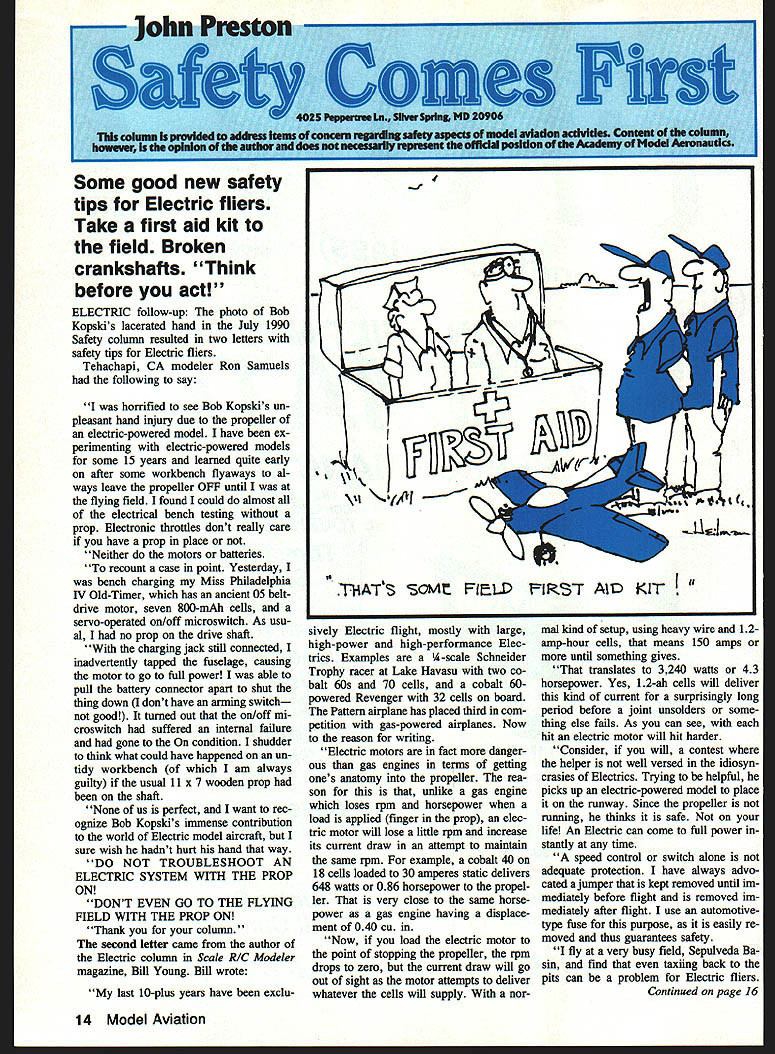
This brings me to the subject of a third letter concerning being prepared to treat an injury should one occur. A recent letter from David Wood stated that he has never seen any mention in this column of the need for having a first aid kit at the flying field. To the best of my recollection, I believe he is correct, and I will now remedy this omission.
David recently retired after 30 years as a pediatrician and now resides in Honolulu, Hawaii. Sounds like the good life to me! His letter was prompted by an accident involving a prop which, fortunately, did not have serious consequences.
As his letter stated, "It sharply focused my attention on an aspect not covered, to my knowledge, in your column as yet; i.e., preparedness for management of injuries—good old first aid. May I propose that along with its frequency pole, every flying field have a first aid box. Most groups include someone with experience in initial injury management, but he or she needs basic supplies."
While there are clubs which operate flying fields that don't need a frequency pole (such as CL and FF), I do encourage all to consider the purchase of a first aid kit containing the following items suggested by David:
- Small lunchbox clearly labeled "First Aid Box."
- Gauze pads — 3 x 3 in., #6, sterile.
- Nonstick pads — 2 x 3 in., #4, sterile.
- Gauze "Kling" bandage rolls, 2-in. and 3-in. width, one each.
- Antiseptic solution in small plastic bottle.
- Clear plastic tape in dispenser, 1-in. width by five yards.
- Bandaids — 1-in. cloth type, #10.
- Eye-rinse solution (e.g., Blinx) in plastic squirt bottle.
- Antiseptic ointment — one ounce (e.g., Bacitracin).
David also pointed out the need to protect the first aid box from excessive heat and freezing, which may present a logistical problem to many clubs. If the first aid box cannot be left at the field due to extremes of temperature, who will be responsible for its presence each day—or at least each weekend?
I'm not sure what the list of supplies would cost, but it may be worthwhile for each member to consider putting together such a first aid kit.
David's letter also offered the following additional pointers which he noted are not intended to be substitutes for a first aid manual obtainable from the Red Cross (or elsewhere):
A) For serious injury, immediately call for help on "911," then place the injured person on a flat surface and ensure that the airway is clear. Use CPR, if indicated.
B) For active bleeding, apply pressure DIRECTLY to the bleeding site and maintain until controlled. Avoid tourniquets, as they may be dangerous if too tight or if left on too long.
C) After bleeding is controlled, the wound can be cleaned and dressed. Use nonstick gauze and Bacitracin as appropriate. Have the injury evaluated in a hospital emergency room. Be sure to get a tetanus booster unless you've had one recently.
D) Eye contamination with fuel or other foreign matter requires immediate copious rinsing. All of us should wear protective sunglasses, preferably a safety type.
I carry a first aid kit in the trunk of my car (Johnson & Johnson kit from the drugstore), but it does not have all the items recommended by David, and, I'm ashamed to admit, it has weathered many a summer and winter without having been checked. If you have room, it would be better if you include a first aid kit in your field box.
In regard to sunglasses, since I wear prescription glasses, I also have prescription sunglasses. However, when I recently purchased new glasses with a more powerful distance correction, I found I had to have bifocals in order to read.
Unfortunately, I did not have the bifocal lenses put into the sunglasses, so cannot use them for reading at the field. To remedy this situation, for outdoor reading I use a pair of nonprescription wraparound-style sunglasses that fit over my prescription glasses. These came from Safety Plus, and I can recommend them whether or not you wear prescription glasses (see the ad elsewhere in this issue).
From D.R. Gibbs concerning the breakage of the crankshaft of his Sachs-Dolmar 4.2 was forwarded to my attention. D.R. reported that such a breakage also happened to another member of his club some two months previously and, because it could present a risk of injury, he wanted to know if this had been experienced by others. I am not aware of any other such incidents concerning this engine but would welcome a letter from any readers who may have such knowledge.
Think before you act
I doubt if there are any readers who would want to return to the days when servo-reversing switches on transmitters were unheard of. However, such transmitters did not allow the type of incident that was reported to me in a letter from Gary Perdew. Gary is the newsletter editor and field marshal of a club that shall remain anonymous, because the incident occurred to a fellow member who related it confidentially to Gary.
It seems that the modeler in question did not check his airplane's control functions prior to arriving at the flying field. After starting his engine, he found that the throttle control was operating in reverse. No problem, just flip the appropriate switch on the transmitter, and all will be well. But there was a problem. The would-be flier did not stop the engine before reversing the throttle servo function. Fortunately, a picnic table arrested the model after it roared off at full throttle, and no injuries resulted. But the potential for an injury was there!
Think before you act.
"Think before you act" could also be the title for a personal experience that Gary also related in his letter. Gary's Phaeton 40 bipe was being flown by a friend and sustained a failure of the elevator joiner. According to Gary, the resulting crash was definitely determined to be due to the structural failure rather than pilot error.
After retrieving the pieces of his model and returning the frequency pin to the control board, Gary wondered about the health of his trusty old Futaba radio. Without thinking, he flipped on the switches and checked all radio functions. Upon hearing a commotion on the flight line, he realized he no longer had possession of the frequency pin which was now in use by another club member. Fortunately this other flier's model was "at least five mistakes high" when Gary realized his mistake and shut off his radio.
He ended his letter by suggesting I warn others about the "seemingly strange vertigo" that afflicts modelers when they concentrate intently on something to the point where they forget to think before they act. It isn't just modelers that can be so afflicted. It's called belonging to the human race!
Till next month, hope yours is a safe one.
SAFE FLYING IS NO ACCIDENT
Transcribed from original scans by AI. Minor OCR errors may remain.

