
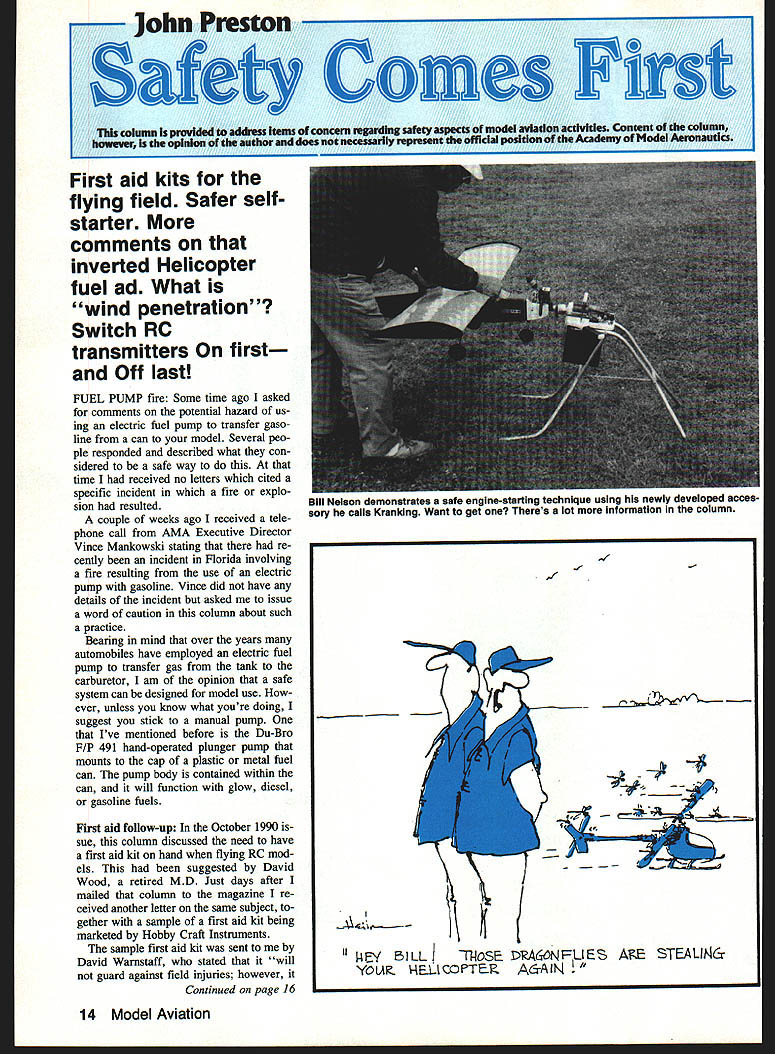





Safety Comes First
First aid kits for the flying field. Safer self-starter. More comments on that inverted Helicopter fuel ad. What is "wind penetration"? Switch RC transmitters On first—and Off last!
FUEL PUMP fire: Some time ago I asked for comments on the potential hazard of using an electric fuel pump to transfer gasoline from a can to your model. Several people responded and described what they considered to be a safe way to do this. At that time I had received no letters which cited a specific incident in which a fire or explosion had resulted.
A couple of weeks ago I received a telephone call from AMA Executive Director Vince Mankowski stating that there had recently been an incident in Florida involving a fire resulting from the use of an electric pump with gasoline. Vince did not have any details of the incident but asked me to issue a word of caution in this column about such a practice.
Bearing in mind that over the years many automobiles have employed an electric fuel pump to transfer gas from the tank to the carburetor, I am of the opinion that a safe system can be designed for model use. However, unless you know what you're doing, I suggest you stick to a manual pump. One that I've mentioned before is the Du-Bro F/P 491 hand-operated plunger pump that mounts on the cap of a plastic or metal fuel can. The pump body is contained within the can, and it will function with glow, diesel, or gasoline fuels.
First aid follow-up: In the October 1990 issue, this column discussed the need to have a first aid kit on hand when flying RC models. This had been suggested by David Wood, a retired MD. Just days after I mailed the column to the magazine, I received another letter on the same subject, together with a sample of a first aid kit being marketed by Hobby Craft Instruments.
The sample first aid kit was sent to me by David Warmstaff, who stated that it "will not guard against field injuries; however, it could help out if an accident occurs." David went on to say that "our flight line first aid kit was developed to fit easily into any field box and provide enough first aid supplies to handle most minor injuries. In addition to this handy item, my company offers larger first aid kits which will serve up to 50 people and would be a smart addition to any club field that does not already have one."
The price for the personal first aid kit is $5.30, and the large kit (for 50 people) is $42. Hobby Craft Instruments has other products (scalpels, sanding masks, medic cups for paint-mixing, etc.), and their catalogue is free if you send an SASE to Hobby Craft Instruments, 9279 Cody, Overland Park, KS 66214. I recommend that you drop them a line right away.
Safe starter: Devices intended to minimize the likelihood of feeding your fingers through the prop always get my attention. A phone call from Texas modeler Bill Nelson described such an example. A few weeks later, he sent in a sample to me. After I had expressed some interest to him and asked for more information, he returned home to find that UPS had deposited a large box on my porch. Inside the box were two versions of Bill’s Kranking. A phone conversation in the interim provided the details.
The Kranking is a self-contained starter unit mounted on a stand. It sits at the front end of the stand and is designed so that it energizes when it is pushed rearward. It is mounted on a battery box that is sized to accept a 12-volt motorcycle battery. However, you can just as easily install (as I did) a 12-volt gel cell. The Kranking stand is designed so that the starter/battery unit without the need for fasteners. It is also designed in such a manner that it does not need to be secured to the ground in order to function.
The beauty of the arrangement of the Kranking (and at least one other similar device that I described in the March 1990 column) is that you are behind the prop during the entire starting operation. The Kranking comes with large pads which are designed to hold and elevate the rotating prop to receive the glow plug ignitor or tweak the needle valve.
Bill has designed the Kranking so that, when folded, the stand can be secured to the starter/battery unit using a rear propeller tie, and it works like a charm. If you want more information, contact Bill Nelson, 283 Orleans St., Beaumont, TX 77701.
Fuel advertisement: Several letters criticizing an advertisement for Byron fuel containing an inverted Helicopter appeared in the July 1990 Safety column. The advertisement depicted an RC Helicopter being flown inverted about 3 feet above the ground—by Mike Mas. The letters writers contended that such a hazardous operation, but I commented that the Helicopter may have been photographed with a telephoto lens that can distort the perspective and make things look hazardous that really are not.
Another letter took issue with my comments, and it arrived almost simultaneously with a letter from the Helicopter’s pilot, Mike Mas. Following is Mike’s letter, which describes how the photo in the ad was planned and executed:
"I was compelled to submit my thoughts after reading the “Helicopter Fuel Ad” comments in the August issue of ‘Safety Comes First.’
“After devoting over 30 years to radio-controlled models, 24 of which were spent in research and development and production consulting services, every Helicopter manufactured in third year, I consider myself a professional pilot—and part of my responsibility has entailed a perfect safety record.
"Perhaps it might help relax those who think that R/C flying inverted is for ‘those who will go to heaven in an inch off the ground.’
"I flew a Helicopter inverted at such a time in the world in 1979.
"The camera which photographed was held by a professional Helicopter modeler when we tested the experiment two weeks telephoto lens and located some 30 ft. from where I had assumed the Helicopter was telephoto lens and assumed that the Helicopter was the shot with extremely lightweight main rotor blades having no tip weights. For safety reasons, the main rotor speed was reduced to a safe 900 rpm.
"Since Helicopters do not sit level when hovering, in order to get the hub of the Helicopter less than an inch off the ground the retreating blade had to be practically at ground level. The tops of the main rotors were outfitted with skid plates which actually touched the ground numerous times during rehearsal shots. In even of an engine failure or loss of control, the rotor would come to an almost immediate stop. Any projectile leaving the machine would be at shoe level.
"In reality, hovering a Helicopter upright at eye level can be considerably more dangerous to the pilot than many maneuvers. Note to mention adjusting the needle valve on a fixed-wing plane with your face and hands mere inches from the prop.
"In conclusion, what the ad reveals that Helicopter pilots, equipment, and radio systems have evolved to a point that has even surpassed full-scale technology. This hobby belongs to all of us. While some of us choose to write complaining letters, others choose to play a part in the contribution to what our hobby is today."
I thank Mike Mas for his rebuttal letter and now consider the “inverted Helicopter matter” to be closed.
Helicopters and bugs: Staying on the subject of whirlybirds, modeler A. Petrinelli (Newport, VT) asks if it is possible that sounds emitted by model Helicopters could be interpreted by the insect world as a declaration of war?
Twice in a very short space of time, while Mr. Petrinelli was testing his Helicopter’s engine, he was attacked by some type of flying insect that first stung him on the upper lip, then caused him to inadvertently try to stop the main rotor with his hand.
Has anyone else had a similar experience? Comments are welcome.
Switch-off sequence: Always turn off an RC system’s receiver before the transmitter is switched off. That was one of the first lessons I was taught before I flew my first RC model in 1968.
Two recent letters described incidents in which this sequence was not followed, and, as a result, two models developed minds of their own.
Bill Luskak, a modeler from Albuquerque, NM, wanted to see if his RC Old-Timer could spin. In his own words:
"I’m one of those types who likes to hear his own engine while in flight, but that was pretty difficult when there are a lot of two-strokers flying around. So, I got the biggest, loudest aircraft on the field out, filled it with fuel, then fired up and took off. The quiet didn’t last long, and the sounds commenced. So I decided this was the time to break all the things I announced (shouted, actually) that I was going to do a flat spin, and lined up with the runway.
I was on final approach when the shifty wind gusted, and I had to apply power. No joy. I landed short, into the rocks and tall weeds, which hid the plane. I couldn’t hear the engine, but I didn’t see any dust rising or parts flying, so I figured that I got away this time.
“I noticed that I was going to have to cross the runway to retrieve my plane. I checked to be sure that no one was landing, stepped onto the tarmac, and did the darndest vertical spin I have ever seen! I couldn’t tell the reason for my predicament until I stumbled across the plane, still snuggled into the weeds. I knew it was dead, but just in case, I did a thorough postflight inspection and discovered that yes, indeed, the throttle of my PCM Futaba system had been left at full song on the approach.
The message is clear: Always turn off your receiver first! And remember: “The flight ain’t over till it’s over!”
The second “switch-sequence incident” was described by Gene Martin in the Wiregrass RC Club newsletter (edited by Harvey Yoder). The incident occurred while Gene was competing in a club fun fly.
“My Big Stick 40 had landed in the grass beyond the runway and was safely back across the runway toward me. I went to sleep and naturally, reset my top hat channel on the 7SP, the Spo-Elev pot gives pitch compensation. Move it some, throw. Adjust the aileron differential pot for minimum movement in the elevator.
When replacing the tap servo in the throttle channel and use the trim tab for three to four degrees reflex to maximize penetration. (Two other references on penetration remain.) If the top hat channel is again linked on the 7SP, the Spo-Elev pot gives pitch compensation. Move it some, throw. Adjust the elevator differential pot for minimum movement in the throttle.
“Connect if you think I’m wrong; There is no such thing as good and bad wind penetration when it comes to either model.
Wind penetration: “The wind penetration of the F-86 had to give it some advantage.” That statement appeared in a newsletter report of the April 1990 Top Gun Scale contest. The statement concerned the first- and second-place aircraft, which were both Violett F-86F Sabres.
At a recent Scale contest in Virginia, I bumped into a good friend, Bob Crosby, whom I hadn’t seen in quite some time. Bob reads this column and suggested I get some controversy going again—like the downwind-turn myth?
Transcribed from original scans by AI. Minor OCR errors may remain.

