

Safety Comes First
John Preston 4025 Peppertree Ln., Silver Spring, MD 20906
This column addresses items of concern regarding safety aspects of model aviation activities. The content of the column is the opinion of the author and does not necessarily represent the official position of the Academy of Model Aeronautics.
Re-Tree-ving models; proper pit practice; and a parable from the editors of The Glitch
FATAL ACCIDENTS
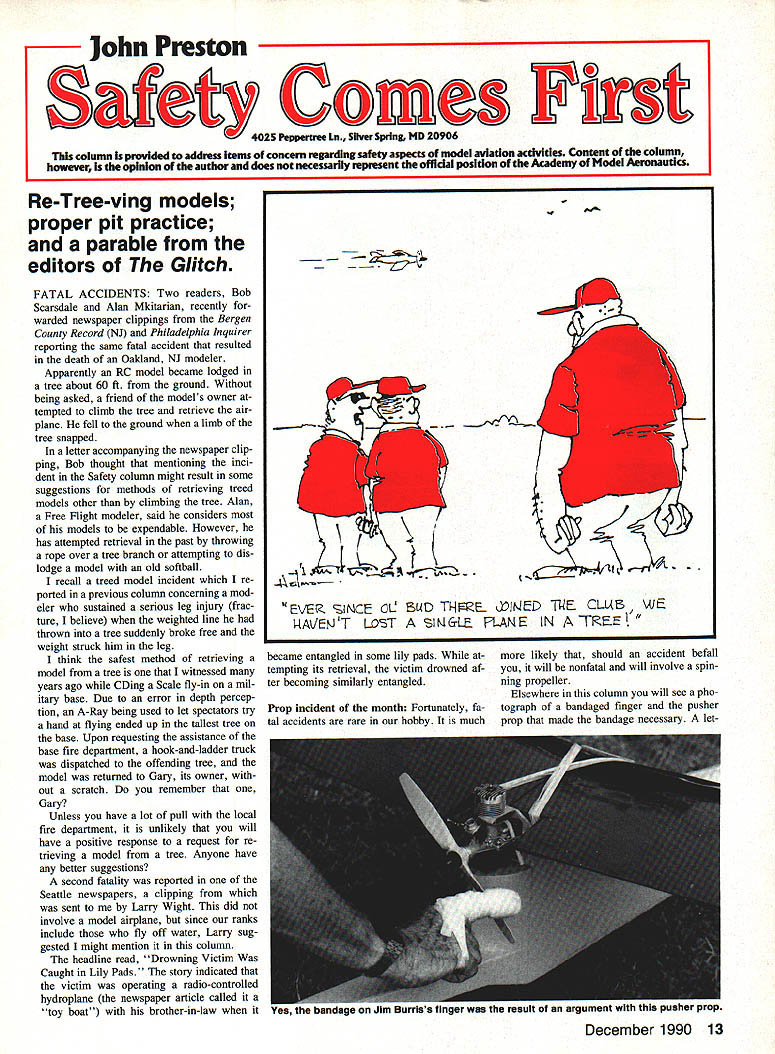
Two readers, Bob Scarsdale and Alan Mikitarian, recently forwarded newspaper clippings — from the Bergen County Record (NJ) and the Philadelphia Inquirer — reporting the same fatal accident that resulted in the death of an Oakland, NJ, modeler. Apparently an R/C model became lodged in a tree about 60 ft. above the ground. Without being asked, a friend of the model's owner attempted to climb the tree to retrieve the airplane, fell to the ground when a limb snapped, and was killed.
Bob suggested mentioning the incident in the Safety column might generate better methods for retrieving treed models other than climbing. Alan, a free-flight modeler, said he considers most of his models expendable; he has attempted retrieval in the past by throwing a rope over a tree branch or trying to dislodge a model with an old softball.
I recall another treed-model incident reported in a previous column in which a modeler sustained a serious leg fracture. A weighted line thrown into the tree suddenly broke free and the weight struck his leg. Those events underscore that attempts to retrieve models can create serious hazards.
Years ago, while CD'ing a scale fly-in on a military base, I witnessed what I think is the safest common method of retrieval: an A-Ray used by a spectator ended up in the tallest tree on the base. The base fire department responded with a hook-and-ladder truck and returned the model to its owner, Gary, without a scratch. Unless you have strong pull with your local fire department, you’re unlikely to get that level of assistance. Does anyone have other safe suggestions for retrieving treed models?
A second fatality was reported in a Seattle newspaper clipping sent by Larry Wight. This incident did not involve a model airplane but is relevant because some members fly off water. The headline read, "Drowning Victim Was Caught in Lily Pads." The story indicated the victim was operating a radio-controlled hydroplane (the article called it a "toy boat") with his brother-in-law when it became entangled in lily pads. While attempting retrieval, the victim became similarly entangled and drowned; the brother-in-law was also entangled.
PROP INCIDENTS
Fortunately, fatal accidents are rare in our hobby. More commonly, accidents are nonfatal and involve spinning propellers. Below are two accounts illustrating typical prop-related injuries and lessons learned.
H. A. Thomas of Little Rock, AR, wrote about his friend and flying buddy, Jim Burns. The airplane was an original pusher powered by an O.S. .35. Being a pusher with a left-hand prop, cranking it by hand was awkward because the tail was in the way. Jim's finger was painfully lacerated, requiring a quick trip to the hospital emergency room and several stitches. He learned that this type of installation is more safely started with an electric starter. The accident also reaffirmed his belief that it is bad practice to fly alone — it is very helpful to have a friend nearby in case of an accident.
I was reminded of a personal incident many years ago when I was attempting to start a Cox TD .051 mounted on a pylon on a Graupner Cirrus sailplane. Being left-handed, I start engines by flipping downward on the prop blade positioned at about 10 o'clock. The engine was reluctant to start, so I flipped it more forcefully than usual. My forefinger and the top of the fuselage (just 1/2 in. below the prop arc) came into contact, producing persistent pain. I later went to the hospital emergency room for an X-ray; fortunately no bones were broken and the pain subsided after several days. The cost of the emergency-room visit, however, was significant — an aspect of safety incidents we don't often discuss but should keep in mind.
The takeaway: certain engine installations require extra caution during starting operations, and electric starters or other safe-start practices should be used where appropriate.
PIT INCIDENT
The Flight Line, newsletter of the Wilson R/C Modelers Association, recently published an editor's account under the headline "SAFETY," reminding readers about the hazards of starting engines in the pits.
Editor Dave Hockaday described setting his flight box out in front of the shelter and, as he had many times before, firing up the engine in his Hots while it was disconnected from the glow driver and idling. As he reached for his transmitter, his thumb bumped the throttle lever, sending the .45 engine to full power. The plane lunged forward and made a 1-in.-deep, 3-in.-wide slot through the 1/4-in.-thick plywood and sheet metal of his starter module/power panel. He grabbed the plane and shut the engine down; the glass-reinforced nylon prop was only nicked, but the potential for a knee or foot injury — or for the plane to go under the shelter — was clear.
His conclusion: starting engines in the pits is unsafe and should not be done. Start engines only at the barriers or on the field.
IN CLOSING
Since this column began on a somber note, I'll close with a lighthearted item unrelated to safety. It comes via The Glitch (Utah Valley AeroModelers), originally taken from the newsletter of the Mile High R/C Club (Aurora, CO):
"In the beginning, God created the heavens and the earth, and rested. And God created man, and rested. Then the Lord God made woman; and since that time, no one has rested."
Transcribed from original scans by AI. Minor OCR errors may remain.

