
Safety Comes First
John Preston 4025 Peppertree Ln., Silver Spring, MD 20906
This column is provided to address items of concern regarding safety aspects of model aviation activities. Content of the column, however, is the opinion of the author and does not necessarily represent the official position of the Academy of Model Aeronautics.
- Don't take shortcuts.
- Charge your battery safely!
- Another way to safe-start your engines.
- Checking Ni-Cds with an ESV before flying.
"BLIMP DOWNED by Model Airplane"
"BLIMP DOWNED by Model Airplane." That was the headline for an article in the October 3 edition of the Washington Post. It described a collision between an RC model airplane and Columbia, one of the Goodyear blimps, as the latter was approaching its landing field in Carson, CA. I have no doubt that many of you saw similar accounts of this incident in your newspapers, since it was carried by the UP wire service. I thank the numerous readers who forwarded newspaper clippings concerning this incident to me.
As I write this column, the only information I have on the accident is the sometimes-contradictory accounts in these newspaper clippings. The Post reported that the pilot of the RC model didn't mean to disable the blimp; the Los Angeles Times alleges two men flying a remote-controlled model airplane intentionally buzzed the airship. Other newspapers reported that the pilot of the model had been charged with intent to do bodily harm and that he was being held in custody in the Carson sheriff's substation.
I'm not going to comment further on this unfortunate incident other than to repeat what I've said in a number of previous Safety columns: Never fly in the proximity of full-scale air traffic.
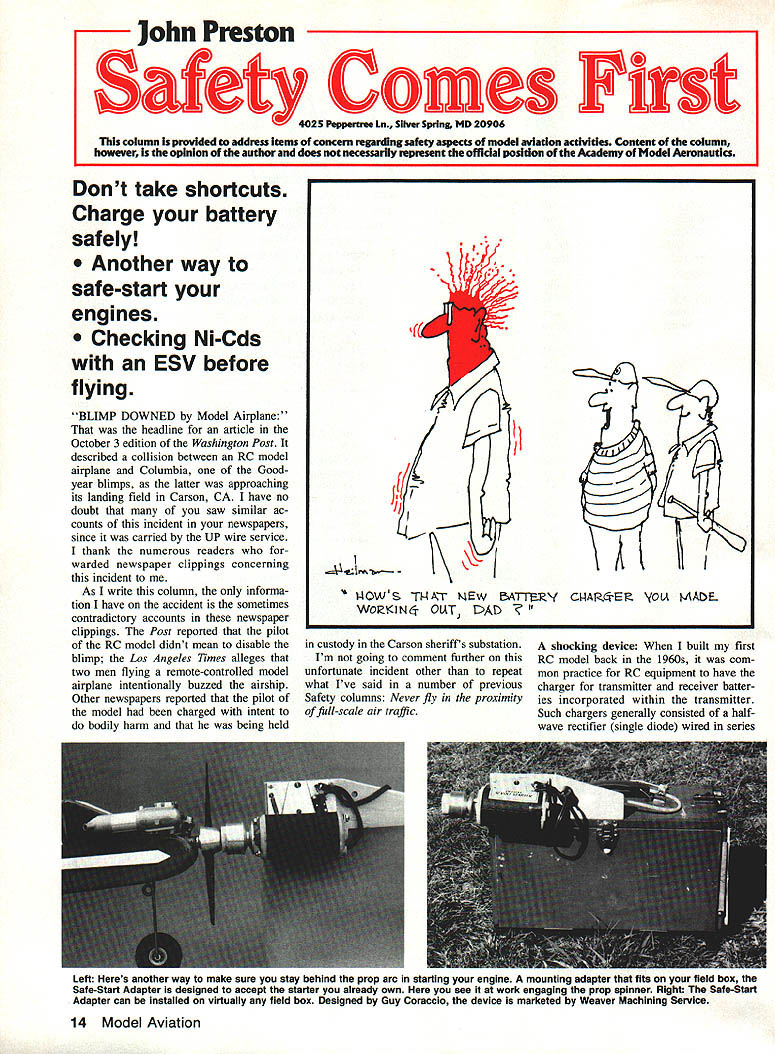
A shocking device
When I built my first RC model back in the 1960s, it was common practice for RC equipment to have the charger for transmitter and receiver batteries incorporated within the transmitter. Such chargers generally consisted of a half-wave rectifier (single diode) wired in series with a dropping resistor of appropriate value to achieve the desired battery charging current. Simple, cheap—and it worked. So what's wrong with such chargers? Simply because a lead battery pack can be at a potential of 120 volts above ground, it could deliver lethal current to an unwary modeler should he or she contact the lead while standing on a damp basement floor or otherwise touching a grounded object such as a water pipe.
An Underwriters Laboratories (UL) standard for hobby/sports equipment, UL 961, includes safety requirements for equipment intended for home entertainment and amusement. If the standard would apply to battery chargers for hobby use, manufacturers should choose to seek UL listing. The UL standard doesn't permit a circuit derived directly from line voltage with a resistance in series as the means of limiting voltage/current; in other words, it requires a step-down transformer used to derive low voltage isolated from line voltage.
Eloy Marez and Ian McQueen both recently wrote about an article describing how to make an inexpensive dual-rate Ni-Cd charger. The author of the article in the September issue of another model magazine stated he had eliminated the usual power transformer and thus saved money. He did, however, go on to state, "Because the charger is direct-coupled to AC line," and he added a 15-amp fuse as a safety measure. Apparently the writer was aware that a typical adult male will be unable to let go of an electrically live conductor when current passing through the body reaches about 15 milliamps. Both Eloy and Ian enclosed copies of letters to the editor of that magazine pointing out the potential shock hazard associated with use of such a charger.
Just how much is one saving by eliminating the usual power transformer? According to current Radio Shack catalogs, transformers are priced at about $3.49 to $10—too much to ensure against receiving a ticket to oblivion next time you attempt to charge batteries.
Another safe starter
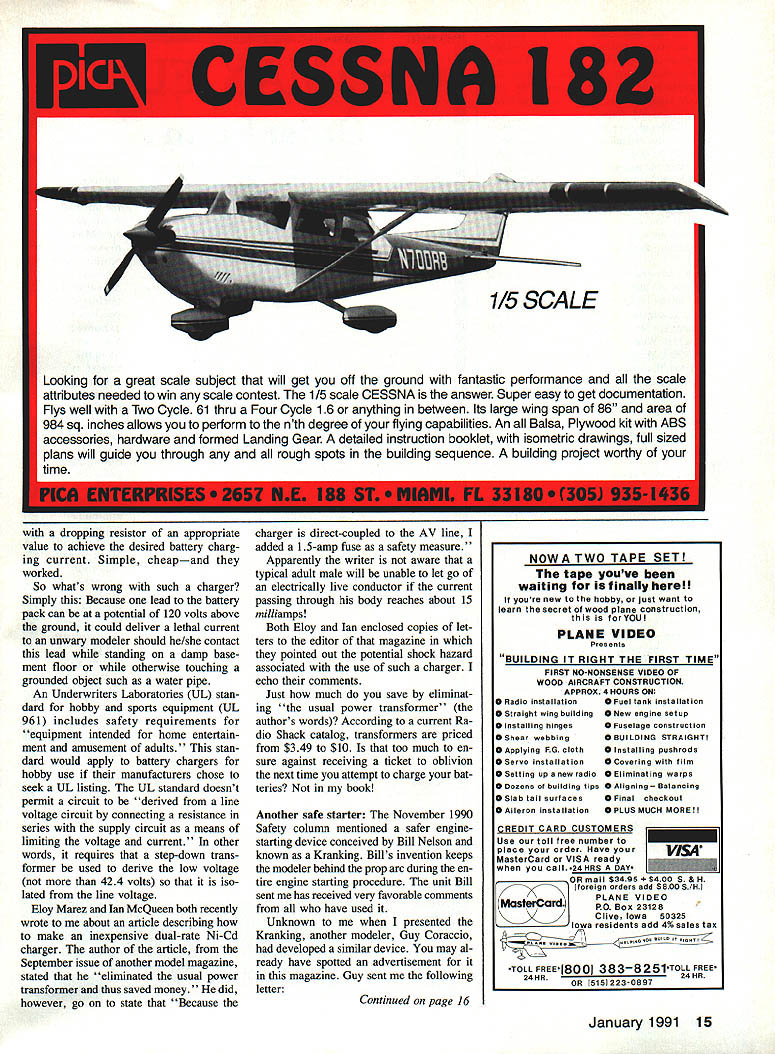
In the November 1990 Safety column I mentioned a safer engine-starting device conceived by Bill Nelson, known as "Kranking Bill." His invention keeps the modeler behind the prop arc during the entire engine starting procedure. Bill sent the unit and it has received very favorable comments from those who have used it. Unknown to me, another modeler, Guy Coraccio, developed a similar device that may already be on the market.
Guy sent the following letter:
"In your November column you featured a safe-starting technique product for model airplane engines. By coincidence I have a paid advertisement scheduled for your December issue for a similar unit. My safe-start adapter, however, is totally different in context and usage.
"Enclosed are photographs and a copy of a new product release, which is also being sent to the editor. My product is a mounting adapter that accepts the starter a modeler already owns. It mounts on most field boxes and is activated by engaging the prop spinner and applying a slight downward pressure. The enclosed seven-minute video will, I believe, display the safest starting procedure available."
A photograph of Guy's device is included in this column. The unit can be purchased for an introductory price of $34.95. Anyone interested should send a check or money order, payable to Safe-Start Adapter, to Weaver Machining Service, 6 Dewey St., Maynard, MA 01754.
From the videotape Guy sent me, it looks as if the Safe-Start Adapter could be installed on virtually any field box and is simple to operate, even by a beginner. Any device that keeps the modeler behind the prop arc during the engine starting procedure is, in my opinion, a step in the right (safer) direction.
Are current engine designs unsafe?
While the devices described above may reduce the likelihood of feeding your fingers through the prop while starting your engine, you are still at risk of having a finger lacerated when you make the necessary carburetor adjustments on many engines. Richard Piccolo raised this issue in a recent letter, excerpts from which follow:
"We all appreciate the vast improvements the manufacturers of model engines have made in design, materials, power output, etc. But what about safety?
"Engines made years ago had the needle valve a fraction of an inch away from the prop. Today, after more than 50 years, the needle valve is still fractions of an inch behind the prop on some engines—and so are the low-speed, high-speed and air bleed screws.
"I recently witnessed a novice RC modeler get cut by a prop while peaking out his engine. I see modelers using screwdrivers to make final adjustments, or tweaking out the needle valve just before taking off. With today's high-power, high-rpm engines, these practices are more dangerous than ever.
"I know that the engine manufacturers tell you to stop the engine before making adjustments, but how many RC fliers do this? The engine manufacturers' answer to this safety problem will probably be, 'It will cost more.' So it will cost more (Will it really?) Can anyone put a price on the loss of a finger or a hand? What can be done to convince engine manufacturers that safety comes first?
"Thanks for taking the time to read this. Maybe your voice can help in this matter."
After I discussed this issue in a previous column, one engine manufacturer pointed out that it offers a long, flexible needle valve, available as an accessory, that puts your finger and thumb in a safer location when adjusting the carburetor mixture. I've been unable to locate the material that was sent to me at the time, but I believe it indicated that there had been very little demand for the device. How about it, guys? Do you feel that engine manufacturers are letting safety take a backseat?
Safety barriers
A letter from Salem, OR modeler Jay Hopkins asked for my advice on the height of barriers used to separate the pit area from the runway. His club uses the four-feet-high, perforated orange plastic barriers commonly employed as fences around construction sites. Such a barrier makes it tough for spectators to observe takeoffs, landings and other field activities. Jay asked me if it would be reasonable to reduce the barrier height to three or even two and a half feet yet still protect spectators and other fliers in the pits.
I don't have a cut-and-dried answer to this question. It hinges on why the barriers were erected in the first place. Are they there only to prevent groundborne models from running out of control into the pit area, or are they also intended as people protectors behind which one could crouch to avoid an airborne model?
I know that some clubs use tennis nets, also about four feet high, as barriers. (Tennis players can correct me if I'm wrong about the height.) Do these also interfere with visibility of field activities? I'd appreciate comments on this subject from anyone who's had experience with runway barriers.
The weakest link: battery packs
A chain is only as strong as the weakest link. In the case of RC equipment, that's probably the battery packs.
In the September 1990 issue of the Utah Valley Aeromodellers' newsletter The Glitch, edited by Mitt Sanders, club president Lynn Hadfield offered an informative article about Ni-Cd battery packs. Lynn's article was prompted by a dead cell in his receiver pack, discovered after a day of "low inverted whatevers and other craziness" at the flying field. Excerpts from his article follow:
"I felt satisfied by a great morning of flying. After cleaning up, I took the plane home and, as is often the case, I plugged the receiver pack into my Digi-Pace to see how much runtime I had left on the pack. It immediately switched into the charge mode. Since I had charged the pack overnight, I could not understand why the Digi-Pace was immediately switching to charge. I plugged my expanded-scale voltmeter into the charge jack and the meter didn't even move from the bottom of the red scale.
"After some further investigation I measured the flight pack voltage—3.64 volts!
"What's going on?" I asked myself, realizing that a dead pack is approximately four volts. After a minute of contemplation, I concluded that one of the cells in the pack must be shorted. A quick test with my voltmeter confirmed my suspicions.
"Our flight packs are assembled using Ni-Cd batteries. Ni-Cd is an acronym for nickel cadmium, the elements from which the battery is constructed. Ni-Cd batteries have some unusual characteristics when compared with carbon-zinc or alkaline batteries. The major difference is that carbon-zinc and alkaline batteries are primary cells and Ni-Cds are secondary cells. Primary cells are disposed of when they become discharged, whereas secondary cells can be recharged numerous times.
"Another difference between primary and secondary cells is that the former tend to discharge in a linear fashion—i.e., the voltage is proportional to the energy left in the battery. Ni-Cds, on the other hand, have a relatively constant discharge voltage for 90% of their life. This is both good and bad: good because they supply a constant voltage to the load (transmitter or receiver), bad because it is very difficult to determine how much energy is left in the battery. For example, one will measure approximately the same voltage after 1/2 of the energy has been expended (1.35 volts for AA cells) as when fully charged (1.4 volts) until near the end of the cell's useful capacity when the voltage drops precipitously."
This characteristic makes visual inspection of cell voltage a poor indicator of remaining capacity. The Digi-Pace and other charging/monitoring devices that indicate charge needed can be misled by this discharge behavior.
User charging practices are also a weak link. Many modelers don't fully understand the importance of correct charging rates and methods. Overcharging can heat cells and reduce their life; undercharging leaves them with reduced capacity and can cause cell reversal in multi-cell packs.
This is why an expanded-scale voltmeter (ESV) is used to determine the state of a Ni-Cd battery. The expanded scale helps to measure the slight differences in voltage. A standard receiver flight pack will have a charged-to-discharged voltage difference of approximately 0.8 volts.
Another unusual characteristic of Ni-Cd batteries is the tendency to develop shorts. This is usually the result of leaving the batteries in a discharged condition for a lengthy period of time, but it can happen at other times for no apparent reason. These shorts are usually caused by little conductive whiskers, called dendrites, growing from plate to plate. The only way of detecting this condition is to charge the pack and measure the voltage: a good reason for using an ESV before you fly. The safest way to use an ESV to check battery condition is after a 4-hour charge cycle. I would highly recommend that you always measure your transmitter and receiver battery pack voltages with an ESV as part of your preflight checklist.
I guess I'd equate flying an RC model without knowing the state of charge of the battery packs with driving a car that didn't have a gas gauge: You never know when you are going to run out of fuel! Since most of you will be reading this column before Christmas, perhaps a note to Santa requesting an ESV would result in a worthwhile gift.
A Merry Christmas to all our readers. I hope that you all have a happy and safe 1991.
Transcribed from original scans by AI. Minor OCR errors may remain.

