
John Preston
Safety Comes First
4025 Peppertree Ln., Silver Spring, MD 20906
This column is provided to address items of concern regarding safety aspects of model aviation activities. Content of the column, however, is the opinion of the author and does not necessarily represent the official position of the Academy of Model Aeronautics.
- Watch those compressed air/CO2 motors.
- Ever have a control stick come out in your hand?
- More on retrieving model airplanes.
Compressed air/CO2 motors
An interesting letter from John Worth arrived last month. In it he described a personal accident (fortunately without injury) that occurred when he was experimenting with compressed air/CO2 motors. In John's own words, here's what happened:
"I have been experimenting with CO2 (carbon dioxide) motors for a couple of years; also for the past couple of months with compressed air motors. Along the way I have combined the technologies with some interesting results.
Typical compressed air motors use initial pressures of 100 to 150 psi (pounds per square inch). Typical CO2 motors use perhaps 800 to 1,000 psi. Compressed air motors are now commonly using plastic soda (soft drink) bottles of anywhere from one to three liters volume. They can apparently handle up to 175 or 200 psi pressure before bursting.
CO2 'bottles' (actually better referred to as tanks) are made of metal and should be able to withstand pressures of 3,000 to 4,000 psi before bursting.
What I have been doing is using both an air bottle and a CO2 tank in a model to run the motor. Here's how: Pressurize the air bottle to about 120 psi with air; pressurize the tank to about 800 psi with CO2. Between the two I have what is in effect a needle valve which normally prevents the CO2 from going into the air bottle—until ready for flight.
With both systems charged to normal pressures, I start the motor—one flick of the prop does it—using the air system. The motor then runs at an rpm (typically 3,000 to 4,000 rpm) proportional to the pressure. I then use the needle valve to bleed CO2 into the air system so as to replenish the air and hold the rpm essentially constant. The small volume (at high pressure) of CO2 expands tremendously as it bleeds into the air bottle and typically triples the length of the motor run (at suitable rpm) over that which is possible with air alone.
So far, so good. The motor acts as a pressure regulator of sorts, varying its rpm according to the pressure going into it. I have been getting excellent bench runs for several months.
At the Free Flight Nats in October, I was ready to do some demonstrating and flying for other modelers to see. A bunch of us gathered together as I prepared to show what I have been doing.
All seemed to be in order. I filled the air bottle and ran the motor on air alone. No problem. Then I refilled the air bottle and started to fill the CO2 tank. What I didn't know (but should have) was that the needle valve between the air and CO2 systems was not fully closed.
As the CO2 passed from my charging tank (a 5-lb. fire extinguisher) several of us noticed snowflakes entering the air bottle. Before it dawned on us what was happening, the plastic bottle exploded like a cannon going off, or like a cherry bomb. Pieces of the model and air bottle blew everywhere. The modeler who was holding the air bottle (and model) next to my chest at the time of the explosion was within two or three feet. Several people were within two or three feet; amazing that nobody was hurt, although I felt like I had been hit in the chest with a sledgehammer.
So the model was destroyed and we were all numb from the noise, shock and surprise. Otherwise nothing else amiss, but it could have been a disaster. Somebody, particularly myself, could have been badly hurt. I think because the air bottle probably blew at something less than 200 psi pressure, the force dispersed quickly. The plastic bottle was broken up into many small pieces, but none went very far.
So we lucked out. But obviously the matter needs further attention to prevent anything like this from happening again. First steps: Provide an interlock valve that must be fully closed before CO2 can be put into the system. Also put a pressure relief valve in the air system (there was one originally but it had not been reliable—obviously a better one is needed).
Until these minimal steps are taken care of, I am adding NO CO2 system. Meanwhile, anyone else who might be inclined to try what I have been doing is cautioned and alerted about what can happen unless adequate safety procedures are followed. I still think combining the systems is a good idea from a motor performance standpoint. It has done so safely—I'll be working on that problem and will advise once I'm satisfied that the danger has been controlled."
Readers might be interested in knowing the reason soft drink manufacturers switched from glass to plastic for containers in the larger sizes (one liter and up) was the serious injuries caused by glass bottles exploding. Apparently some of these incidents occurred when the bottles were sitting on shelves at the supermarket.
The Canadian government has a mandatory regulation prohibiting large-size glass containers for carbonated soft drinks. This wasn't necessary in the U.S. because the soft drink manufacturers made the switch to plastic bottles voluntarily. Little did they know that this would also benefit compressed air modelers. The old glass containers weren't light enough for use in a model; but if they had been, they would also have been an accident waiting to happen.
My only comment on John's experience with his hybrid air/CO2 system is that I believe a pressure relief valve is a must. If the model were to crash shortly after takeoff and the crash prevented the prop from turning, it wouldn't take long for the CO2 to build up sufficient pressure in the air bottle to instantly destroy the motor.
Transmitter control stick failure
Sandy Schmidt of Brunswick, ME had a unique experience while flying a friend's model. Over to Sandy:
Several weeks ago a fellow club member was continuing tests on his prototype cabin biplane. This gorgeous and well-built model flies sedately with a .29 diesel. Al had a total of about 30 flights on the model, three on this particular day. In the pits he mentioned that he thought it was time to see how well it would accomplish simple aerobatics.
Al asked me to fly the plane through a sequence of loops and rolls—perhaps, if the plane behaved, even try a spin. Both of us checked the control sensitivity, range, CG and general airworthiness. Al started the diesel and I watched the throttle, elevator and rudder controls. The taxi on its tricycle gear was perfect, the takeoff was straight, and initial turns to a normal altitude disclosed no out-of-trim conditions. Larger rectangular patterns were flown to check how the ship handled with the engine at various settings. I felt very comfortable with the new plane.
I planned to first do one loop and then a roll to ascertain control authority and any over‑lean or out‑of‑trim conditions. The loop was beautiful, so without hesitation I commenced the roll. The maneuver was completed just fine and the model returned back to straight and level.
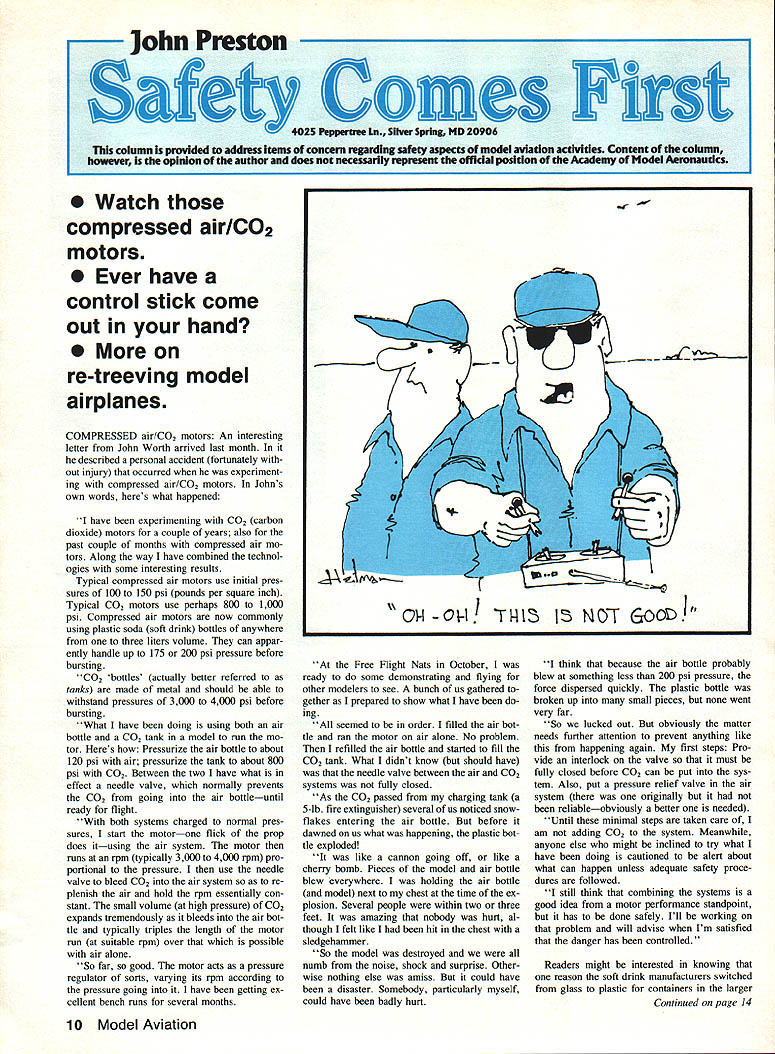
Then just as we started to turn back to downwind for another pass, the transmitter control stick came out of my hand. The plane was reasonably steady but quickly making time away from the field. I yelled to Al, "The rudder/elevator control stick fell on the ground!" After I'd screamed a second time, he got the message and started looking for the stick.
About this time I throttled back on the engine control. I jammed my right thumb down into the right gimbal and found that I had some slight control of the plane. We made a series of sweeping S-turns back into the wind and headed toward the field. We tried to put the control stick back into the gimbal, but Al said the plastic was broken.
Al suggested that rather than attempt a runway landing, which might endanger spectators and fellow pilots, I should gently crash‑land the model out in the boonies. It seemed like a great idea to me. I pulled the throttle all the way back, tried to keep the wings level, and let the model settle into two‑foot‑tall grass, shrubs and clay.
To my amazement, other than the broken control stick the only discernible damage was a broken prop. Al took apart the transmitter and snapped the stick back in place. It has been very successfully flown for several more days.
I have been flying R/C since 1958 and have had my share of battery, radio, motor, prop and fuel failures, and a case of reversed controls when a transmitter switch short reversed the ailerons on an Aeromaster. But never did I foresee a transmitter stick falling out in my hand!
Ironically, Sandy's letter arrived in my mailbox on the same day that I experienced a control failure problem. The parking brake release handle on my 1988 Taurus came off in my hand due to cable breakage. It happened when leaving work on a dark and rainy night, so it was fortunate that it released the parking brake before the cable snapped.
For others who might have the same experience, it is fairly easy in daylight to see which piece of the parking brake mechanism the cable attaches to, and you can reach down under the dashboard and trip it by hand. But installing the replacement cable ($6.75) proved to be another matter. Cables are not designed to be easily repaired.
Planes in trees
The December 1990 Safety column mentioned a modeler who fell to his death while attempting to retrieve a model from a tree. I asked if any readers had better methods for retrieving treed models than by climbing the tree. I received some diverse suggestions.
- Bill Lang of Chester, IL reports 100 percent success in five model retrievals by shooting off the limbs of the tree in which the model was stranded. He says you must use a high‑velocity rifle to ensure that the bullet shatters as it passes through the tree limb. Slow bullets won't do this and tend to go off in uncontrolled directions. Maybe it works for Bill, but I can't recommend it for any area in which, if you miss the limb, the bullet could threaten human life.
- Jim Scarborough, a well‑known Free Flight flier who served as AMA District XV VP for many years, uses a bow to shoot an arrow over the tree limb. To the arrow he ties a light line that is used to pull a heavier line over the limb. He shakes the limb until the model falls free. This may not work in all cases, but it's a lot safer than shooting at limbs.
- If you still have your May 1989 issue of Model Aviation, you will find an article by Joe Wagner on how to make a "grabber" for retrieving models from trees under 30 feet high ("The Easy Way Out of Trees"). The grabber is made from electrical conduit and features a fork (similar to a pickfork) at its end for grabbing the model.
When Joe Wagner's model was trapped in a 70‑ft. hickory, he called a professional tree surgeon. I strongly recommend that method, as do George Wilson (AMA District 1 safety coordinator) and Warren Boudrie of Pittsford, NY. Warren's letter described a recent incident in which his R/C‑200 made a beautiful landing at the end of a 50‑ft. tree. He looked in the yellow pages under Tree Service and located a professional tree man who responded within two hours. Using appropriate climbing gear, the professional scaled the tree and lowered the model to the ground. The only damage was a small tear in the covering material. The cost of this recovery was $35 — well worth it, in my opinion.
George Wilson noted that one should never retrieve a model by oneself near power lines; one could be electrocuted. This could be dangerous to both the rescuer and the model. It may also be illegal in your area.
Cyanoacrylate (CyA) glue in the eye
A letter from Mark Miller of El Segundo, CA related the painful consequences of getting a drop of cyanoacrylate (CyA) glue in his eye. Mark was gluing a split piece of balsa wood when the two sides of the split suddenly snapped together and ejected a droplet of glue. It landed on his cornea and immediately cured. At the emergency room a nice man gave him a local anesthetic and muscle relaxant so that he could open his eye again.
I've previously mentioned incidents similar to Mark's. While it can be a painful experience, I've never heard of a lasting injury.
Mark added: "This incident drew to my attention an interesting flaw in my medical coverage, but that's another story." I'm assuming that he had to shell out some bucks for the hospital visit. Accidents can injure you financially, too. That's something we don't always think about till it happens.
Clarification
A letter from Clair Sieverling pointed out that he is the original author of the tongue-in-cheek segment in the December 1990 Safety column called "The History of Balsa Wood and Model Aviation." Clair, from Phoenix, AZ, wrote:
"I am the original author of this piece of nonsense, which I wrote when I was the editor of the Arizona Model Pilots Society (AMPS) newsletter, the Prop Nut. It was printed in the September 1985 issue thereof."
Thank you, Clair, for setting the record straight.
Have another safe month.
Transcribed from original scans by AI. Minor OCR errors may remain.

