
Safety Comes First
John Preston 4025 Peppertree La., Silver Spring, MD 20906
This column is provided to address items of concern regarding safety aspects of model aviation activities. Content of the column, however, is the opinion of the author and does not necessarily represent the official position of the Academy of Model Aeronautics.
Hot Pocket
Boise Area Radio Kontrol Society (BARKS) member Claude Tanner is one of several regular contributors whose letters keep this column alive. Claude's most recent letter described an incident that could have resulted in a very serious, if not fatal, injury to a fellow club member. In Claude's own words, here's what happened:
"Several weeks ago, two BARKS members, Rube Wilski and Harley Forstner, headed for the club flying field. On the way they stopped at the local gun club to sight-in Rube's new pistol. Upon completion of this task, they proceeded to the flying site.
"After their usual chat with members already at the flying field, they assembled their models for flight. Rube fired up his engine, picked up his model and transmitter, and headed for the taxiway. At that instant, there was a loud explosion and Rube, with a fired-up model in one hand and a transmitter in the other, was seen to be wildly jumping around and at the same time trying to set the model and radio on the ground. By now you have probably guessed what happened.
"A few leftover rounds of ammunition from the prior target shoot were in his pocket. As soon as his model's engine was started, he put the glowdriver in the same pocket without the safety cap on the headlock. The headlock slid over the casing of one of the rounds and, in just seconds, exploded or rather 'cooked-off' the round.
"At first they thought that the bullet had penetrated his thigh. As it turned out, the wound was caused by the exploding casing, and the bullet lay on the ground at his feet. It could have been worse, but the wound and the powder burns were bad enough.
"The enclosed photo was furnished by Rube and shows torn pants pocket, powder burns, and exploded shell casing and the spent bullet. I have witnessed fliers getting a hot pocket when a glowdriver headlock encountered keys, but this incident is a first for me. I hope that it will serve as a warning to all."
I guess the moral of this story is to always replace the protective cap on the headlock of your glowdriver after each use. Did I hear you say that you don't do that because you lost it? Well, be forewarned by Claude's account of Rube's misfortune. Even if you're not in the habit of keeping your glowdriver in your pocket, it could also short across something in your field box and possibly cause a fire. A fully charged Ni-Cd has a lot of energy and can generate much heat when shorted. Supposedly, all Ni-Cds have vents that prevent them from exploding when shorted, but I wouldn't want to test the effectiveness of that feature.
More on safety barriers. Claude Tanner's letter also pointed out the reason why the BARKS club installed a six-foot-high chain link fence between its pits and runway (see discussion on BARKS safety barriers in the April 1991 "Safety Comes First" column). A previous four-foot-high snow fence was not adequate to stop a quarter-scale biplane, which caused an injury to a young person who was behind the barrier, he said.
Claude said that more than a few models have tried to penetrate the chain link barrier, without success.
Pinched battery leads
Cincinnati modeler Jack Whitaker admits to being an old-timer in the hobby, and his following letter to a 17-year-old Aeromaster concerning a "loss of signal" is directed at new kids. It's also another illustration of the heat that can be generated by a shorted Ni-Cd battery.
"Due to a muddy winter runway at the HAWKS (Hamilton, Ohio) field, I elected to put away my hot Pattern aircraft and dust off a 17-year-old Aeromaster that can be flown off wet grass. Yesterday, I lost the signal and the plane crashed, luckily away from any spectators because the leads of my 1,200 mAh battery were crushed between the fuselage and lower wing. The subsequent short circuit and resulting minor internal fire could have been a disaster if the aircraft had been headed toward the pits or spectator area."
Careful attention to the protection of battery pack wiring is of special concern, because of the potential release of a fair amount of heat energy that could ignite both structure and fuel. Avoid frayed insulation, kinks, sharp bends, or any installation that could result in the wires becoming abraded or crushed.
Where do you start your engine? Many clubs have rules that prohibit taxiing a model through the pit area, and others prohibit engine starting in the pit area. In a recent issue of The Flightline, newsletter of the Wilson RC Modelers Association, editor Dave Hockaday had the following to say:
"This is a subject that the Safety Officer has talked about and I have written about before. It is also an example of noting that the practice starts with your approach to starting engines in the pits. A couple of weeks ago I had my flight box set up out in front of the shelter. I fired up the engine in my Hots just as I have scores of times before.
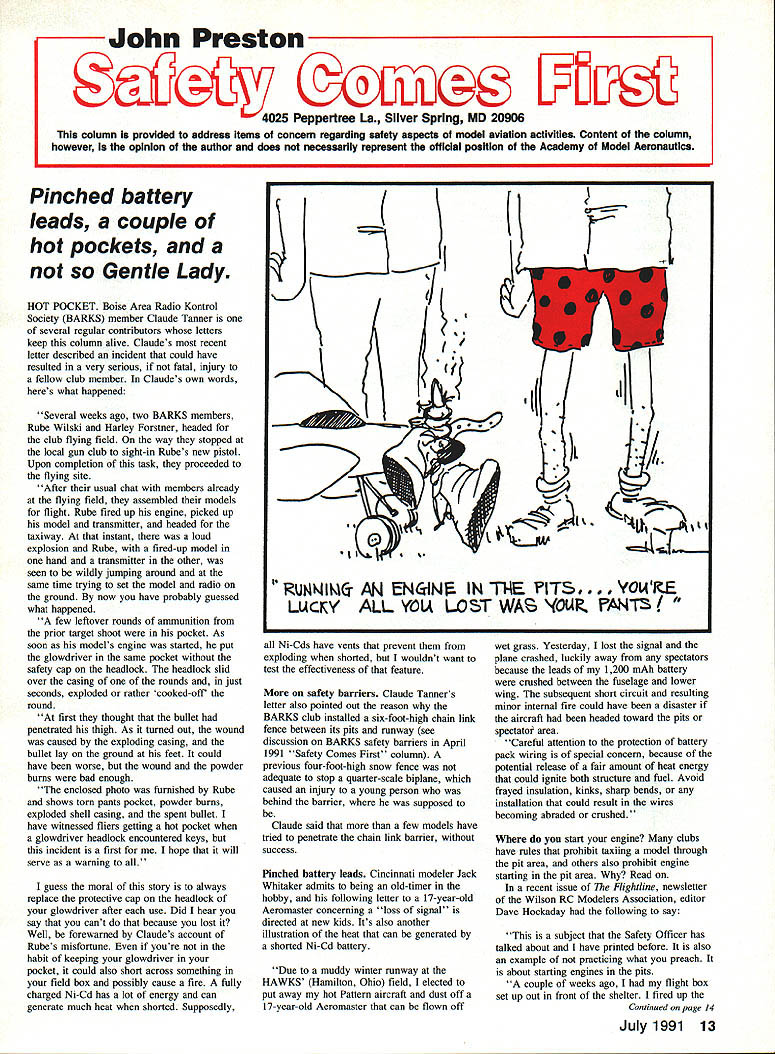
"With the engine disconnected from the glowdriver and idling, I reached over to pick up my transmitter. Just as I did, my thumb bumped the throttle lever and sent the Piper .45 screaming to life. The plane lunged forward, milling a 1-in.-deep by 3/4-in.-wide slot through the 1/4-in. thick plywood and sheet metal of my starter module/power panel. I grabbed the plane (the engine was still running), and when I shut it down I found that the prop (glass-filled nylon) was only nicked.
"If it had hit a knee or a foot it could just as easily have missed my power module and gone into the shelter. I'm a believer. Starting our engines in the pits is an unsafe practice and should not be done. Start engines only at the barriers or on the field. Thanks!"
I can't add anything to Dave's advice other than to say that I agree with him.
A not-so Gentle Lady
Kevin Green is a 13-year-old Joelton, Tennessee modeler. Kevin's recent letter had the following message:
"I'm writing you concerning getting hit by a model Glider. My fellow fliers and I were out on a Friday afternoon, and we had been flying Gliders for about an hour when I, stupidly, walked out onto the runway. As I turned around, I was hit by a Gentle Lady doing about 20 mph. When it hit me I fell, and was left with a bruise and hurt feelings. I see people at the airfield walking onto the runway all the time. If someone were hit with a gas model, it could probably kill or seriously injure them. So remember—Safe flying is everyone's business."
Yes, Kevin, safe flying is indeed everyone's business. Fatalities have resulted from being struck by a powered model airplane.
Why Crash?
This was the title of an article that I spotted a while ago in an issue of the newsletter of the Chicagoland RC Modelers, edited by Lee Parlow. The article was written by Floyd Lawrence and had previously appeared in another newsletter, the ARCS Flypaper.
"Only two things cause crashes—a mechanical or structural failure in your airplane, or a failure of the pilot in judgment or lack of skill. Take care of each of these and you will not crash—but neither is easy.
"Mechanical Inspection: A good time to inspect the mechanical condition of your airplane is during the wipe-down after each flying session. You're going over the airplane to clean it up. While you're doing it, check these items:
- All screws, particularly on the engine, muffler, and servo, ensuring that they are snug. Loctite is a good idea on engines and mufflers. Replace any servo screws that are not good and solid.
- All control surfaces to see that they are solid, that the hinges aren't loose, and that the control horns, Kwik Links, and internal linkage are not loose.
- Fuel leakage inside the fuselage, particularly around the battery pack and receiver. At the same time, check that the clunk in your tank is falling freely.
- The plugs on servos and the battery pack. Tape them to prevent them from coming loose. Look for signs of wires chafing or stressed wires from things shifting inside the fuselage.
- Any signs of stress or structural failure, particularly if you have made a hard landing. In fact, it's wise to check this immediately after a hard landing. We once had a wing fold after a landing that "didn't look that hard.""
Pre-Flight Checklist
With all defects corrected, here you are, back out at the field and ready to fly again. Or are you? More than one day has been spoiled by a forgotten transmitter or antenna. A checklist reviewed before you leave for the field can prevent disappointment. Before you leave home:
- Use a checklist of items that you will need.
- Perform a range check of your radio in your driveway or back yard to be sure it is operating properly, and that your servos respond normally.
- Be sure you have done all the things you said you were going to do following your last wipe-down check at the field.
When you arrive at the flying field, obtain the frequency pin and continue your pre-flight checklist as follows:
- Re-confirm range with the airplane assembled.
- Check that the wheels freely turn (dirt and oil can congeal and cause ground loops).
- Open the needle valve slightly to ensure rich setting upon starting the engine. Lean just a touch into two-cycle at full throttle and confirm the setting by holding the nose of the model vertically.
- Go to idle for at least 20–30 seconds and check control surface operation and direction, then go to full throttle again and re-confirm full throttle control operation. (Be careful that your prop blast isn't directed at others, and take no more time than is really necessary to avoid being a noise nuisance.)
"Crash-proof" flying begins by understanding that flying airplanes don't crash, but they can, of course, be flown into the ground.
"As your plane builds airspeed, the rudder becomes effective first, then the elevator, then followed by the ailerons. The controls stall in reverse order. This means that you can pull your airplane into the air with the elevator flying but not the wing of the airplane. Unless the airplane has flying speed, it cannot be controlled.
"That's why take-off is the most dangerous maneuver and landing is the next most dangerous. In both cases, the airplane passes through a stall. Moral: Don't lift off if there is any doubt about your airspeed. Instead, cut the throttle and abort the takeoff.
"Once you have lifted off, climb out gently, without turning, until you have attained a safe altitude. Keep your airspeed up on your landing approach until you are close enough to the ground to flare and settle for a safe touchdown. Don't be afraid to use your throttle. If there is any doubt about your landing approach, go around and try again. It's much safer to land a little hot and run into the weeds than to stall in from six feet in the middle of the field.
"Think throttle at all times. If you get into trouble in the air, cut the throttle first, then try to re-trim and figure out your difficulty. Cutting the throttle will give you time to think and it will lessen the impact if all else fails.
"Think of the sky as a funnel with the field at the bottom. The further away you fly, the higher you have to be. This is true both from the standpoint of visibility and control, and because of possible engine failure. Altitude will allow you to glide back to the field. Getting into trouble at a low altitude far from the field is a sure way to court disaster.
"Learn from your mistakes. If something about your airplane surprises you, land and try to figure out what happened. The key is to try to identify what the airplane is trying to tell you on each flight. Reading those messages teaches you what you can ask your airplane to do and what you cannot.
"Use a flight plan. If you want to improve your flying, you need to ask your airplane questions as well. That means creating a learning situation for each flight by planning what you are going to do during the flight before you take off.
"Without a flight plan you will not progress as quickly, because you will either make the same mistakes or fail to try new things. For example, if you are uncomfortable about something, say a right-hand traffic pattern approach, practice it at a safe altitude. It doesn't matter how much sky you have above your model; when it comes to recovering from a difficult situation, it's only the amount of sky beneath your model that counts."
Floyd started this article by stating that there are only two things that cause crashes: mechanical/structural problems and pilot error. Maybe he includes radio problems in the mechanical category. All of us are vulnerable to outside interference, but this can be minimized by using only narrow-band equipment and by keeping your receivers and possible interference sources well away from the flying field. Remember the RC deer decoys in the last safety column? Hope you don't experience any more "hot pockets!"
Till next month, have a safe one.
Transcribed from original scans by AI. Minor OCR errors may remain.

