
Gary A. Shaw 85 Twin Lakes Circle, Atoka, TN 38004
Safety Comes First
Abstract
- Attack of the Killer Helicopter
- A glow engine starts unexpectedly
- A quick look at a Flight Instruction Program Manual
- Precautions to take when applying paints or other finishing materials in enclosed spaces
Turning my back was all I could do — that's the crux of one modeler's unhappy experience we'll examine this month.
Not all injuries associated with our hobby occur at the field. This month I received a letter describing an incident that occurred at home and resulted in a trip to the hospital followed by a month of recuperation.
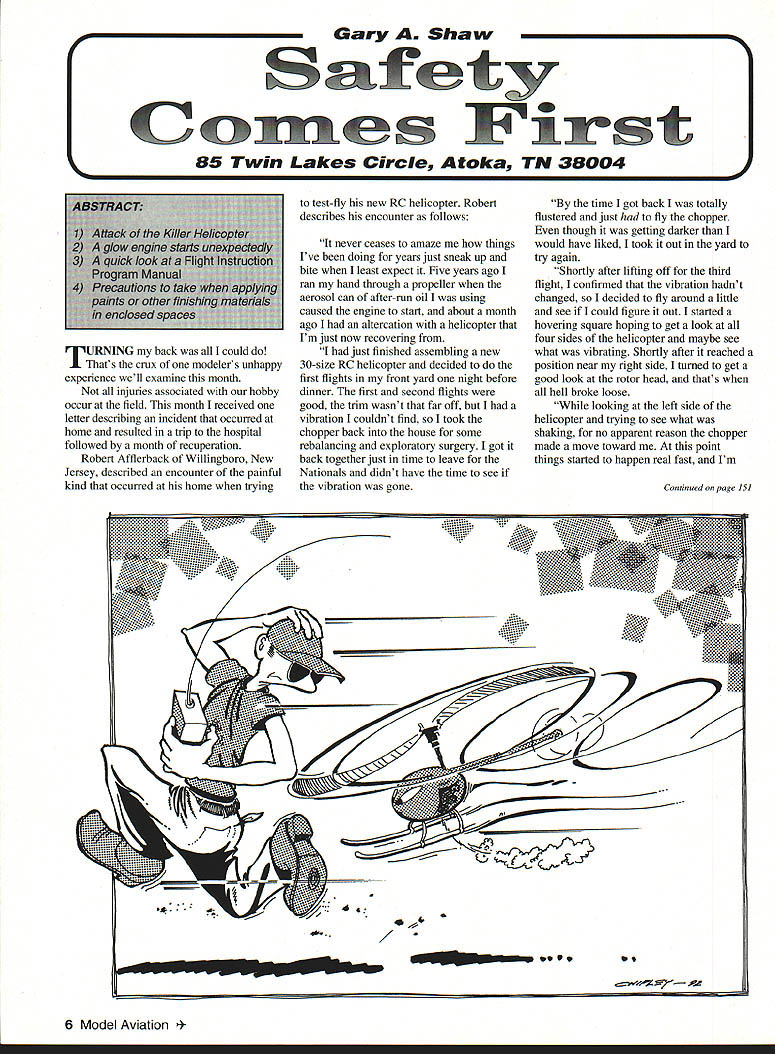
Attack of the "Killer" Helicopter — Robert Afflerback's report
Robert Afflerback of Willingboro, New Jersey, described a painful encounter that occurred while test‑flying a new 30‑size RC helicopter at home. He related the incident as follows:
"It never ceases to amaze me how things I've been doing for years just sneak up and bite me when I least expect it. Five years ago I ran my hand through a propeller when an aerosol can of after‑run oil I was using caused the engine to start, and about a month ago I had an altercation with a helicopter I'm just now recovering from.
I had just finished assembling a new 30‑size RC helicopter and decided to do the first flights in my front yard the night before dinner. The first and second flights were good — trim wasn't that far off — but I had a vibration I couldn't find. I took the chopper back into the house for some rebalancing and exploratory surgery. I got it back together just in time to leave for the Nationals and didn't have the time to see if the vibration was gone.
By the time I got back I was totally flustered and just had to fly the chopper. Even though it was getting darker than I would have liked, I took it out in the yard to try again. Shortly after lifting off for the third flight I confirmed the vibration hadn't changed, so I decided to fly around a little and see if I could figure it out. I started a hovering square hoping to get a look at all four sides of the helicopter and maybe see what was vibrating.
Shortly after it reached a position near my right side I turned to get a good look at the rotor head, and that's when all hell broke loose. While looking at the left side of the helicopter and trying to see what was shaking, for no apparent reason the chopper made a move toward me. At this point things started to happen real fast, and I'm not sure exactly what happened next. I do remember giving some sort of control, taking a few steps backward, and seeing the chopper turn toward me and drop its nose. With the house behind me and a line of trees to my left, all I could do was turn my back, tuck my head and arms, and pray.
The rotor made contact with my right shoulder blade right below my neck and proceeded to make four deep cuts down the middle of my back. The only reason I wasn't hurt worse than I was is the wooden rotor blades shattered on contact, and evidently I had the presence of mind to pull the Idle Hold. I don't remember pulling it, but it was on when the chopper hit the ground. Had the engine stayed up, or had I installed the glass blades I was talking about, I would have spent some time in the hospital.
No accident is worth having if you don't learn something from it! The first thing I learned is that my front yard is no place to fly a helicopter. That field at the end of the street has become very inviting.
The other thing I learned is that no matter how good you think you are, you're not above making a mistake. If you think it can't happen, it probably will. Luckily, I didn't cut my head off."
Robert was extremely fortunate: his reflexes allowed him to tuck his head and protect it, and the wooden blades shattered rather than penetrating anything vital.
Lessons Robert learned
- Don't test‑fly helicopters in a front yard — use an appropriate flying field.
- Never assume you are immune to mistakes; even experienced fliers can be caught off guard.
- Consider blade material and the added risk of glass/carbon blades in close quarters.
After‑run oil and unexpected engine starts
A follow‑up call to Robert revealed the earlier incident (running his hand through a propeller) involved a product sold as CRC 556 Aerosol After‑Run Oil. Robert said he duplicated the event several times using the same product, a different finger, and no battery connected to the glow plug.
There have been prior reports that a combination of aerosol propellants, oil, and heat from compression strokes can produce a rich enough mixture to run the engine briefly when the prop is flipped. If you've had similar experiences, it's worth sharing them so we can better understand and prevent this hazard.
Flight Instruction Program Manual — a recommended resource
I was given an excellent manual titled Flight Instruction Program Manual by members of the Texarkana R/C Flying Club during their annual pattern event (weekend of October 3, 1992). The manual is thorough and professional, covering safety, club etiquette, initial plane setup, and step‑by‑step learning to fly.
A copy was forwarded to the AMA and should be available upon request. To obtain a copy, contact: Bill Kilbride, Chief Flight Instructor 2105 Wood St., Texarkana, TX 75501 Tel: (903) 792‑9403
Contest notes and other safety items
From my standpoint, the pattern meet was a great success. The main safety concern was the lack of a first‑aid center at the contest. There was some excitement when a group of pelicans from nearby Lake Wright Patman strafed the field during the contest, but there were no midairs and the day went on as planned.
Final safety reminder
It may seem easier to hover in the yard to check simple adjustments rather than drive to the field, but for everyone's safety it's much better to fly at an appropriate field with proper space, emergency support, and fewer bystanders.
Transcribed from original scans by AI. Minor OCR errors may remain.

