
Gary A. Shaw 85 Twin Lakes Circle, Atoka, TN 38004
Safety Comes First
Junkbox Compressor
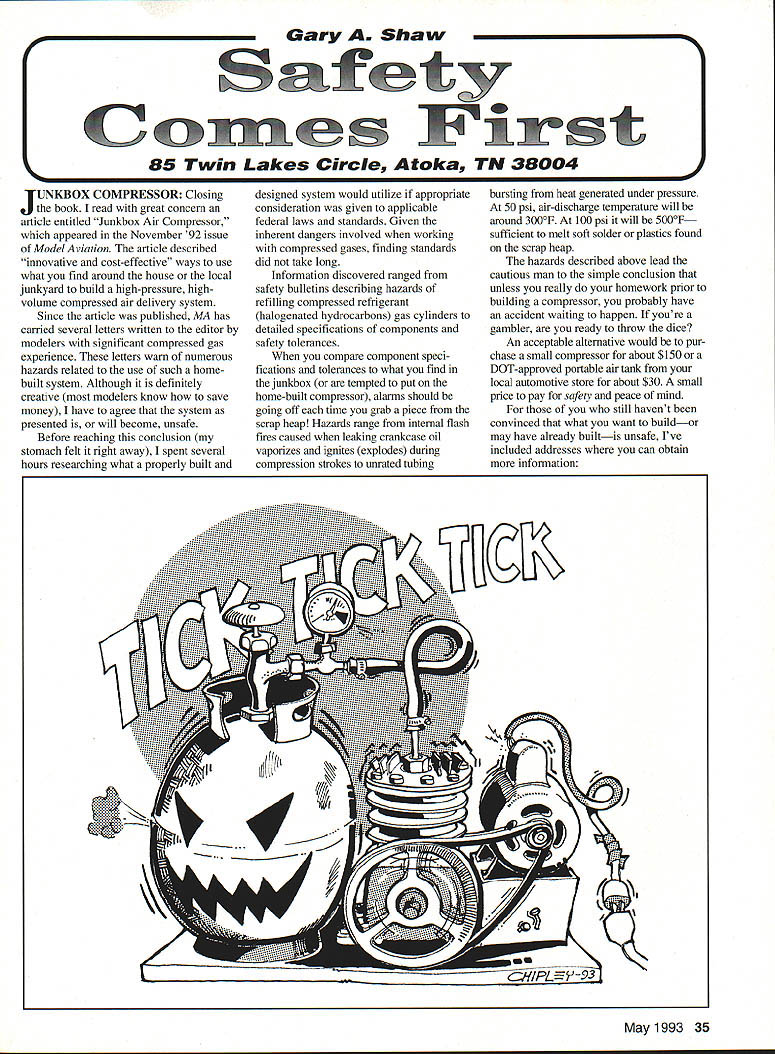
Closing the book, I read with great concern an article entitled "Junkbox Air Compressor," which appeared in the November '92 issue of Model Aviation. The article described "innovative and cost-effective" ways to use what you find around the house or the local junkyard to build a high-pressure, high-volume compressed air delivery system.
Since the article was published, Model Aviation has carried several letters written to the editor by modelers with significant compressed-gas experience. These letters warn of numerous hazards related to the use of such a home-built system. Although it is definitely creative (most modelers know how to save money), I have to agree that the system as presented is, or will become, unsafe.
Before reaching this conclusion (my stomach felt it right away), I spent several hours researching what a properly built and designed system would utilize if appropriate consideration was given to applicable federal laws and standards. Given the inherent dangers involved when working with compressed gases, finding standards did not take long.
Information discovered ranged from safety bulletins describing hazards of refilling compressed refrigerant (halogenated hydrocarbons) gas cylinders to detailed specifications of components and safety tolerances.
When you compare component specifications and tolerances to what you find in the junkbox (or are tempted to put on the home-built compressor), alarms should be going off each time you grab a piece from the scrap heap. Hazards range from internal flash fires caused when leaking crankcase oil vaporizes and ignites (explodes) during compression strokes to unrated tubing bursting from heat generated under pressure. At 50 psi, air-discharge temperature will be around 300°F; at 100 psi it will be 500°F—sufficient to melt soft solder or plastics found on the scrap heap.
The hazards described above lead the cautious man to the simple conclusion that unless you really do your homework prior to building a compressor, you probably have an accident waiting to happen. If you're a gambler, are you ready to throw the dice?
An acceptable alternative would be to purchase a small compressor for about $150 or a DOT-approved portable air tank from your local automotive store for about $30. A small price to pay for safety and peace of mind.
For those of you who still haven't been convinced that what you want to build—or may have already built—is unsafe, I've included addresses where you can obtain more information:
- SB-1—1981: Hazards of Refilling Compressed Refrigerant (Halogenated Hydrocarbons) Gas Cylinders, Compressed Gas Association, Inc., 1235 Jefferson Davis Highway, Arlington, VA 22202
- ASME Unfired Pressure Vessel Code, The American Society of Mechanical Engineers, 345 East 47th St., New York, NY 10017
- ANSI/CSA/CGA V-1: Compressed Gas Cylinder Valve Outlet and Inlet Connections, Compressed Gas Association, Inc., 1235 Jefferson Davis Highway, Arlington, VA 22202
- ANSI B19.3—1981: Safety Standard for Compressors for Process Industries, The American Society of Mechanical Engineers, 345 East 47th Street, New York, NY 10017
Broken Prop Perils
"Broken Prop Perils" is the title of an article published in the Imperial R/C Club newsletter edited by Bob Hunter. The article, which appeared in the fall issue, was written by Bob and dealt with where props go when they break. If you think they go forward, think again! Bob describes the danger as follows:
"There have been a number of incidents recently of props breaking in flight and during run-up on the ground. If a blade suddenly separates from a propeller, where does it go? Most people would reply that it will go forward because of the thrust force exerted on it. Not so! If a propeller comes off an engine intact, as often happens to four-stroke engines when they backfire, it will go forward; but not a separated blade. The centrifugal force acting on the blade is at least 100 times as great as the thrust force. So the most dangerous place to be when a blade separates is along the side, in the plane of the spinning prop."
Just how dangerous is a flying prop blade? If we take, as an example, an 11-inch prop turning at 13,000 rpm (typical for high-performance engines), a separated blade will fly off at 340 feet per second (232 mph) spinning at 216 rps. It is a missile somewhat like those things that ninja warriors throw in the movies, only much faster. A good fastball pitcher can throw a baseball around 100 mph; however, the prop blade is traveling over twice as fast. That blade is not only dangerous, it is lethal.
All of this should make us think about what goes on in the pits. If someone is cranking the engine up, adjusting the needle valve for maximum rpm, don't stand in or near the plane (arc) of the spinning prop. Certainly don't be working on your airplane right next to him. You or your helper may get speared! Maybe it would be better if all high-throttle operations were performed away from the pit area, or at least well forward on the pit concrete so that no people or airplanes are in the plane of the spinning prop.
Bob describes a peril I see pilots subject themselves to every time I go to a flying field. Have you ever been to a field and not seen half of those at the field gathered around a new arrival's plane as it's started? What do you think people get upset about when the plane's engine starts screaming—the noise? the prop arc? Okay, okay, it's the propswash! Whose face will benefit from the blow? The new guy's props going to dust? Predictably, one or two members will move to the circle and move their equipment while all the others stand in the prop arc waiting to get chewed. I remember past safety columns with stories of props embedded in chests and chopped fingers held together by pins—all victims of loose or broken propellers. Question: Would you let a young child stand in your prop arc? Be nice. Props have no conscience!
Safety Now!
This is the title of a letter written by Karl Valasek, of Westport, Mass., which I received some time ago. He suggested that the club adopt a rule that all planes must have a functional electric starter switch at the engine compartment that prevents the engine from being started unless the pilot is holding the switch, or that the starter box be arranged so the starter will not work unless the handle is in the box. The idea is that by having such a device the number of starters hitting props during the starting process would be drastically reduced. The motor automatically turns on and off as the nose of the plane is pressed against it or released. With detachable holders on the top of the tote box for the model, a person (especially us older ones) can work without painful kneeling—and in safety.
"Perhaps manufacturers will see this article and get busy on this most critical of safety problems."
I agree with Karl. I'd appreciate some comments from manufacturers who may have a product to fit the bill or clubs that might have developed other ideas. (Editor's note: The Kranking Safety Starter—made by one of our advertisers—is a commercially available device that does the same job.)
Safety Zone
Can you see it? Such is the subject of a column entitled "Safety Zone," by John Kenna, which appeared in the #10 issue of the newsletter of the Azalea City Model Aeronautics Club, Finks Fetten, editor. John writes the following:
"This month's topic is flying a visible plane. Many beginners are shocked to find that their plane's color scheme looks great on the ground but completely disappears in the air! Most longtime RC aircraft pilots have learned (sometimes the hard way) that to have a visible plane the following rules apply:
- Finish the top and bottom of the wing completely differently, both in color and scheme.
- Use contrasting colors next to each other, such as red/yellow, red/white, or black/orange.
- Avoid an abundance of small markings. In the sky none of the details will be visible.
- Don't use large amounts of white or blue. These colors will blend with a cloudy or blue sky.
- If possible, avoid large amounts of gray or black, especially that low-visibility gray used on jets!
"When designing that next color scheme, keep these rules in mind. The plane will be more visible, possibly preventing a pilot-induced crash due to loss of orientation."
Keep in mind that it doesn't matter how much sky is above your model when trying to recover from disorientation. It's only the amount of sky beneath that counts. Take John's advice and use bright, contrasting colors to keep you out of trouble.
There It Goes!
Recently, Morris Burner of the Helena, Montana, Flying Tigers called to pass on a lesson-learned story involving the near loss of his favorite aircraft, a Road Runner.
Morris described a nice day at the field while he and his buddy were flying. He had a new SuperTiger engine installed on his plane, flying at about 250 feet. Without warning, the plane developed a mind of its own. He described the sick feeling you get when you move the stick one way and the plane goes the other.
Having experienced radio interference at the field on past occasions, he thought that if he ran toward the plane, somehow the interference would be overridden by a more powerful transmitter signal. Alas, this was not to be the case. The Road Runner leveled off from its radical gyrations and shot across a nearby lake at about warp factor 10.
With the plane now appearing as a yellow dot quickly becoming smaller in the distance, he stood at the end of the runway and pondered. Should he tell the builder/nephew/author of this column that the plane was gone? Suddenly, a faint voice from the pits yelled out, "Try pulling your antenna up!" Instantly the antenna was up, and sticks were working to retrieve a model that was merely a distant sound—no color. To Morris's relief, the sound became louder and the distant dot grew into a yellow Road Runner.
Morris went on to describe an uneventful, intentional, straight-in approach and landing. As for the rest of the day, he was last seen walking toward the Porta-John.
The moral of the story is obvious: check your antenna before flying, and never tell the builder/nephew/columnist a story like this. He might print it!
I'm looking forward to a summer of safe flying. See you next month!
Transcribed from original scans by AI. Minor OCR errors may remain.

