

Safety Comes First
Gary A. Shaw 85 Twin Lakes Circle, Atoka, TN 38004
Fire extinguisher explosions
FIRE EXTINGUISHER EXPLOSIONS prompt recall: I recently came across an alert that indicated that two models of American LaFrance fire extinguishers are being recalled by Badger-Powhatan of Charlottesville, Virginia, in cooperation with the U.S. Consumer Product Safety Commission (CPSC). The affected models were manufactured from May through December 1985.
A recall has also been issued for BECO's model P-250MA.
Because of a defect in the threads connecting the nozzle assembly to the red canister, the plastic valve and nozzle assemblies of the extinguishers could blow off with enough force to cause serious injury. Badger-Powhatan has received 100 explosion reports. While only three injuries have been reported, in several incidents the nozzle assembly blew off with force sufficient to embed it in a wall or ceiling.
About 84,000 P-250MA and P-275RA extinguishers are being recalled. The model and serial numbers of the recalled extinguishers are printed on the canister label. They include:
- American LaFrance
- Model P-250MA — Serial Numbers
- FS024000 through FS087500
- FZ650001 through FZ656500
- FS834501 through FS836000
- FZ838001 through FZ847500
- FM947501 through FM949500
- FZ780001 through FZ781500
- Model P-275RA — Serial Numbers
- See canister label for specific ranges
- BECO
- Model P-250MA — Serial Numbers
- FM947501 through FM949495
- FZ780001 through FZ781500
The extinguishers were sold nationwide in retail stores for about $9 to $15 each. Contractors and manufacturers installed them in buildings, boats, and mobile homes.
If you have an American LaFrance and/or BECO fire extinguisher at home, in the shop, or at the flying field, check the model and serial numbers against those above. If you have one with those numbers, handle it carefully, with the nozzle assembly pointing to the ground, and return it to the nearest authorized American LaFrance or BECO distributor for a free replacement.
For the location of the nearest distributor, call Badger-Powhatan at (800) 922-3499, Monday through Friday from 8 a.m. to 5 p.m. Eastern time. You can also write Badger-Powhatan at P.O. Box 7146, Charlottesville, VA 22906. Address your letter to the attention of the sales department.
Respirators for CyA glue?
A letter received recently from Ralph Wehrheim of Florissant, Missouri, asked:
"Months ago in an edition of MA I noticed a company that boasted of a respirator that they sold for use with cyanoacrylate glues. My mistake was not marking this edition, and I cannot find the advertisement.
"I have problems with asthma, which seems to be aggravated by the use of this form of glue. Several hardware stores in my area sell respirators, but none list cyanoacrylate glue specifically. Not taking chemistry in school has not helped me to decipher which respirator to purchase. Can you direct me to a company that sells this type of respirator, or advise me of what type would be effective?"
I reviewed numerous material safety data sheets (MSDS) of commonly used cyanoacrylate glues (CyA) and found none that indicated a respirator is necessary as long as adequate ventilation is used and the atmospheric concentration of vapor remains below the irritating level.
Let me emphasize ventilation as the key to using CyA glues if you want to avoid mucous membrane irritation in your eyes, nose, or lungs. If your building area does not allow adequate ventilation, I suggest the purchase of a respirator that has a prefilter for airborne particles and a charcoal layer to absorb organic vapors.
As mentioned in my April 1993 MA column, a respirator that meets our hobby needs very nicely is the 3M 8709 Paint Spray Respirator. It's about the same size as a dust mask, it's inexpensive, and it provides protection against organic vapors and paint particles from enamels, lacquers, epoxies, acrylic enamels, and polyurethanes.
This respirator should be available from almost any store that carries 3M respirator products, or call 3M toll free at (800) 243-4630. From within Minnesota, call collect (612) 733-6234 for selection assistance and location of the nearest dealer.
Exploding payload!
My jaw hit the floor recently after reading a letter sent to me by modeler Tim Gillow of the HHL/ID Model Club, Horseheads, New York, regarding what he found in the remains of an airplane he recently crashed:
"Back a couple of months ago, our club was contemplating its annual event, and I became involved in a plan to present a 'staged' dogfight at the show—really nothing more than two planes flying close together. I went to a local hobby shop to see what was available in the 'crash and burn' category—something I didn't have to put a lot of sweat and time into, and wouldn't get too upset over crashing in a midair. I found a good ship—long moments and nice lines, but a bit on the heavy side.
"After a few nights in the shop, she was ready to go. Unfortunately, the plane encountered some radio interference one afternoon and didn't survive its third flight.
"The pile of pieces didn't look so bad, so I scooped them up into a box and carried them home. Several months later, I thought I'd rebuild the bird. Within a few minutes I decided it was too far gone—I'd spend more in glue than on new wood. So my young son Jeremy, standing nearby, got the job of stomping those pieces of balsa into toothpicks.
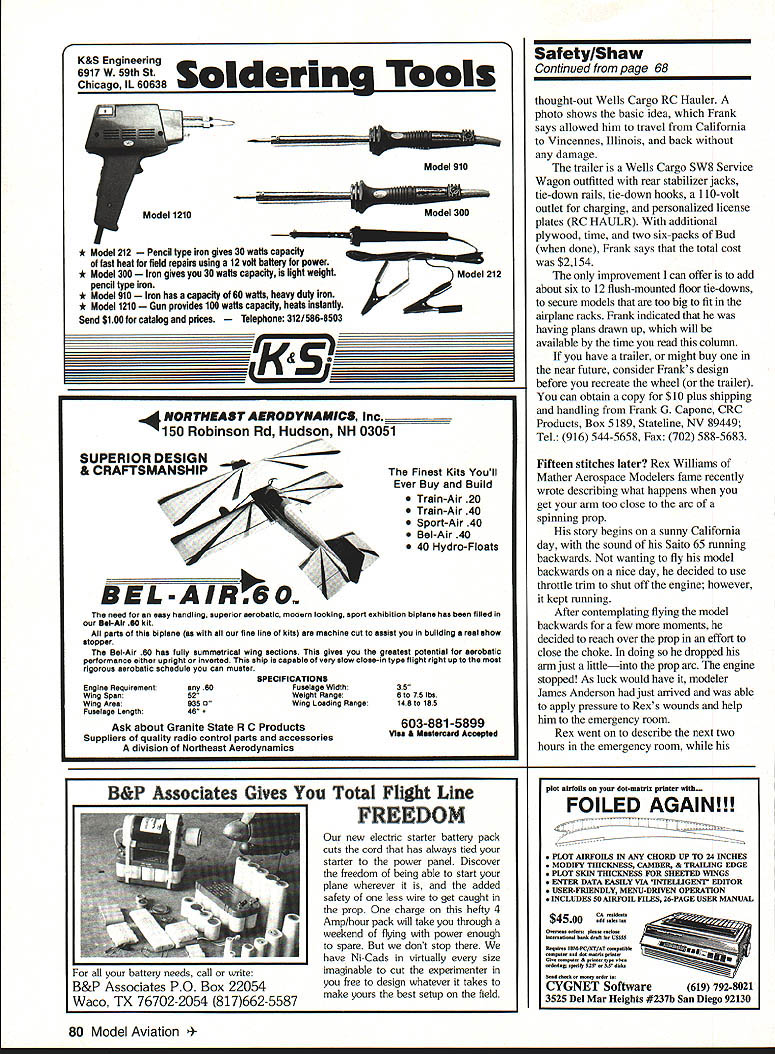
"He was having a great time until he stomped on a piece of the rear fuselage, and nothing broke. He stomped on it several times, then asked me for help. I picked it up, and to my alarm discovered that the tail section was full of live ammunition rounds, glued in as weight in the fuselage!
"Holy ricochet, Batman! Several hundred accident scenarios flashed through my mind, from the original crash causing the 'shooting' of an unsuspecting spectator, to having my son's foot shot off by an exploding round of ammunition.
"Imagine the possibilities if those shells had found their way into a club picnic bonfire, with everyone gathered around telling safety stories!"
Tim goes on to say that he's shown the piece containing the live rounds to anyone who would look and the reaction is always the same: What kind of fool would risk several lives for the sake of tail weight?
The photo is worth a thousand comments. I wonder if the new museum in Muncie has a place to display the piece Tim describes. An appropriate inscription could read "How to Kill a Hobbyist." Tim says he'll X-ray his next preflight purchase!
RC hauler
Traveling often to pattern contests or around town to fun-flies has made me very aware of what can move around in a vehicle or trailer if not well secured. More than once I've arrived at a field and found damage that could have been prevented had something not rolled over during an unexpected turn or slid into something else (my head) during a quick stop.
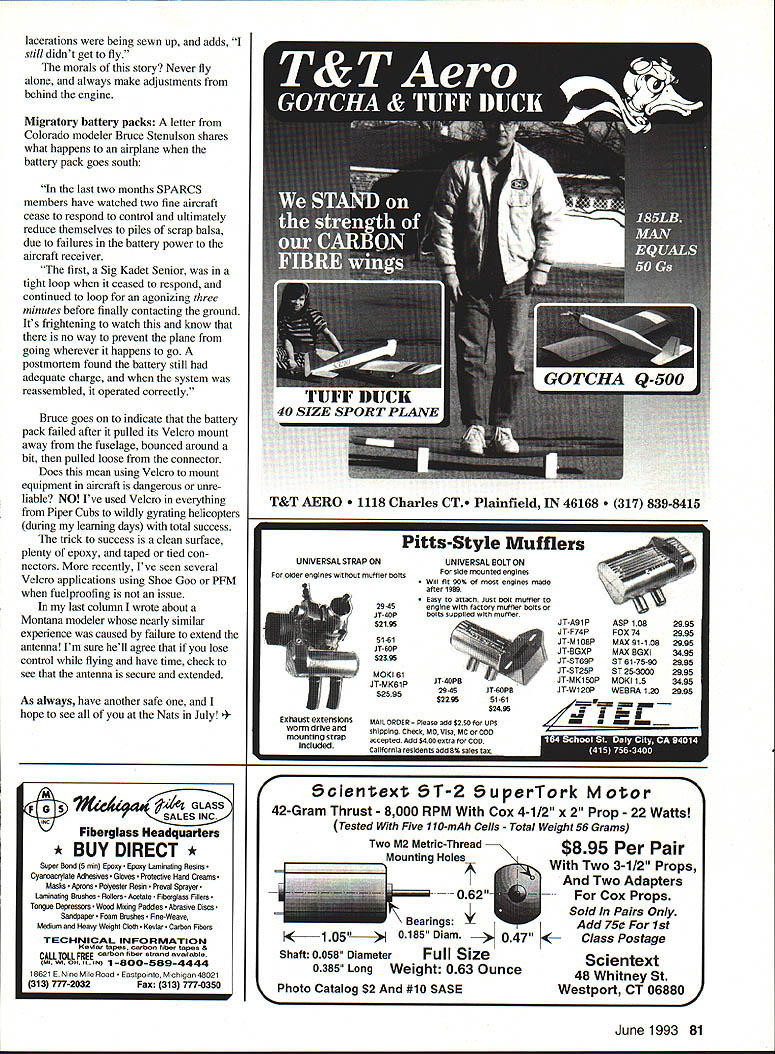
While nosing around RC trailers at N-PAC last July I came upon Frank Capone (CRC Products) of Stateline, Nevada, who had designed a very impressive, well-thought-out Wells Cargo RC Hauler. A photo shows the basic idea, which Frank says allowed him to travel from California to Vincennes, Illinois, and back without any damage.
The trailer is a Wells Cargo SW8 Service Wagon outfitted with rear stabilizer jacks, tie-down rails, tie-down hooks, a 110-volt outlet for charging, and personalized license plates (RC HAULER). With additional plywood, time, and two six-packs of Bud (when done), Frank says that the total cost was $2,154.
The only improvement I can offer is to add about six to 12 flush-mounted floor tie-downs, to secure models that are too big to fit in the airplane racks. Frank indicated that he was having plans drawn up, which will be available by the time you read this column.
If you have a trailer, or might buy one in the near future, consider Frank's design before you recreate the wheel (or the trailer). You can obtain a copy for $10 plus shipping and handling from Frank G. Capone, CRC Products, Box 5189, Stateline, NV 89449; Tel.: (916) 544-5658; Fax: (702) 588-5683.
Fifteen stitches later?
Rex Williams of Mather Aerospace Modelers fame recently wrote describing what happens when you get your arm too close to the arc of a spinning prop.
His story begins on a sunny California day, with the sound of his Saito 65 running backwards. Not wanting to fly his model backwards, he decided to use throttle trim to shut off the engine; however, it kept running.
After contemplating flying the model backwards for a few more moments, he decided to reach over the prop in an effort to close the choke. In doing so he dropped his arm just a little—into the prop arc. The engine stopped! As luck would have it, modeler James Anderson had just arrived and was able to apply pressure to Rex's wounds and help him to the emergency room.
Rex went on to describe the next two hours in the emergency room, while his lacerations were being sewn up, and adds, "I still didn't get to fly."
The morals of this story? Never fly alone, and always make adjustments from behind the engine.
Migratory battery packs
A letter from Colorado modeler Bruce Stenluson shares what happens to an airplane when the battery pack goes south:
"In the last two months SPARCS members have watched two fine aircraft cease to respond to control and ultimately reduce themselves to piles of scrap balsa, due to failures in the battery power to the aircraft receiver.
"The first, a Sig Kadet Senior, was in a tight loop when it ceased to respond, and continued to loop for an agonizing three minutes before finally contacting the ground. It's frightening to watch this and know that there is no way to prevent the plane from going wherever it happens to go. A postmortem found the battery still had adequate charge, and when the system was reassembled, it operated correctly."
Bruce goes on to indicate that the battery pack failed after it pulled its Velcro mount away from the fuselage, bounced around a bit, then pulled loose from the connector.
Does this mean using Velcro to mount equipment in aircraft is dangerous or unreliable? NO! I've used Velcro in everything from Piper Cubs to wildly gyrating helicopters (during my learning days) with total success.
The trick to success is a clean surface, plenty of epoxy, and taped or tied connectors. More recently, I've seen several Velcro applications using Shoe Goo or PFM when fuelproofing is not an issue.
In my last column I wrote about a Montana modeler whose nearly similar experience was caused by failure to extend the antenna! I'm sure he'll agree that if you lose control while flying and have time, check to see that the antenna is secure and extended.
As always, have another safe one, and I hope to see all of you at the Nats in July! †
Transcribed from original scans by AI. Minor OCR errors may remain.

