
Safety Comes First
Is an AMA Safety Committee needed?
John Preston
Council vote
At the AMA Executive Council meeting of January 19, 1980, it was moved by Chuck Foreman and seconded by John Grigg that an AMA Safety Committee be established. The motion failed, 5 for, 6 against, and 1 abstention. In the minutes of the council meeting it was stated: "In discussion it was noted that, in the recent past, such a committee had been attempted but was found to be ineffective from lack of authority to enforce recommendations and rulings. Also, the proposal was too vague as to intent."
At this same council meeting, another motion was made by Vince Mankowski (then AMA District IX VP) and seconded by Homer Smith, "that the council follow up by asking the original proposer of the motion (an AMA member who had written to the District IV VP) to submit a more complete proposal with specifics as to purpose and authority."
Since the original proposal came from your "Safety Is First" column, this month's column is being devoted to the subject of why I think there should be an AMA Safety Committee and what its roles might be.
Why a safety committee?
Before you dismiss the idea of such a committee as being ridiculous and probably an attempt to expand the bureaucracy of AMA, take the time to read the following few facts.
- The original letter proposing a Safety Committee was entirely my own idea.
- As the author of this column, it appears that I am regarded by some as "AMA's Safety Expert." Not so.
- I'm not alone in believing that we should have a Safety Committee.
- In a recent lawsuit that stemmed from a control-line (CL) flier's electrocution death, manufacturers of the model and its accessories had to make large settlements to the flier's widow. An examination of the facts in this case by a committee of knowledgeable people could prevent such an occurrence in the future.
- The idea that we might benefit by having a Safety Committee within the AMA had been in my mind for some time. The Shea Stadium incident in December 1979 was the moving force behind the letter to my District VP, Chuck Foreman. In the case of this incident, action by the whole Executive Council now effectively bans RC model airshows in spaces surrounded by spectators. While it could be argued that the Executive Council is all we need to discuss the safety of our hobby, I believe that their hands are already full with other AMA business. At the council meetings that I've attended, there is barely time enough to discuss routine administrative topics without adding safety to the list.
Composition of the committee
As I visualize it, while an AMA Safety Committee might include some current members of the Executive Council, it would—perhaps—be far more effective if its members were experts in certain fields. For example, I believe that we would need an electrical engineer with knowledge of high-voltage power distribution who is also a modeler. It would also help if we had a lawyer.
Authority and reporting
The Safety Committee would report to and be directed by the Executive Council. However, the chairman of the committee should have the authority to initiate actions himself in the event that an imminent hazard emerged that required quick action. (Note that I said that the chairman should be able to "initiate" actions himself. Any final rulings or recommendations of the committee should be voted on by the council members.)
My role and need for consultation
Regarding the "Safety Expert" image that some readers have apparently attached to my name: although I happen to earn my living as a regulator of safety, when it comes to the many facets of our hobby I'm far from the expert. Nevertheless, during the past year several specific products presenting alleged hazards have been discussed in this column. Although in many cases brand names have been deliberately avoided, in the case of the charger for CO2 motors that was reportedly blowing apart in hot weather, we saw fit to cite the specific brand. It would certainly be nice to have a committee of knowledgeable people to consult before I have to make such a decision. It is an uncomfortable feeling to be put in a position where one can either be judge, jury, and executioner simultaneously, or ignore the issue and learn at a later date that an injury could have been prevented.
Support from others
The motion to establish an AMA Safety Committee failed to pass by a vote of 5 for to 6 against. The conclusion is that there are at least five people on the Executive Council who believe, like myself, that such a committee would be beneficial to the hobby. There appear to be others with similar thoughts. For example, in the February 1980 issue of Model Airplane News, Hal DeBolt addressed AMA actions on reducing the risk of an injury during pylon races. He stated that, "AMA should first determine, authoritatively, what would improve safety, and establish a safety program based on that knowledge." It appears to me that a Safety Committee could do just that.
Another advocate of AMA-sponsored safety programs formulated by a committee is Arthur J. Sabin, Professor of Law at the John Marshall Law School in Chicago. Readers of RC Modeler magazine will need no introduction to Professor Sabin because of his many columns in that publication. Back in April of 1980, after a meeting with Carl Maroney of the AMA HQ staff, he drafted some suggestions with respect to an AMA Safety Program. Among these he stated: "That there be a permanent committee of the AMA charged with the responsibility of creating and implementing modeling safety programs." In response to a question from Carl about serving on such a committee, Professor Sabin responded: "My answer is yes, provided I see that this is not just a 'window dressing' committee, but one that reflects in its constituency and in its charge from the AMA that it means business on this matter of modeling safety." It looks like we already have the lawyer member of the Safety Committee lined up.
The question remaining to be answered is: Do we, the members of AMA, believe that a Safety Committee is desirable?
Safety issues that need attention
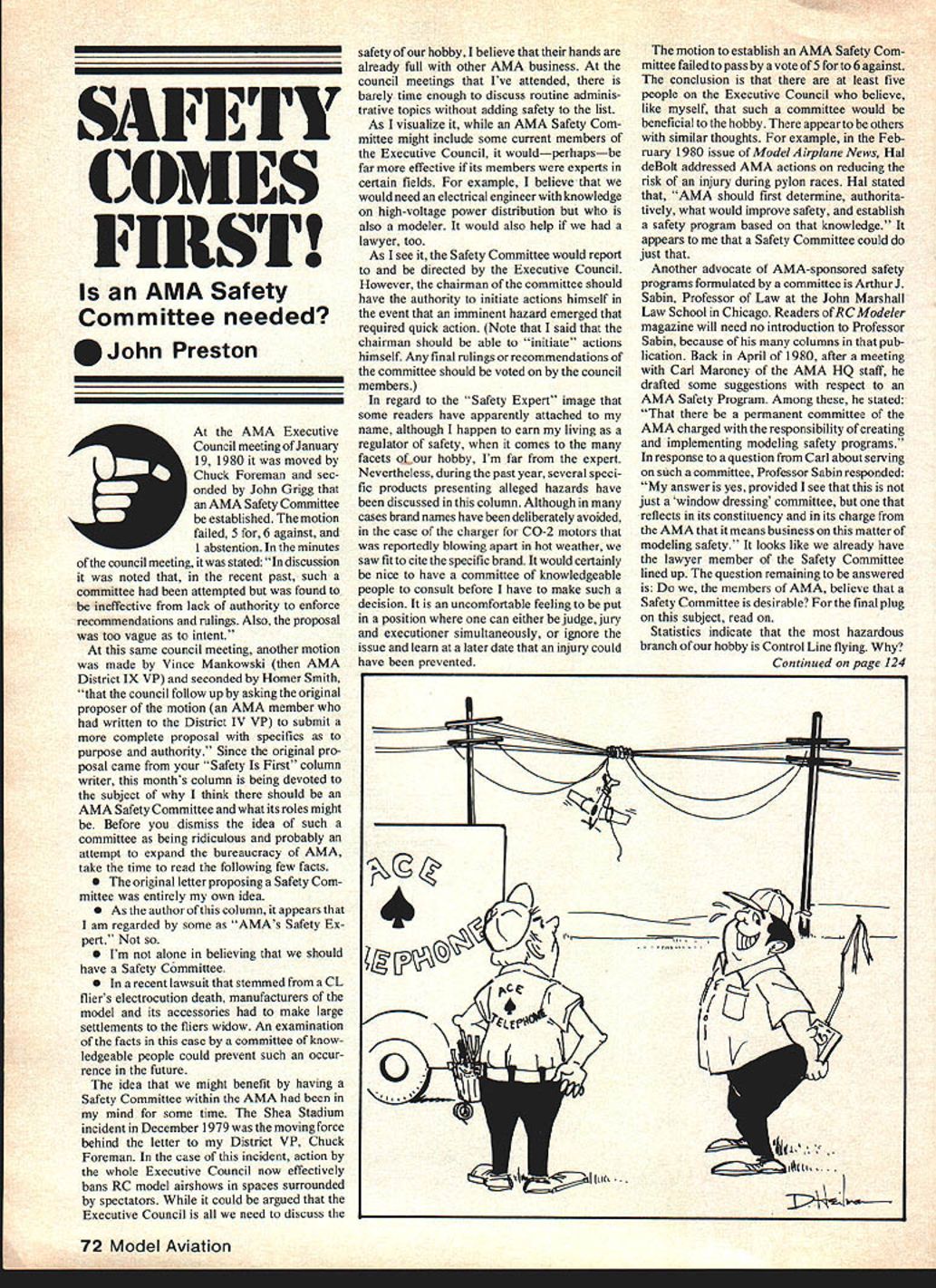
Statistics indicate that the most hazardous branch of our hobby is control-line flying. Why? Since 1974, eight people have died as a direct result of flying CL models. In all cases the model, or the control lines, contacted overhead power distribution lines, and death by electrocution was the result. In three additional incidents severe burns to the flier were the result. The most recent of these incidents occurred in April 1980. The "Safety Is First" column in the February 1980 issue of Model Aviation discussed electrocution incidents at length, and you may be wondering why it is being brought to your attention a second time. Consider the following situation.
A lawsuit that stemmed from a 1975 incident was recently settled. A substantial settlement was made against a number of hobby manufacturers. One of the arguments that decided the case was that the control-line handle was not designed to prevent this type of incident from happening. In other words, the handle should have insulated the flier from the control lines and/or the model. The question is now being asked as to whether this is feasible and practical.
While I have no doubt that non-conducting lines would solve the problem, I think that most CL fliers would agree that there are no such lines currently on the market that provide the necessary insulation and, at the same time, retain the strength and control precision of steel lines. An alternative would be to consider an insulated control handle. Although I'm only a humble mechanical engineer, I would venture to say that this would not solve the problem. I say this based on the facts of an incident that was verbally related to me by an authoritative source.
In this incident a CL model was being flown at a site bordered by power lines. The flier was standing at a point that placed his model at least 250 feet from the lines when it was at its closest point. Nevertheless, an arc jumped from the power lines to the model, resulting in severed control lines and severe burns to the flier. Power company officials who arrived at the scene after the incident refused to believe that the model was never closer than 250 feet to the power lines. In light of this incident, I find it hard to believe that a few inches of high-dielectric material, as might result from an insulating handle, would be sufficient to provide the necessary protection. The opinion of an expert is needed to resolve this question. Such an expert could either be a member of an AMA Safety Committee or be a consultant to this committee.
Another potentially hazardous situation that could be resolved by a Safety Committee involves black propellers. Reports of finger lacerations from invisible (when running) black propellers continue to trickle in. The latest report was received by Model Aviation just two weeks ago and involved an incident that required the amputation of the severed extensor tendons in a child's finger. Would painting the tips of such propellers white or yellow solve this problem? Should manufacturers of these props be asked to do this?
Conclusion and call to action
A copy of this column is being sent to each of the members of the AMA Executive Council, along with a request that they reconsider the need for the establishment of an AMA Safety Committee. If you have opinions on this subject, either pro or con, contact me or your District VP. It's your safety and the safety of your fellow modelers that we are concerned about.
John Preston 7012 Elvira Court Falls Church, VA 22042.
Transcribed from original scans by AI. Minor OCR errors may remain.

