
Safety Comes First
Gary A. Shaw
85 Twin Lakes Circle, Atoka, TN 38004
Field-box fireworks
Arriving just in time for the Fourth of July and in response to my March MA request for mail is a sparkling letter from veteran modeler Martin Gambill of Sumter, South Carolina. Martin's letter begins with a story about a fellow modeler's field-box disaster and ends with a few good tips which, if put to use, may prevent you from having a similar experience.
Martin writes the following:
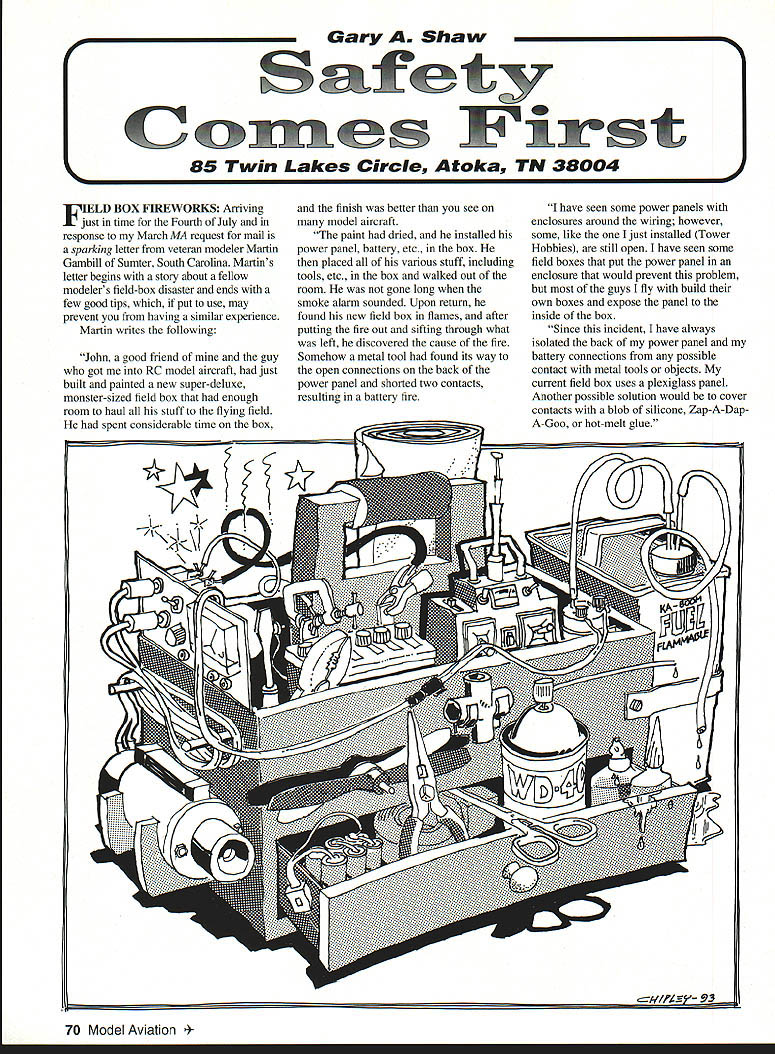
"John, a good friend of mine and the guy who got me into RC model aircraft, had just built and painted a new super-deluxe, monster-sized field box that had enough room to haul all his stuff to the flying field. He had spent considerable time on the box, and the finish was better than you see on many model aircraft.
"The paint had dried, and he installed his power panel, battery, etc., in the box. He then placed all of his various stuff, including tools, etc., in the box and walked out of the room. He was not gone long when the smoke alarm sounded. Upon return, he found his new field box in flames, and after putting the fire out and sifting through what was left, he discovered the cause of the fire. Somehow a metal tool had found its way to the open connections on the back of the power panel and shorted two contacts, resulting in a battery fire.
"I have seen some power panels with enclosures around the wiring; however, some, like the one I just installed (Tower Hobbies), are still open. I have seen some field boxes that put the power panel in an enclosure that would prevent this problem, but most of the guys I fly with build their own boxes and expose the panel to the inside of the box.
"Since this incident, I have always isolated the back of my power panel and my battery connections from any possible contact with metal tools or objects. My current field box uses a plexiglass panel. Another possible solution would be to cover contacts with a blob of silicone, Zap-A-Dap-A-Goo, or hot-melt glue."
Martin ended the letter saying the best way to prevent a problem like this is to simply buy power panels from manufacturers who make products modeler-proof by incorporating circuit shielding. Personal note: I quickly checked my panel after reading Martin's letter and discovered I, too, had bought an unshielded unit. No problem, though—a quick shot of hot glue from my daughter's glue gun and Martin's suggestion had me back in business as usual.
The letter brings up another point I'm sure you've pondered at one time or another: some modelers feel they have to haul their entire garage to the field — a monster field box — every time they go flying. No matter; I've always noticed the boxes keep getting bigger and bigger. This phenomenon has intrigued me since the day I saw a box so big it drove up to the field with a slight resemblance to an old converted school bus—justified by hobby shop wheels. Although I think "bus" might be a bit much, the limiting factor in field-box size is how much weight you can carry.
I guess some people have everything they own at the field for several reasons: poor maintenance, a sense of security — two that quickly come to mind. People found at the club can—and often do—conduct major aircraft engine diagnostic surgery almost every time they go to the field. I have reached three simple conclusions through years of observation:
- The modeler has everything along because he has traveled very far; a conscious effort is being made to avoid Murphy's Law.
- The modeler does proper equipment maintenance after days of flying, thereby needing everything at the field; expected repairs at home are unacceptable.
- The modeler has the gadget book and feels, since no one else does, he can be of assistance when requested — the school-bus theory: unusual is the norm.
Now, before you send hate mail telling me my conclusions are way off base, let me get to the point. I have always emphasized: get to the field early, find Murphy has followed, enjoy a little socializing, tell a few safety stories and do the day maintenance homework you've probably forgotten; failure to do so will likely lead to airplane demise and possible bodily injury. Never take maintenance for granted. Don't try to substitute a giant field box for essential maintenance or poor planning. Always do your homework at home and come to the field prepared to have a full day of fun.
Hungry Cub eats modeler's toes
Veteran modeler Fred C. Scaggs Jr., treasurer, Kent County Aeromodelers, Dover, Delaware, recently wrote to describe an accident. A Cub suddenly turned and consumed the better part of two toes on his right foot. He describes the event as follows:
"I started the engine (OS 70 Surpass) with a 12 x 8 Master Airscrew prop. I stood up, transmitter in hand, stepped to the right of the wing, then leaned over to adjust the engine. As I leaned over, I accidentally hit the throttle on the transmitter. The plane spun around, the prop hit my foot and killed the engine. The transmitter stick was back in about two or three seconds; it could have been much worse."
Fred described the damage to his toes, pocketbook and ego: several stitches in both toes — cuts very deep. He wore a wooden shoe with open toes for six weeks. Cost approximately $800.
He now wonders if a wooden prop, rather than the Master Airscrew he was using, might have broken on contact and caused less damage. (The Master Airscrew didn't break.) Fred adds the following comments about how to avoid this type of accident:
- In regard to selecting a prop that might break upon contact and do less overall damage, I believe wood wins the debate hands down. However, when most of us select a prop, we do so based on expected performance, not breaking reliability during an accident.
- Because of the nature of our hobby, some elements of modeling are inherently more dangerous than others. It's the manufacturer's job to design a safe product; it's our job to use it responsibly.
- Take a tip from Fred. After starting your engine, avoid becoming the next statistic: make all adjustments from behind the airplane.
Unexpected engine firing may cause injury
In my April '93 column I shared a story sent in by helicopter pilot Robert Afferback of Willingboro, New Jersey, in which he mentioned that he ran his hand through the prop when the after-run oil he was using caused the engine to start as he was flipping the prop. I requested comments from modelers who had had similar experiences, and I received two excellent letters.
The first was from Toby Hudson, a high school junior and member of the Silent Electric Flyers of Long Island (SEFLI). Toby indicated that he would like to help stop a few people from losing a finger or two by sharing the following with us:
"I, being a member of SEFLI, have never experienced this problem because I only fly electric planes; however, today in my physics class we were studying adiabatic machines and thermodynamics (pistons and effects on pressure and temperature), and the teacher did a demonstration that is similar to what occurs in a glow engine when you flip the prop while applying after-run oil.
"What he did was put a small piece of cotton and some alcohol or oil in a test tube, and then inserted a long piston and pressed it down forcefully. The cotton immediately burst into a bright flame. When you spray an after-run oil into a glow engine, you are providing fuel for it, and if the prop is spun quickly enough, the compression stroke may be enough to ignite it and start the engine running."
Right on the money, Toby! As far as I'm concerned, you get an A for class observation in addition to taking the time to share your thoughts with about 160,000 potential finger-whackers. Show this magazine column to your teacher, and tell him we appreciate both your efforts.
The second letter arrived more recently from James G. Smith, Erial, New Jersey, who indicated that he had written to my predecessor, John Preston, on the same subject some time ago. James goes over what he told John:
"Most glows, and notably diesels, will at least fire if enough oil gets up into the head to raise the compression ratio to the point that enough heat is produced to initiate combustion. The problem can be lessened by using the proper oil in the first place, and I can't think of one spray-type oil that can be described as proper.
"The problem is that the oil enters the motor as a mist to begin with, and that makes it already conducive to spontaneous ignition.
"Secondly, most modelers tend to over-oil, which gets all that oil up into the head, thereby raising the compression ratio to the point that it will fire. Some oils that I've found to be unacceptable engine protectors and subject to inadvertent firing are CRC, WD-40, 3-in-1, and Marvel Mystery Oil.
"Most common after-run oils, especially spray types, have one major problem: Over a period of time (usually a month or more), they tend to dry out and lose their protection. The solution to that particular problem is to get some oil used to lubricate commercial air-driven tools like air wrenches or air-driven nailers or staplers.
"These tools are especially prone to damage from moisture, so the oils tend to disperse water. Also, these tools may be idle for long periods of time, so the oil must hold up until the next usage. Air-tool oil can be purchased at most large hardware stores.
"Next, some dos and don'ts for lubing engines. When flipping an engine, either by hand or electric starter, always assume that it will start on that flip. This rule is ingrained on every full-scale pilot and should also be on modelers as well.
"Whenever I hand-prop my Ercoupe, I assume that the ignition is hot—even if I know that the key is off. It's the unexpected firing that causes injury. Note that I said firing, as the engine does not actually have to start and run to cause injury.
"Don't over-oil. All you have to do is neutralize the last dregs of combustion and then coat the moving parts with oil to protect, especially the bearings and cylinder bore.
"Don't add your oil (whatever type you choose to use) and then flip the prop with the intake ports on the down side, or worse, with the engine upside down, as this aids in getting the oil up into the head where it can fire off.
"Even if it doesn't fire, you may get so much oil up there that you end up with a hydraulic lock, where the engine can't turn over, and the prop will come to a screeching halt. When this happens, one of two things will occur.
"First, if hand flipping, you'll probably slice your finger as it slides off the trailing edge of the prop. Second, if using an electric starter, something is liable to break, most likely the conrod or the crankpin.
"The best procedure for oiling an engine is to fill the venturi (or the carburetor, if RC) with oil, then slowly turn the engine over until the oil is spread throughout the bottom end. If you're running a muffler, there isn't an inlet to spread the oil, so it is best to take the muffler off and squirt it in through the cylinder port. Do not overfill.
"After that, pull the prop over until the oil works its way into all the nooks and crannies. If you have nothing but a glow plug in place, don't expect much more you can do except repeat the process a couple more times.
"If you have an open exhaust, as in control line and free flight, close the exhaust port with the piston and wet the piston's surface with oil and give it a few slow flips. Then with the piston down and the port open, try to get a drop or two — no more — against the bypass ports on the liner opposite the exhaust, and flip it over again a few times slowly.
"After all this, all the parts should be properly coated, and no injuries should have occurred. The most important thing is to flip slowly. In control line racing, the guy with the slowest flip has the slowest restarts! Therefore, flip slowly, and don't get hurt!"
The only thing I can add to what James has provided is my preference for after-run oil. An after-run oil that I feel protects engines very well and hasn't eaten up silicon pump parts in any of my engines over the last few years is Mercon Dexron II Automatic Transmission Fluid. Well worth the 98-cents-per-quart investment.
In parting this month, let me leave you with two notable quotations:
- Any system that depends on reliability is unreliable.
- Death has been proven to be 99% fatal in laboratory rats.
Don't take chances this Fourth of July, and have fun at the field. Keep the mail and club newsletters coming.
Until next month.
Transcribed from original scans by AI. Minor OCR errors may remain.

