
Safety Comes First
Gary A. Shaw 85 Twin Lakes Circle, Atoka, TN 38004
Big Bird Bites Modeler
BIG BIRD BITES MODELER. No, this isn't a story about some new species of bird that swoops down and bites unsuspecting modelers when they least expect it. It's just a slightly sensationalized headline designed to attract your attention toward this column with the hope that you might read it!
Cheap trick, but it worked, so why not continue reading a story sent to me by Charles Castaing, of New Iberia, Louisiana. He describes an "arm-in-the-prop" encounter with a "big bird" in the following letter:
"I was starting the SuperTigre 3000 on my Ultra Hots with a chicken stick in my right hand and a friend holding the plane during this procedure. I was also holding the plane with my left hand, and my forearm was close to the arc of the prop.
"I was extremely aware of the possibility of the plane surging forward and striking anything in its path (i.e., me!). What I didn't expect, and what caused injury to my arm, was that the engine started backwards! My left arm was holding the plane and was braced for a forward motion when suddenly the plane moved backwards.
"The result, predictably, was that my arm was pulled into the path of the prop. Fortunately, I had on a long-sleeved shirt and a light jacket (unusual for southern Louisiana). The injury did hurt, but it required no stitches, and x-rays revealed no damage to the bone.
"The lesson learned? Never! Never! Never! Never hold the plane while starting the engine, particularly the big bird engines!"
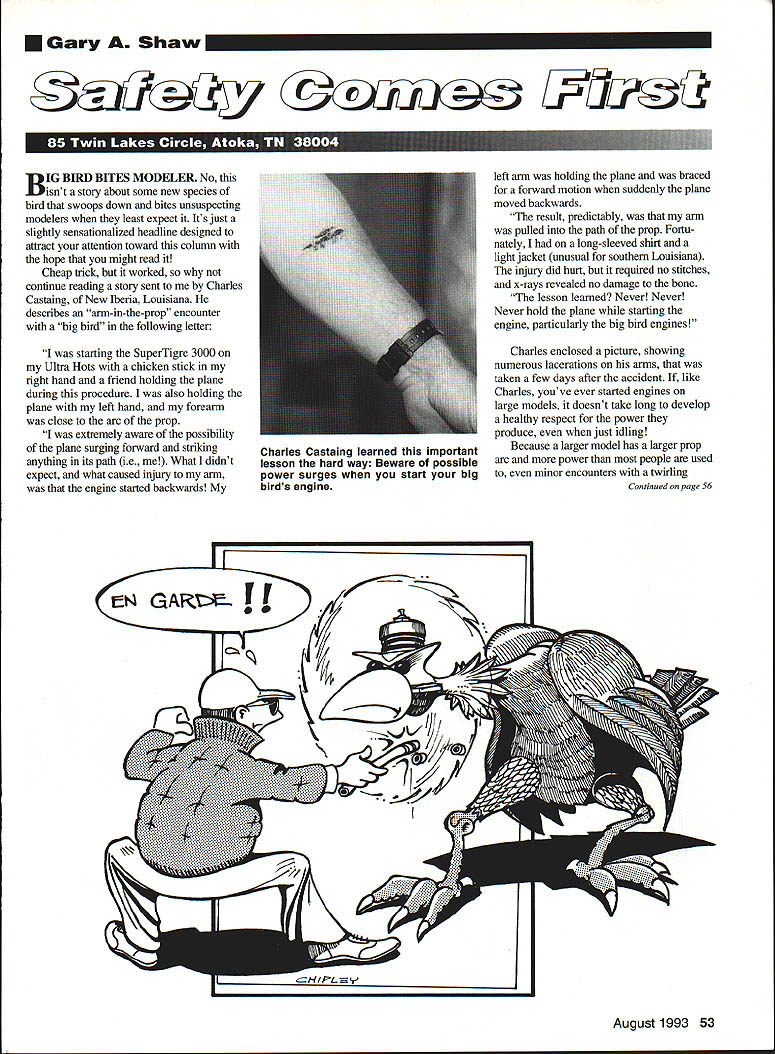
Charles enclosed a picture showing numerous lacerations on his arms that was taken a few days after the accident. If, like Charles, you've ever started engines on large models, it doesn't take long to develop a healthy respect for the power they produce, even when just idling!
Because a larger model has a larger prop arc and more power than most people are used to, even minor encounters with a twirling blade on a big bird are much more likely to cause serious injury.
To add clarification to Charles's comment "Never! Never! Never hold the plane while starting it," you should take that to mean that your assistant should hold the plane securely from behind while you flip the prop with a chicken stick or an appropriately sized starter. Remember to stand back a sufficient distance to protect yourself from any possible plane surge when the engine starts.
Recommended safety steps when starting large-model engines:
- Have an assistant hold the model from behind; do not hold it yourself while flipping the prop.
- Use a chicken stick or an appropriate starter and stand back.
- Wear long sleeves, eye protection, and other appropriate PPE.
- Be aware an engine can start backward and cause unexpected movement.
RC Launching Buddy
Recently I received a neatly packaged product in the mail from the R/C Launcher Co., 5806 Lancelot Court SW, Olympia, WA 98502. Inside I found a handsomely designed R/C launching system developed to offer another helping hand when trying to start an aircraft at the field.
At first blush, the launcher appeared extremely durable and well thought out. It was clear that no expense had been spared to produce this high-quality product. The unit incorporates a very simple one-step release mechanism which, when activated, drops the arms that hold a model.
Lifetime durability is virtually guaranteed because fiberglass-filled composite parts are used throughout.
To use the unit, you simply place it where you want it, anchor it to the ground with the four steel stakes provided, and lift the arms into the locked position. While testing the unit, I found the spike-mount method so secure it was virtually impossible to pull loose!
During field trials near my home, I tried everything I could think of to make something fail; however, the unit is built so well that none of my efforts produced negative results. Frankly, I was so pleased with the unit I've found myself recommending it to virtually every modeler I know. In my opinion it's a product whose time has come — and one that should be considered part of every AMA-chartered field!
Although this unit should never be used without the presence of another modeler, I believe it offers a safe second pair of hands.
On a negative note, the picture that advertises the product shows a gentleman kneeling in front of a plane held by the launcher, checking engine RPM with a tachometer at full throttle. Although the launcher is perfectly capable of holding a model at full throttle, modelers should never subject themselves to potential hazards related to loose or broken props flying forward.
Always make adjustments from behind the engine. A tach works just as well from the rear as it does from the front. A call to the folks at R/C Launcher revealed they were already aware that the picture posed a major safety concern and were changing their advertisements.
Additionally, if you happen to fly off paved runways, you'll have to find some open ground to anchor the unit. A possible solution might be to anchor one in the grass at the edge of a runway start-up area.
As indicated on the box and in a letter from the manufacturer, the unit is available in sport, control-line, and big-bird models at a reasonable price. It's a great gift; every modeler's sweetheart should consider buying one for her man, or vice versa!
Dial 911!
A letter received this past March from electric model flier Robert A. Johnson, Calabash, North Carolina, pointed out a potentially serious safety deficiency he has noted while attending numerous club fly-ins. Robert makes the following observations:
"I have attended fly-ins at a good many club fields and have yet to find a posted emergency plan. I have made discreet inquiries of many event officials, and have come to the conclusion that being prepared to handle a heart attack or serious injury is not on their agenda.
"The average flier at the typical field is 20 miles or so from home and has no idea which rescue squad or fire department serves the field location.
"Personally, I am of the opinion that AMA should require the submission of an emergency plan as a condition of issuing a club charter or event sanction. As an insurance carrier, it is certainly their right to do so.
"As a member of another radio club, I have helped to provide standby communications for various types of events—everything from bicycle races to cucumber festivals. In a few instances, our being there was worthwhile; we actually contributed to a life-saving effort.
"None of the radio clubs to which I've belonged have ever been called upon to help at a model aviation event. Maybe the Pickle Growers Association cares more about the safety of their guests!"
Ouch. That's a hard pill to swallow. Searching back through my mind for the number of times I've seen emergency coverage provided at local events leaves me scratching my head. I can't recall a club meeting I've attended that covered the basics of first aid. Since I work in the medical profession, you might think I would be more inclined to pass on what I know to my fellow modelers; instead, because the hobby serves as a stress release for me, I unintentionally find myself feeling slightly guilty.
As for the rest of you out there, I'd like to disagree with Robert Johnson on your behalf, but I still can't think of enough supporting evidence to do so. Naturally a few events with obvious coverage do come to mind, but only very large events at which the obvious lack of medical support would be criminal — events held on military installations or national/international contests. I can count those on one hand.
Out of concern regarding Robert's observation, I rummaged through the few AMA rule books I possess, thinking I must have missed something that requires organized club or association emergency coverage at sanctioned events. As I write this column in early April, I still haven't discovered past AMA guidance on this subject — not even a recommendation regarding the contents of a first-aid box!
Now I know what I've already said is going to result in a flood of mail, so while writing, take the time to share with me what your club does to educate its members regarding first aid, first-aid box contents, and emergency response plans.
I'll share the responses with you in this column and forward some recommendations to AMA.
Debate Continues Over Cellular Phone Safety
Considerable discussion has taken place recently regarding the safety of electromagnetic radiation from low-power frequency emitters such as cellular phones, police walkie-talkie radios, and radar detectors.
The debate stems from a Florida man's lawsuit claiming his wife died of a brain tumor that he feels resulted from exposure to radio waves emitted near her head while she was using a cellular phone. Since it became a media issue in mid-March, I've received a few letters from concerned modelers seeking information related to our risk from exposure to electromagnetic radiation emitted by our transmitters.
Without going into lengthy detail this month describing radio frequencies, frequency bands, power emitted, and population studies conducted concerning exposure to electromagnetic emissions, let me just say I'll review the literature available and report in a future column.
Currently I'm only aware of research done in this area related to occupational exposures—i.e., constant exposure over an eight-hour time-weighted average from high-power emissions. That type of research might be applied to those working in the hobby manufacturing or repair area.
Without conducting a review, I'm not aware of any research that relates to infrequent hobby exposure to low-power sources like hobby transmitters. Rest easy: I think it's safe to assume the sunburn we get at the field or exposure we receive from the television does us greater harm than our radios — just ask my wife.
Parting Thought
It takes a minute to write a safety rule... It takes an hour to hold a safety meeting... It takes several meetings to plan a safety program... It takes several months to put it into operation... It takes a lifetime to make a hobby safe. It only takes a second to destroy it all with an accident.
Until next month, Happy Landings!
Transcribed from original scans by AI. Minor OCR errors may remain.

