
Safety Comes First
Gary A. Shaw
85 Twin Lakes Circle, Atoka, TN 38004
Malicious Mischief
I received a call recently from a concerned modeler who pointed out that radio hits we sometimes receive when flying may actually be signals transmitted by other modelers intent on shooting down RC aircraft. Or they could be the result of trim tab settings changed through tampering when radios are left in the impound area.
As he described it, he was referring to a select group of modelers allegedly spread throughout clubs in his hometown. He had overheard them at a fun-fly, laughing about adverse outcomes of outright attempts aimed toward shooting down an aircraft.
The caller provided a story about a particular modeler who, while flying at his field one sunny afternoon, received a page from his office that required him to leave for a short period of time. Not wanting to pack up all his equipment for what he knew would be about an hour's absence, he asked another flier to keep an eye on his gear until his return. After a short absence, he returned, thanked the person who had watched his gear, and began to fly.
As soon as he left the ground, he knew he was in trouble. The aircraft dove toward the ground with neutral stick and pulled hard right. Hearing his cries for help, a more experienced pilot took controls and landed the aircraft. The modeler was perplexed. He had flown the plane earlier with no problems, and the weather was picture perfect. What had changed with the airplane or the radio?
Upon investigation, it was discovered that the electronic trim memory function of his Futaba Super Seven had been programmed to memorize fully deflected trim settings—down elevator and right aileron. However, the trim tabs themselves recentered on the radio, giving the appearance that all was well.
A conversation with the individual who watched the plane revealed he was unaware of any tampering.
His next story was a little more disturbing. He heard the same group of modelers chuckle over a crash that resulted when a frequency was intentionally turned on to jam that of another modeler flying his plane. Apparently the modeler had fallen into disfavor with this particular group of individuals, who allegedly set out to discourage him from the hobby because of "radio interference."
Although I do not intend to mention in this column who passed the information to me, where the events allegedly took place, or if the individuals involved have been exposed, I thought the content of the stories significant enough to pass on, hoping we might learn from them.
How can we prevent this sort of thing from happening? A few things come to mind:
- Each time you set up at the field, be sure to do a range check of the radio before flying.
- After obtaining the frequency pin, turn the receiver on first to see if the aircraft responds to any radio signals emanating from radios left in the impound area or from a radio whose owner has switched crystals but not frequency flags. Then turn on the transmitter.
- With the antenna collapsed, walk away from the plane, moving the sticks until the aircraft stops responding. My owner's manual says the distance should be more than 75 feet; I use that as my guideline.
- Each time you pick up your transmitter from the impound area, visually check the trim settings to ensure no roaming hands (usually curious kids) have changed things.
- Beyond a safety check, range check, and having the pin for the frequency, there's not much one can do to make things foolproof.
- If you suspect foul play (sabotage) at your field, take action immediately by informing your club officers about your suspicions.
Should have stayed in bed
I guess it wouldn't be fair if I wrote about everyone else's experiences and omitted my own. On that note, my most recent blunder began May 1 with an unplanned, unprepared trip with the kids to attend the annual Five Flags Pattern meet at Pensacola, Florida. I kept hearing that if you wanted to compete with some of the best pilots, this was the meet to attend.
As luck would have it, on the way from Memphis to Pensacola, the weather turned sour and stayed that way the entire drive down.
On the first morning of the meet, the rain appeared to be holding off, and the sky was full of aircraft making final trim adjustments in preparation for the 9 a.m. start time.
I knew I should have stayed in bed. While assembling my LA-1, I dropped the belly pan screws in the grass and couldn't find them. Not to worry, though—I always carry extras. I assembled the plane and completed half a round when sudden rain convinced me I should land. Because of the rain, the meet didn't start until 3 p.m., but went smoothly once underway.
The next morning proved to be a little better weather-wise, and most pilots had stayed to finish out the meet. After assembling my plane and checking the battery power, I decided I'd feel better if I topped off the juice with my fast-charger. Since my charger doesn't have particularly long leads, I placed the aircraft in front of my truck, lowered the hood just in case it rained, and wandered down the 200-yard flight line, shooting the breeze.
I had been talking to folks for about an hour when I heard an announcement that donuts and hot coffee were available in the food tent. A quick glance at my kids confirmed those donuts sounded too good to be true, so we hopped in the truck and started off down the line.
CRUNCH!
Waves of nausea and anger flowed through me as I realized the source of the crunch was my airplane, now located somewhere under my right front tire. I can't describe the humiliation I felt once my buddies gathered around and asked what happened.
Let me quote one of the many comments made by my so-called friends: "Well, Mr. Safety, I guess this accident is one for the column, right?"
In review, a few important lessons can be learned from my embarrassment:
- Always preflight your aircraft after each day's flying and fully charge the batteries before flying again. Had I done this, I wouldn't have needed a fast-charger to top things off.
- Never place an aircraft in the path of something that can move, especially a Ford F-150 pickup.
- If fast-charging from a vehicle, do whatever is necessary to give visual cues that the fast charger is still connected to the aircraft. Since my hood was lowered, nothing was visible to remind me about the location of the aircraft.
Ride 'em, cowboy
Probably even better than driving over your own airplane is a story sent to me this month by John B. Morris of Princeton, Kentucky. John tells his story in the following letter:
"It was a beautiful day and perfect to go for an afternoon of flying. I tied my Big Bingo! to the top of my van and drove to the local airport. My friend Gunther Priester arrived about 10 minutes later.
"After two flights with my Sig 4-40, and Gunther's making a flight or two, I took down the Big Bingo! After fueling, I attached my glow starter. It is homemade with a D-sized Ni-Cad, an 18-inch zip cord, and a connector for the plug.
"I had a routine start and began to remove the glow starter. That's when the routine became extraordinary.
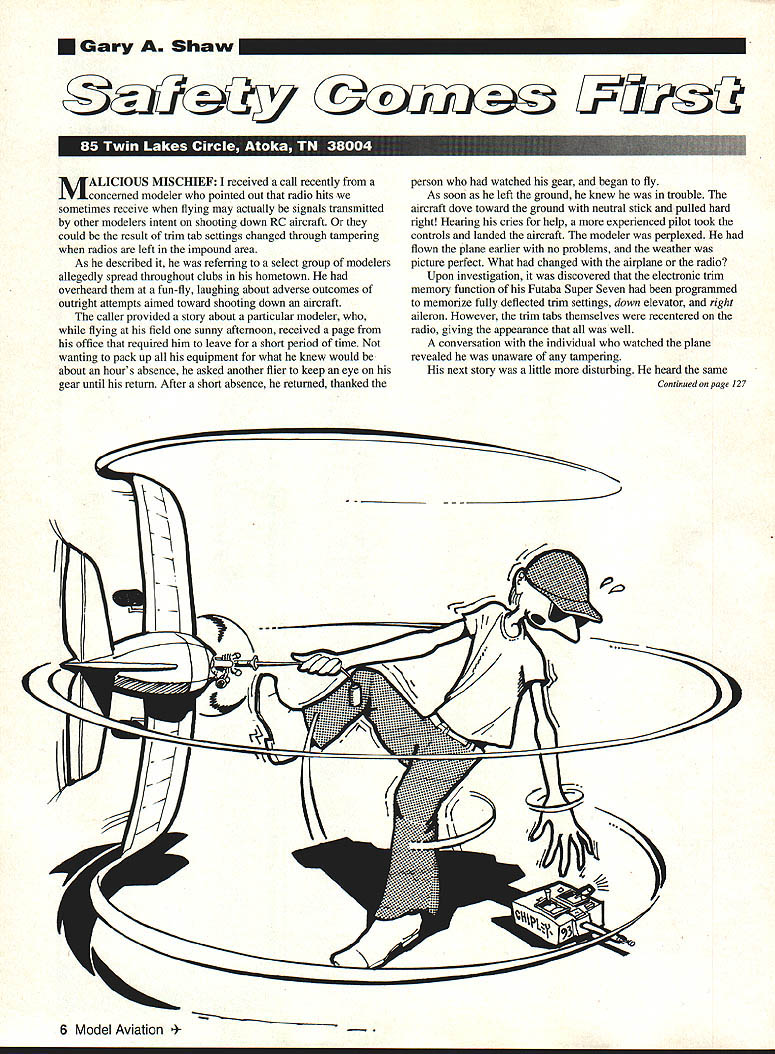
"I grasped the battery with my left hand, and reaching around the prop, I brushed the transmitter throttle control, and the YS-120 four-stroke roared to life. The pump and blower did their job, and the plane became a living thing with a head of its own. It started for me and the car as I hung on to the battery and turned the plane.
"I immediately became airborne and flew around me with an 18-inch control line. My friend could do nothing! If I grabbed the only wing available to my right hand, the plane would fly directly into me.
"After four complete circles with a control line 18 inches long, I was able to pick up the transmitter and reduce the throttle setting.
"With the plane sitting on the concrete, I collapsed into a lawn chair and exhaled a great sigh of relief.
"In flying, we often become careless and do things that put us and others in great danger. I have resolved to be more safety conscious!"
All I can say is that John must really love his airplane to hold onto it until he could reach the transmitter. I believe had I faced the same dilemma, I would have tossed the plane if I were sure it wouldn't be thrown toward a bystander.
Thinking about it a little more, John probably completed his circles in record time and didn't have the time to think. Would it have been safer to ask another modeler to start the aircraft while John held the transmitter? Thanks to the Ni-Cd, at least John will get another chance.
More lost battery packs
In my June '93 column, I did a short piece entitled "Migratory Battery Packs" in which a modeler shared some insight into what happens when a receiver battery pack disconnects inside an airplane.
This month I received another letter describing a related incident involving a helicopter. Modeler F. Meincher tells the following story:
"The pilot had just run up his helicopter, which needed a little trim so he idled it down. At that moment the on-board battery fell out onto the ground allowing the fun to begin! Just then a gust of wind picked up the heli and swept it downwind toward the flight line. Everyone scattered except for me; I was lying flat on the ground.
"The breeze stopped, and the heli settled down bumping a blade and stopping the engine—no one injured this time.
"The moral of the story—anchor the battery and servos securely, lock all electrical connectors with tape, twist ties, rope, and whatever will fight the vibrations."
As I mentioned in the June column, I've used Velcro to mount equipment in everything from Piper Cubs to wildly gyrating helicopters with total success. The trick to success is a clean surface, plenty of epoxy, and taped or tied connectors.
Bullets for ballast
Letters from four modelers this month took strong issue with me regarding the "Exploding Payload" portion of my June '93 column. All four letters shared the opinion that there is no danger from live ammunition if used in an aircraft for ballast.
One letter in particular, from Bob Haas of Conway, Connecticut, provided some clarifying information in a more pleasant tone than the others. Bob wrote the following:
"Concerning the portion of the piece titled 'Exploding Payload,' I feel that a clarification of the dangers of using live .22 caliber ammo as ballast should be considered.
"While I don't advocate the use of cartridges as dead weight in a model, I don't think one has to be overly concerned about the danger of those cartridges as explosives. The fuel used by the engine probably is more dangerous than the cartridges.
"It can be shown that when a few .22 rounds are carelessly thrown into a fire, the heat ignites the primer/powder in the cartridge, but since the cartridge is not confined, as in the chamber of a gun designed to fire it, no dangerous pressures are developed, and the cartridge usually makes a loud pop and the bullet separates from the case, but not with enough velocity to do damage.
"Ammunition has its proper place and use, and putting it in a model as weight is not one of them, but it is also important not to cause alarm out of proportion to the facts.
"The statement 'What kind of fool would risk several lives for the sake of tail weight' is out of place, but understandable. The builder of the model probably thought that the ammo was heavy and not likely to be set off. When you think about it ... he was right.
"While I'll agree one could debate the danger of ammo used as ballast weight in a plane, I can't help but think of countless other alternatives that could be used to eliminate any potential risk and/or controversy altogether."
A review of paragraph 8 of the AMA Safety Code may lend assistance for some in this area. As for me, I'll stick to lead weight every time!
Many happy landings!
Transcribed from original scans by AI. Minor OCR errors may remain.

