
Gary A. Shaw 85 Twin Lakes Circle, Atoka, TN 38004
Safety Comes First
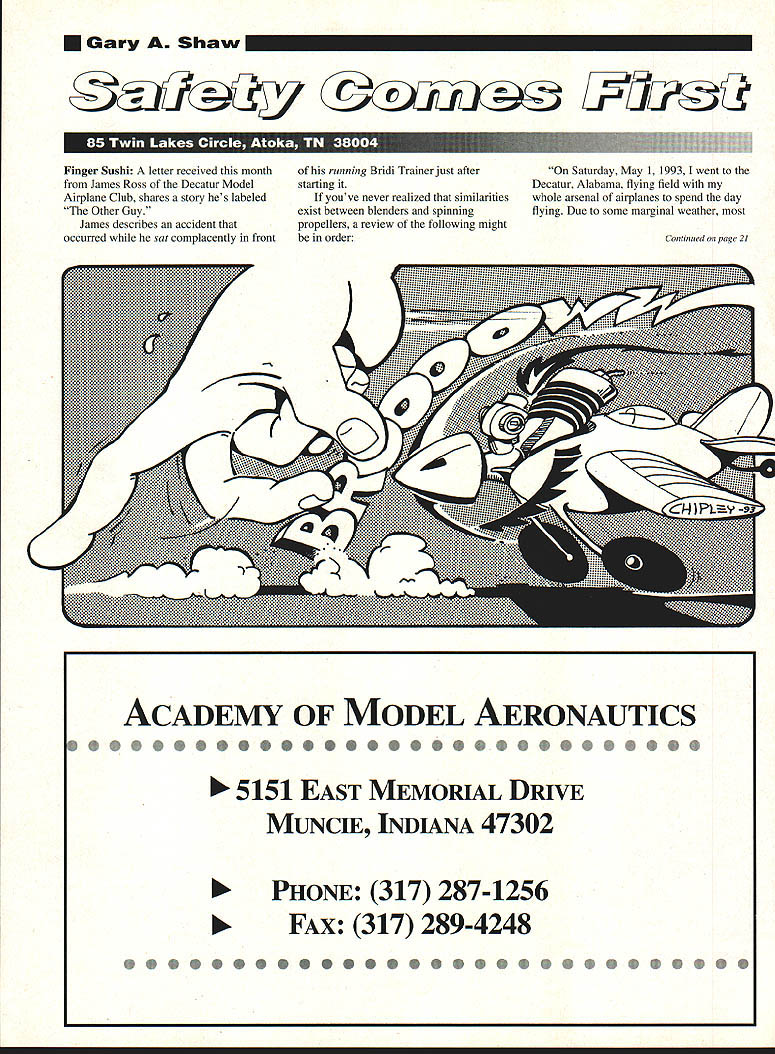
Finger Sushi: "The Other Guy"
A letter received this month from James Ross of the Decatur Model Airplane Club shares a story he's labeled "The Other Guy."
James describes an accident that occurred while he sat complacently in front of his running Bridi Trainer just after starting it. If you've never realized that similarities exist between blenders and spinning propellers, a review of the following might be in order:
"On Saturday, May 1, 1993, I went to the Decatur, Alabama, flying field with my whole arsenal of airplanes to spend the day flying. Due to some marginal weather, most of the members had packed up and gone home, leaving only myself and one other flier at the field. Luckily my wife and daughter were there also, as she was elected to take me to the emergency room while my friend packed up all my stuff and brought it home for me.
"One of my planes suffered a minor mishap when the wind blew it off a table and broke the needle valve flush with the housing. After a few expletives, I put it up and got my Anniversary Cub out, fueled it up, took off, and when trying to show my friend how low and slow it would fly, caught the wheels in the grass and stuck the nose in the ground, breaking my cowling into a bazillion pieces. Into the van it went.
"About now something should have told me it was time to give up and go home. Did I? Naw! Like I said, 'That stuff only happens to the other guy.'
"Okay, last chance, out comes the Bridi Trainer. Ha! Ha! Trainer — this thing is a rocket. It will do 2,765 rolls in a second. Well, okay, maybe only 1,765. It will lomcevak faster than most aerobatic airplanes. At any rate, it is a very light, fast, maneuverable airplane equipped with a Webra .40 Schnuerle engine and a 10 x 6 propeller that responds instantly to the engine's commands.
"One of the bad habits I've developed over the years is sitting down in front of the airplane to start it. Another is messing with the radio while sitting there. Yet another is not waiting for someone to assist in holding and moving the airplane after it's running. Quite a list of dumb habits, ain't it?
"Well, to get on to the meat (pun) of the incident, I was sitting in front of the plane, started the engine, removed the glow-plug battery, and was moving the radio off to the side so I could get up and take the airplane to the runway. Something, and I still don't know what, hit the throttle control moving it to the full position. The plane did exactly what it was told to do and went wide open, jumping the foot-and-a-half distance between us in about half an instant.
"All I remember is the ugly sound propellers make when they chew up fingers (blender effect). Fortunately, the engine died and didn't get anything else to eat. I grabbed a clean rag and wrapped my hand in it, afraid to even look to see if there was anything left of my now completely numb hand.
"What were the damages? I lost the end of my thumb, the whole left side of my index finger from the tip to the first knuckle, a cut on the right side of the same finger that went to the bone and chipped it. The end of my middle finger went away, my ring finger was cut diagonally through the nail and nail bed to the left side. The doctor took some skin and meat from just above my elbow to rebuild my index and middle fingers, and sewed the other fingers back together. Right now I look like I have a hand full of marshmallows, what with all the bandages and tape.
"So you say, what have you learned? Well, I picked up on several things:
- Never start your airplane without some means of restraining the airplane—either a person to hold it, or some sort of mechanical restraint.
- Never sit down in front of a running engine.
- Never, never fly model airplanes by yourself. Always have someone go with you.
- Always, if you use plastic or carbon-fiber or glass-filled nylon propellers, dull the edges and rebalance them. As they come from the factory, they will cut like very sharp knives.
"I am sure there are other things that should be brought out about safe model operation, but for now, these should keep me from having to pay another visit to the emergency room any time soon!"
As James pointed out, it's unfortunate that modelers continue to injure themselves in ways that are preventable. Of all the mail I receive each month (one or two letters), "something went into the prop" stories continue to hold the lead. Folks, we all know props are dangerous; however, injuries are plentiful, and complacency continues to abound.
What's the solution? Can injuries be reduced? Sure. We all know they can be, if we try, and most of us do. Be an actively concerned modeler and do your part to practice the safety approach! Offer a helping hand when needed and influence those around you by teaching sound safety practices. The fingers you save may be your own.
Sun spots
I have no doubt that many of us are familiar with what happens to our vision after we've accidentally stared into the sun for a moment as our aircraft flies through it. For those of you who haven't had this pleasure, it can best be described as an initially painful sensation, followed by bright dots remaining in the center field of vision for a brief period of time.
Since forward vision can be temporarily blocked by these sun spots, real potential for aircraft demise exists unless a fellow modeler is available to temporarily take the controls.
To avoid this problem, most clubs try to find fields that allow positioning of the runway so the sun is to a flier's back from sunrise to sunset. Normally, one would think that having the sun on your back would open the sky to a full day of flying opportunities, but for Kevin Cassidy of Northport, New York, this benefit proved to become an interesting liability. Kevin writes:
"I want to alert model fliers to a subtle and dangerous phenomenon that can occur when you think you are well protected during a lengthy period of flying.
"I was recently treated to one of the best RC flying weekend weather periods in memory. The sky was crystal-clear blue, cloudless, and there was virtually no glare since the humidity was so low. Cool temperatures and a light breeze made for two days of absolutely perfect time to test winter-built projects and bank old favorites. I spent many hours at the field.
"My flying site is situated such that we can keep the sun behind us at all times. This has, I thought, been an interesting benefit. Throughout the day, the fliers subconsciously become a sort of 'negative solar collector' by keeping the sun behind them at a generally constant angle. That's comfortable to the eyes, of course. My prescription sunglasses are quite dense, and I always thought my eyes to be well protected while looking skyward; however, at the end of each day my left eye hurt terribly.
"An optics scientist has confirmed my suspicion that my eye was sunburned by the sunlight reflected into my eye from the inside surface of my sunglasses. I had unknowingly held my head at a nearly constant and correct angle to capture the backward-entering rays.
"The moral of this story is that a side shade attached to the glass frame is sometimes as important as the lenses themselves."
Vintage control-line story
Although it's a vintage story, the advice it provides is still very germane to all control-line enthusiasts flying today:
"The picture of Howard Bueschel on page 59 of the March issue of MA brought to mind a happening I experienced in 1953. I just realized that was 40 years ago and U-control was big in those days. Back then I had a brand new Veco Chief with a Super Cyclone engine installed and my flying buddy was, and still is, Tom Delmont. Normally, we held each other's plane for takeoff.
"As things sometimes happen, on one particular flying day, Tom was nowhere to be found. I waited about an hour, and he never showed up at the flying site, so I decided to fly the Chief anyway. I had read somewhere that to launch a U/C airplane without the help of another person or a stooge was possible with the following steps. All you had to do was drive a stick in the ground halfway from the center of the circle and pass the lines around it and back to the plane. The plane then would start taking off, circling around the stick and become airborne.
"Well, I followed this procedure, drove the stick, strung the lines, started the engine, and reached for the handle, but it wasn't there! I had replaced the plane before I reached for the handle, and so the plane rolled around the stick and into the air. With 50 feet of lines and the handle holding the left wing in a bank, the new Veco Chief and Super Cyclone lazily circled out of sight, never to be seen again.
"Needless to say I haven't repeated this trick again and do not recommend this idea to anyone. The point is never fly alone! If there are no other people at the flying site, go home! Tomorrow is another day, and it will be a safer one too."
Tips and Tricks
Ron Ogren, of the R/C Aircrafters of Western New York, recently wrote to relay a concern regarding the use of a safety pin as an antenna holder as suggested in the "Tips and Tricks" column, page 84 of the March '93 issue.
As described, the suggestion called for you to squeeze the clasp of a safety pin with pliers to form a small hole, then thread the antenna through it and into the coil's hole. The sharp end of the pin is then pushed into the end of the fin to secure the antenna.
Since the inside of the clasp on a safety pin is somewhat sharp, Ron is sure — and so am I — that in a very short time the wire will be cut by pressure, vibration, or snagging, and result in a suddenly short antenna! Since changing the length of antenna alters the tune of the receiver (or so I am told), a resulting crash may be possible.
Ron suggests a better method that uses a rubber band to secure the antenna to the fin, and a piece of soft tubing that the antenna should pass into as it goes through and exits the fuselage. I use the same method on all of my planes. For tubing, I prefer the type used for aircraft.
Until next month, soft landings!
Transcribed from original scans by AI. Minor OCR errors may remain.

