
Gary A. Shaw
85 Twin Lakes Circle, Atoka, TN 38004
Safety Comes First
Mail Call
I'm constantly searching for topics that readers might find interesting, and it's always a pleasure to receive cards and letters that ask questions, tell stories, give pictures, etc., for use in the column.
Recently the mailbox seems to have dried up. I've discussed this with other columnists to see how they generate mail, and I'm told that a little controversy always sparks someone's interest. I've also been advised that satisfied readers don't always write, because they think you're doing such a good job, and are flooded with information, that their efforts to jot something down and forward it along would just go into the giant mail pile. No pile here!
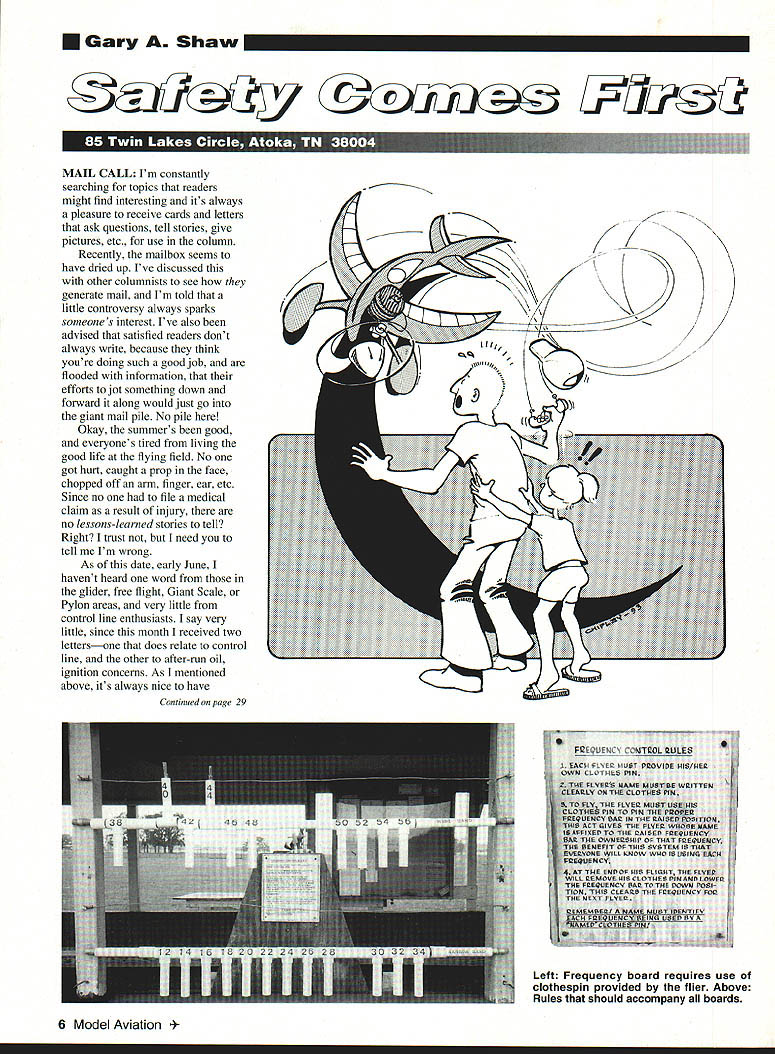
Okay, the summer's been good, and everyone's tired from living the good life at the flying field. No one got hurt, caught a prop in the face, chopped off an arm, finger, ear, etc. Since no one had to file a medical claim as a result of injury, there are no lessons-learned stories to tell? Right? I trust not, but I need you to tell me I'm wrong.
As of this date, early June, I haven't heard one word from those in the glider, free flight, Giant Scale, or Pylon areas, and very little from control-line enthusiasts. I say very little, since this month I received two letters—one that does relate to control line, and the other to after-run oil and ignition concerns. As I mentioned above, it's always nice to have abundant material to choose from, so if you could, lend a helping hand.
Duck and scramble
In the control-line arena, it's a pleasure to recognize Jack R. Ellison from the Arizona Radio Control Society ranks, who reminds us to check, check, and double-check to avoid accidents. This applies to control-line fliers just as it does to those in RC. Jack describes the following:
"My twelve-year-old daughter wanted to build and fly a model airplane as part of her school science-fair project on 'How and Why an Airplane Flies.' Being an old control-line flier I had several CL kits packed away for a rainy day and was able to supply her with a Ringmaster Jr., Fox .15, and the necessary miscellaneous parts to construct her first model, and I might add, a beautiful science-fair project.
"I decided to start my daughter off on the Snorkey because of its docile handling and rugged construction (sort of a control-line Duraplane). After the third flight I felt that she was beginning to get the feel of the airplane and understanding of flying she would need to fly her own airplane. A couple more flights and she'd be ready to solo.
"We locked the Snorkey into the launching stooge and fueled it up. I started the engine and moved to the rear of the plane to tune it; meanwhile my student pilot went out and picked up the control handle. I went out to her and asked if she was ready; she gave me the nod and I pulled the cord to release good ol' reliable Snorkey.
"Snorkey left the stooge and started its takeoff roll. My daughter was very cool and let the plane gain speed before I told her to ease it into the air. To my utter amazement and bewilderment, the plane stayed on the ground like some insane dragster trying to break a land-speed record.
"I grabbed her wrist and tried to coax the speeding little monster into the sky, thinking that something could have jammed the bellcrank, but all I could do was get the tail to raise. Then the realization hit me... she had the control handle upside down! I thought about trying to reach around her and get the handle but I didn't want her to let go and have a runaway.
"Suddenly the up line snagged something on the ground and the plane leaped into the air and began to arc toward the center of the two of us. I grabbed the control lines and told my daughter to hit the ground. I was able to get some tension on the lines but had no control as the plane made a large loop and smashed into the dirt. The airplane was repairable, and after about an hour, my daughter was recovered enough to fly her new plane."
"I don't hold my daughter to blame for this one; the blame is mine for not double-checking her grasp on that control handle. It took only that split-second lapse in attention and instruction to cause this mishap."
Jack's near miss highlights the point that no matter how routine the procedure seems to be, completing a preflight check before getting airborne can save you a lot of grief in the crash-and-burn category. Full-scale pilots review a printed checklist before every flight as insurance against forgetting something critical. Maybe that practice is something we should consider applying each time we go to the field. Any thoughts?
Finger fillet
In last month's column, I indicated the amount of mail received monthly regarding "something in the prop" routinely outpaced the number of letters written to me regarding other subjects. Since this has been the case since I started writing this column, I think it's a safe bet to assume that injuries from spinning props present one of the greatest dangers we face in the hobby.
To substantiate that assumption, Michigan's Michael Russell wrote recently to describe how his old habits led to the near loss of one of his fingers. Michael writes the following:
"Memorial Day weekend I took out several of my planes for a day of flying, not suspecting that it would end with a less-than-pleasant memory. After several hours of enjoyment, I decided to bring out my Ace 120 biplane and try the new muffler I installed on my Saito 120. I didn't plan to run the pipe; rather, I just wanted to check out the dB levels, as the original pipe was quite loud.
"I fortunately have a plane restrainer which anchors to the ground, which I set the plane in. I fired the motor up and let it come to life immediately. I was holding the fuselage with my hand touching part of the muffler, which quickly heated up. Reacting to the heat of the muffler, I quickly removed my hand, jerking it right through the area of a 13-inch fiberglass prop.
"The better part of my thumb was split open down through the bone, which was split in two and shattered in three pieces. The joint also received damage. Fortunately, when all of this happened the plane remained restrained and went nowhere. The fiberglass prop received no damage and the motor kept on running without even skipping a beat. If I hadn't had the restraint holding the airplane, maybe more damage would have resulted. Additionally, the angle of my hand was more from losing the thumb."
Michael's letter continues with some discussion regarding what he could have worn on his hand to help prevent some of the damage he received. Although a leather glove or padded mitten would offer some protection, if you stop to think about blade sharpness—even when sanded dull—and the horsepower of machines these days, I'm not convinced you'd benefit that much. That's not to say I don't think it's a wise idea. It's just that I like to look at it from another angle—one that ensures I have a friend hold my plane when I start it, even if I use a plane-restraining device.
On the note of plane-restraining devices, one that I reviewed (used) and commented on in the August issue of MA receives an A in my book, if used as a second pair of hands (i.e., a helper and holder). The simple fact still remains: nothing beats the assistance another modeler can provide—when asked.
Easy-to-build frequency board
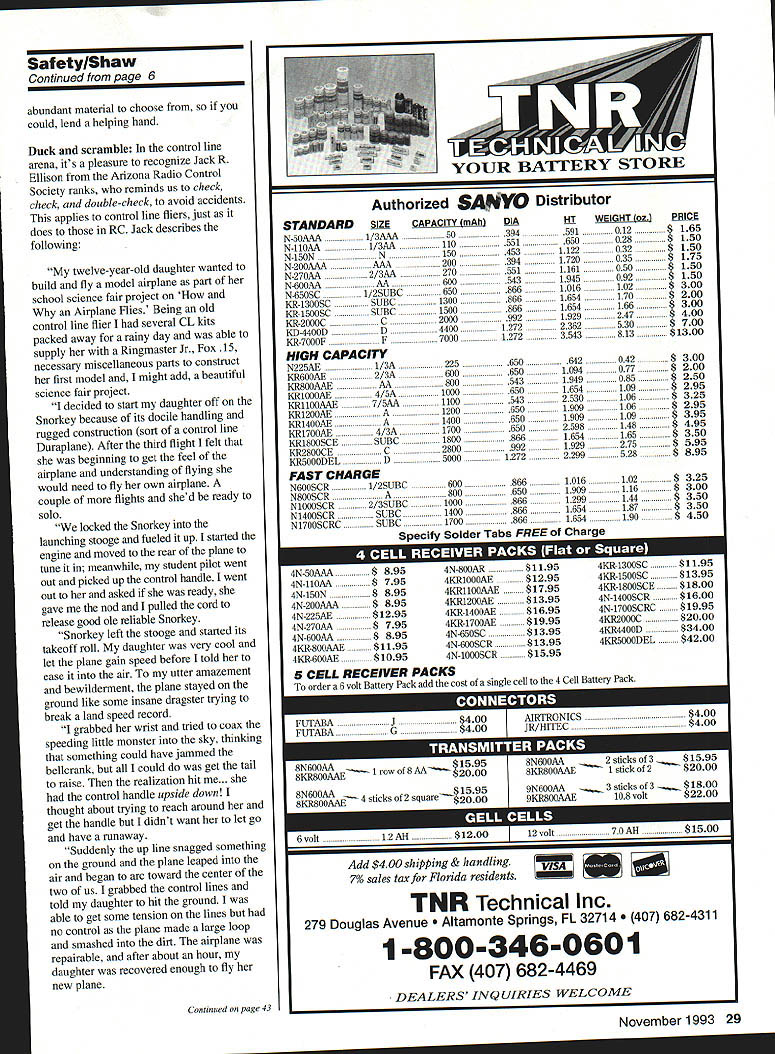
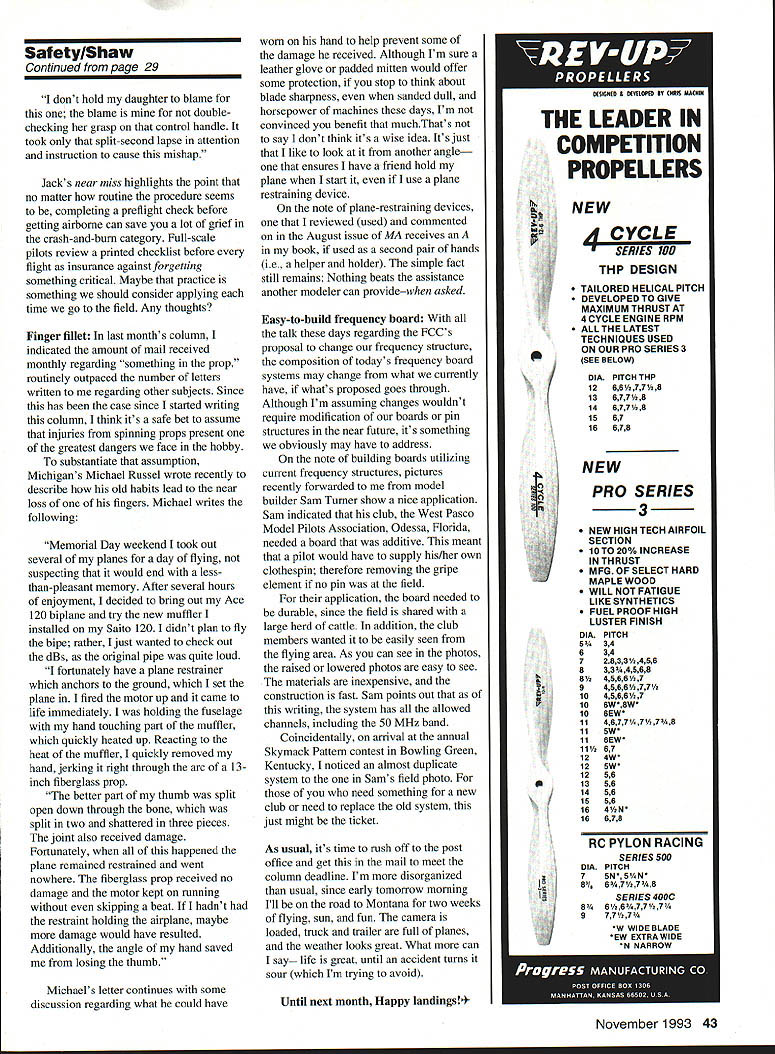
With all the talk these days regarding the FCC's proposal to change our frequency structure, the composition of today's frequency-board systems may change from what we currently have, if what's proposed goes through. Although I'm assuming changes wouldn't require modification of our boards or pin structures in the near future, it's something we obviously may have to address.
On the note of building boards utilizing current frequency structures, pictures recently forwarded to me from model builder Sam Turner show a nice application. Sam indicated that his club, the West Pasco Model Pilots Association, Odessa, Florida, needed a board that was as attractive as it was durable, since the field is shared with a large herd of cattle. In addition, the club members wanted it to be easily seen from the flying area. As you can see in the photos, the raised or lowered posts are easy to see. The materials are inexpensive, and the construction is fast. Sam points out that the salient features of the system are the recessed channels, including the 50 MHz band.
Coincidentally, on arrival at the annual Skywac (?) Pattern contest in Bowling Green, Kentucky, I noticed an almost duplicate system to the one in Sam's field photo. For those of you who need something for a new club or need to replace the old system, this just might be the ticket.
As usual, it's time to rush off to the post office and get this in the mail to meet the column deadline. I'm more disorganized than usual, since early tomorrow morning I'll be on the road to Montana for two weeks of flying, sun, and fun. The camera is loaded, the trailer is full of planes, and the weather looks great. What more can I say—life is great, until an accident turns it sour (which I'm trying to avoid).
Until next month, happy landings!
Transcribed from original scans by AI. Minor OCR errors may remain.

