

Gary A. Shaw
85 Twin Lakes Circle, Atoka, TN 38004
Safety Comes First
Jet Turbine
After reading a recent article in MA (September, Toledo/Berman) regarding the procurement and proposed testing of the new French T-240 Turboreacteur model-jet engine, I couldn't help but ponder the next generation of safety stories to be told once the engines are made available to the general public.
Understanding the true-scale potential for injury such an engine represents — i.e., high-frequency noise, severe burns, fires, fuel explosions, or injury from expelled turbine blades rotating at super-high RPM — one has to wonder if the benefits the engine provides are worth the risks associated with it.
As for me, my pocketbook doesn't allow the lavish costs associated with such a purchase (several thousand dollars). For those of you who have already set the money aside in eager anticipation of replacing your Byrofan unit, I urge you to wait until the novelty wears off and accurate information can be shared regarding the engine's safety and reliability.
If you can't wait, I urge you to avoid the yo-yo factor by ensuring maintenance is completed as recommended by the manufacturer, safety precautions are followed, and AMA rules are observed regarding when, where, and how such a device should be used.
Reversed Servos
As revealed in a letter from Bob Paddock, secretary and newsletter editor for the North Olmsted, Ohio, Westlake RC Club, Inc., the advent of computer radios has been a blessing in disguise for those modelers possessing the cash necessary to purchase one. However, for the more careless, they are an electronic accident waiting to happen.
The bugaboo, as Bob describes it, stems from the fact that most computer radios allow you to program setups for multiple aircraft into a single transmitter (helicopters, gliders, fixed wing, etc.). Although not a problem in itself, true excitement usually occurs when the wrong aircraft setup is used to fly an aircraft it wasn't intended for.
Things such as engines starting at full power, or reversed ailerons discovered during takeoff, are but a couple of the possibilities waiting to be discovered by those unfortunate modelers who bypassed the required ground check. With that thought in mind, Bob provides the following words of warning:
"If you've started your aircraft and find a control reversed, never, never start flipping servo-reversing switches until you shut the engine down, or properly restrain the airplane. If you accidentally reverse the throttle on an unrestrained airplane with an idling engine, you are in for a big shock as the engine immediately goes to full bore. Yes, I've seen it done! No, it wasn't me who did it, but it really gets the adrenaline flowing when it happens!"
To avoid what Bob describes above, simply adhering to the following well-established principles should be all that's necessary to ensure a great day at the field:
- Always obtain the pin for the frequency you use prior to turning on the transmitter. This applies to all modelers, regardless of a radio's capacity; some radios have selectable tuning to unoccupied channels.
- Always complete an appropriate ground check for airworthiness prior to the first flight of the day.
- After obtaining the pin, conduct a thorough radio check to ensure the appropriate model is selected (computer radios), and that all servos operate to a distance specified by the radio manufacturer.
- If your computer radio does not have the capability for model names to be input as visual cues to the model you've selected, place a label on the radio indicating which program belongs to what aircraft.
- Never attempt to start a model prior to ensuring you're using the correct radio (or, for computer radios, the right program).
- Never, never activate different aircraft setups within a computer transmitter while your model is running. Shut the model down and page through the programs until you are certain that what you have selected is what you want.
Uh-oh, Something's Funny
By the time you read this column, Christmas should be right around the corner, and winter should be no stranger to the folks I visited this past summer in Montana. As I've done in past years, early June found my pickup and trailer loaded with models and on the road to Helena for a week of pure flying relaxation.
Accompanying me on the annual trek were two beautiful — and unflown — aircraft, a new Byro F-16 and an Ultra Sport 1000, waiting for their chance to rise into pure mountain air. With a handful of club members gathered around the field on the day of reckoning, the first aircraft to break into the morning sky was the Ultra Sport 1000.
Circling effortlessly around the flying field, all seemed to be going well until the engine began to act as though it had become excessively lean. Having enough height to do a full approach and landing, the model touched down and rolled to a stop just as gracefully as it had taken off only minutes before.
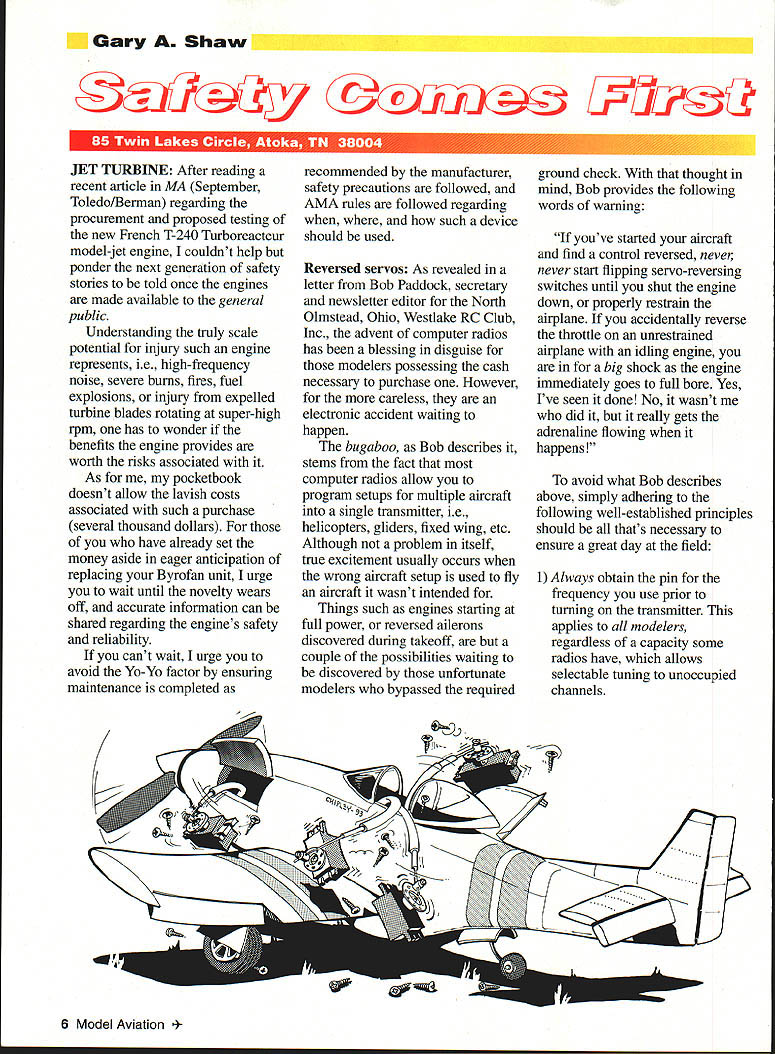
Upon inspection back at the pits, the cause of the power loss was discovered to be the result of losing all four screws holding the throttle servo in place, thereby allowing the throttle servo an opportunity to fall into the fuselage. Additionally, all but three of the 12 servo screws holding the elevator, rudder, and smoke-system servos in place had vibrated out to join the throttle servo dangling inside the fuselage.
Ironically, upon returning home I found a letter from modeler Edwin Gerhardt (Basking Ridge, New Jersey), describing a similar story:
"George Bonnell recently brought out his beautiful Top Flite P-51 for its maiden flight with Tom Schaefer, one of our top pilots, at the controls. Knowing the Top Flite reputation for quality, and George's building skill, the flight was expected to be routine. The takeoff and climbout were normal, but when Tom turned the plane he said, 'Uh-oh, something's funny!' Nevertheless, he made several passes up high, at which time he discovered the throttle stuck in the wide-open position. Additionally, about this time the elevator lost its authority to the extent that it was difficult to keep the aircraft turning within the bounds of the field. Use of the rudder didn't help much; however, switching to high rates made the plane just barely controllable. To shorten the story, the engine eventually ran out of fuel and Tom made a perfect landing on the far side of the field.
"The cause—all 12 of the screws holding the motor, elevator, and rudder servos had unscrewed, allowing the servos to flop around in the servo trays. The tray, made of only 3/8-inch Lite Ply, was not capable of holding the screws. If the kit had required the use of an additional 1/4-inch of bass or spruce, it probably would have worked just fine."
As George mentioned, the addition of some hardwood to servo mounting areas can provide additional insurance against servo loss. Since the servo mounts in the Ultra Sport 1000 were already reinforced, the addition of a little thick CyA (cyanoacrylate) to the screw holes seemed to fix the problem I encountered to date.
As always, a precaution to take after the first several flights of a new aircraft is checking all bolts, nuts, and screws to prevent similar problems from becoming yours while in flight.
Since the moving van is literally sitting outside my door and my residence is in a state of semi-chaos, that's all I can provide this month. Hopefully I'll be more organized for the next column, which will come to you from sunny Orlando, Florida.
Until next month, Happy Landings!
Transcribed from original scans by AI. Minor OCR errors may remain.

