


Safety Comes First
1013 Vernon Loop, Oviedo, FL 32765-6013
Check Those Batteries!
A recent phone call from veteran Pattern flier Albert Glenn of Memphis, Tennessee, brought back how easily you can save an aircraft from an early trip to the garbage can by simply checking your batteries prior to each flight.
Albert shared a "preventable" story about a rival Pattern flier who lost control of his aircraft and crashed because of low receiver battery power — an electrical condition created in this case by one-too-many flights. I say "preventable" because a simple battery voltage check with a VOM (Volt-Ohm-Milliammeter) after each flight is all that is needed to avoid losing an aircraft and prevent injuries.
To get a true representation of battery condition, check batteries just before a flight and again right after landing. Checking them right after landing lets you know the battery condition at its lowest level. After a half-hour or so, batteries can bounce back enough to give you a false sense of security; however, under load they quickly return to post-flight levels.
If you check your batteries often and seem to be getting less and less usable flight time at the field, then cycling them to remove built-up "memory" may be in order. Several excellent battery cyclers are available for this purpose through hobby shops and catalogues nationwide. These cyclers charge batteries to peak and then discharge them slowly, timing the duration of discharge on a display. If, after being cycled at least twice, you don't see an increase in battery cycling time, this indicates that a cell has gone bad and needs to be replaced. It's an easy routine to get used to, and cheaper than replacing an entire aircraft.
Painting Precautions
It's that time of year again: Santa has come and gone, the new year has rung in, and building projects delivered by the elves are well underway. Many have finished basic construction and are waiting for warmer weather to do a little painting.
While scanning the August 1993 newsletter of the Belleville RC Flyers of Mascoutah, Illinois, I picked up a valuable tip from John Benson that many of you may benefit from if your trigger finger on the paint gun is itching. John writes:
"The Health and Safety Division of the 3M company warns that hazardous isocyanate vapors are formed when epoxy paint is mixed with its catalyst. These vapors, if inhaled, can cause severe respiratory damage.
"The injurious vapors build up in the body over time to the point of sensitization, which leads to a severe allergic reaction. There is no antidote for this condition, and modelers are warned to use appropriate ventilation combined with the correct respirator."
Available from both automotive suppliers and 3M Safety Products outlets are the following painting masks:
- #6986
- #8709
They are identical masks and contain impregnated chemicals that neutralize the harmful isocyanate vapors. To promote freshness, the masks should be stored in clean Ziploc bags when not in use. The cost of the masks ranges from $8 to $12, which is cheap considering the alternatives if not used.
The use of epoxy paint for finishing models is very popular since it is extremely durable, fuelproof, has high gloss, fast tack, and is relatively easy to use. The major disadvantages of using epoxy are that it is heavy and can increase the weight of a model if not used sparingly — not to mention being potentially injurious to your health.
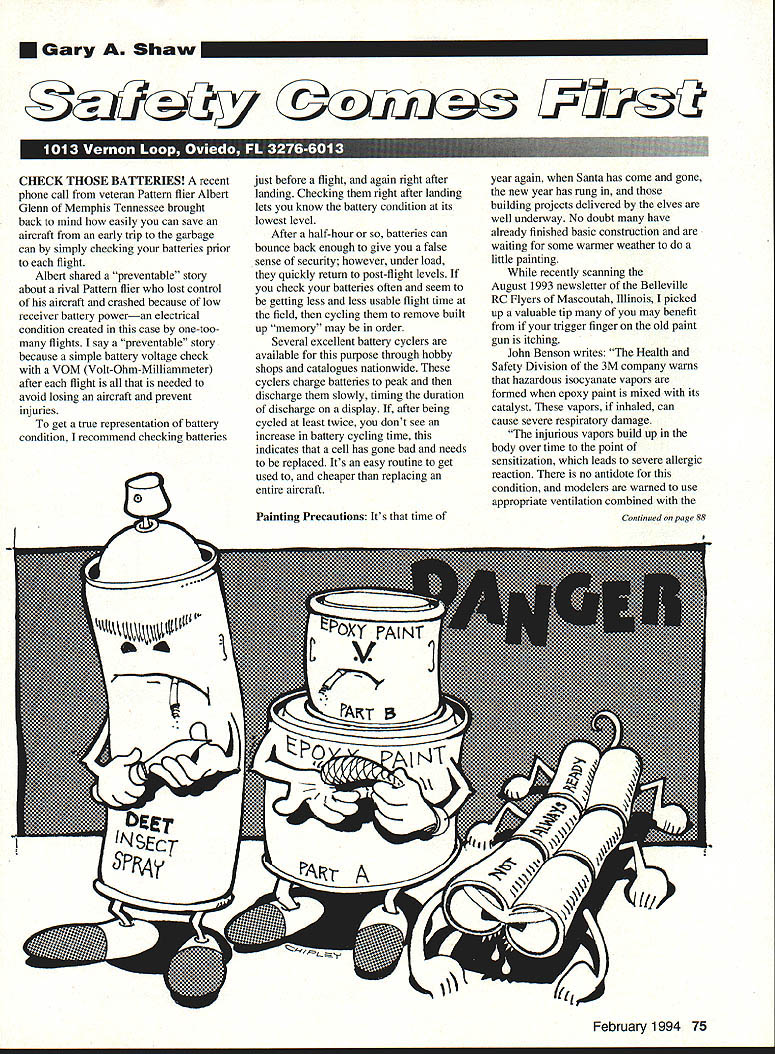
Organic vapors created during many painting operations can be deadly if not properly controlled. Don't think that wearing a respirator alone will keep you out of harm's way. These masks are only rated for specific concentrations of vapor, and if exceeded they will quickly become saturated and useless. Good ventilation and an appropriate respirator are keys to good health.
For those interested in more on this subject, my March 1993 MA column provided additional information. As another example: one time when my wife and I were spraying each other with Deep Woods Off! repellent, we proceeded to fly. It wasn't long before I noticed the case of the transmitter was beginning to get sticky, as though my hands were covered in honey or glue. I landed the plane and wiped my hands and the transmitter free of the stuff with some window‑cleaning spray I had along for wiping the plane. This seemed to stop any further damage to the transmitter, except for a few already dulled glossy spots in some areas.
After carefully reading the label on the repellent can, I found they don't recommend use of the stuff on anything but skin. The label states that most synthetic materials — including painted surfaces, plastics, plastic lenses, etc. — are harmed by the spray. Check the non-aerosol versions — same warning.
Can you imagine your transmitter feeling as if it were sliding from your hands, the control sticks suddenly getting soft where your fingers touched them, or permanent fingerprints embedded all over that beautiful Byron P-51 finish? Just a few thoughts to ponder while you're waiting for the weather to warm up and the bugs to come back.
Run Away?
Changing our focus from the tundra of the frozen North to the arid climate of the California West, comes a story hot off the press from the Direct Connection newsletter, published by the Anaheim Knights of the Round Circle Control Line Club.
As described by Jim Swoop, avid modeler and control‑line enthusiast, it appears it is possible to severely injure oneself while trying to gain control of a model by running away from it.
"It was a beautiful Sunday morning, the week before the Knights' Joust. I had just finished a Profile Scale P-40 Warhawk that I planned to enter in the Joust. Since this was my first contest and the rule book says you have to have flown the model prior to entering it, I had spent every available moment (and some that weren't available) to get this baby finished. I was down to the wire. Out at Mile Square Park I went to prove my new ship airworthy.
"I got a few flights in and was satisfied that the ship wouldn't embarrass me in the contest. The wind was coming up a bit, so I thought it best not to risk my new pride and joy with another flight. I took my old standby out, which I call 'The Penetrator' but is really a Sarpous Challenger. Being a bit heavier and powered with a .40, it penetrates the wind much better.
"The flight was OK until the engine quit. I had about 20 feet of altitude on the center of the downwind side of the circle. As the plane headed into the wind I had it about two feet off the ground when a gust came up. The plane floated back up to about 12 feet and the lines went slack. I stepped backward to tighten the lines. This didn't help. I moved back smartly but the lines were still slack, so I started running backward—moving fast. Next thing I knew, I had fallen and was lying on the pavement in severe pain.
"'Hey Jim, get up!' yelled Eric Rule. (Pause.) 'Jim, you can get up now.' (Longer pause.) As the rescue party approached, I tried to be as cool as possible—or at least as calm as you can be when you're lying in pain and you know you can't get up by yourself.
"Well, Eric Rule, Rob Kolaire, and the guys I was flying with helped me up and insisted I go to the hospital and get checked out, even though I kept insisting my arm wasn't broken and I wasn't that seriously hurt.
"After the X‑ray, the doctor told me I had a 'nasty' break, with a lot of bone fragments floating around. The doctor put me back together with a bunch of screws and metal plates, and I put the Challenger back together with a new prop and spinner."
Jim closes with a recommendation for what to do when you can't keep your control lines tight: casually take one or two steps backward; if the lines don't tighten, casually raise your left hand and wave the aircraft goodbye.
— An excerpt from Safety Corner by Vaughn Gavin of the Millington, Tennessee Barnstormers R/C Club; Fred Lincoln, president.
Transcribed from original scans by AI. Minor OCR errors may remain.

