
Gary A. Shaw
Safety Comes First
1013 Vernon Loop, Oviedo, FL 32765-6013
Is your engine safe? Certainly not if the motor you use has its carburetor located directly behind the prop (most brands), or the glow plug slanted into the prop arc (Enya four-stroke).
For years, some engine designers and manufacturers have consistently used poor configurations that place the hand extremely close to the prop when adjusting the carburetor. Some engines have carburetors installed so close to the prop that it's commonly understood some skin will be lost each time the motor is started.
One manufacturer utterly amazed many of us by mass-marketing a four-stroke line that cannot be started with a pocket Ni-Cd because the plug is angled directly into the prop arc. Although remote Ni-Cd systems are around which allow Ni-Cd starting virtually anywhere on the model, I don't believe we should have to add safety solutions to correct questionable design.
It's high time that companies contemplate changing their paradigms and consider putting carburetors behind the engine heads. As for the four-stroke engines that have plugs angled into the prop, the companies that manufacture them should think about curtailing sales until redesigned.
156 Stitches and Several Units of Blood
While scanning the November issue of K-Factor, a monthly newsletter published by the National Society of Radio Controlled Aerobatics (NSRCA), the word "Warning" drew my attention to a column written by modeler Mack Patterson of San Jose, California.
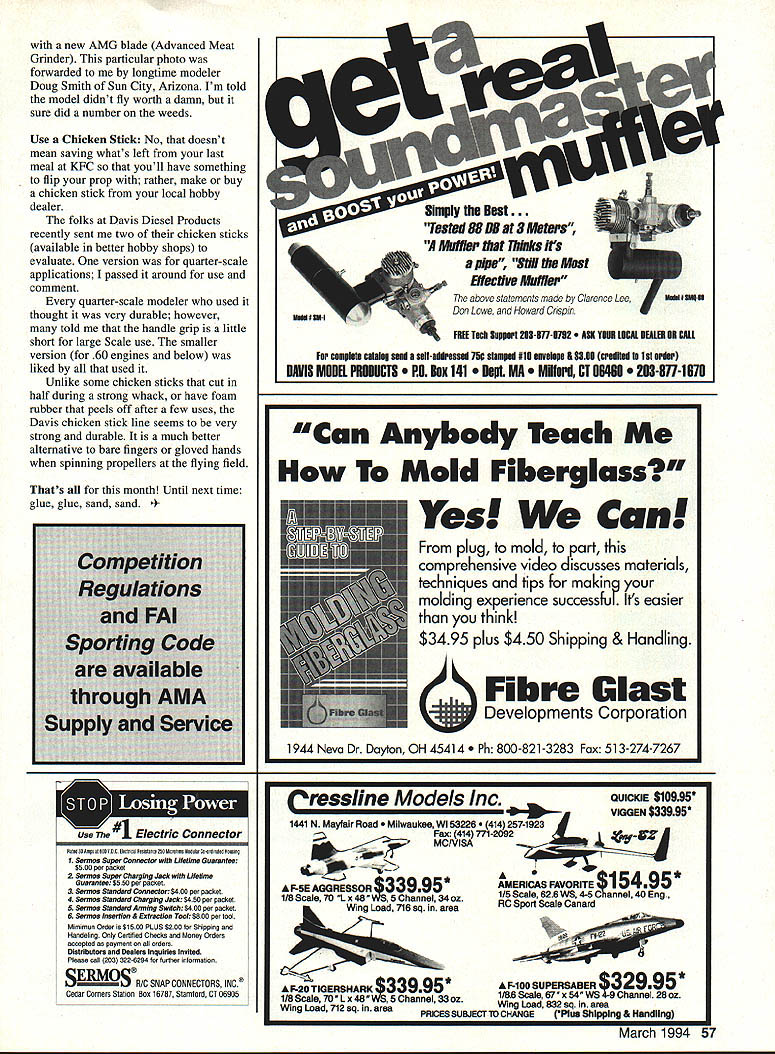
In his column, Mack describes an accident that occurred when a quarter-scale pilot accidentally turned off the transmitter controlling his idling model in the pits. The model went to high power, jumped ahead, careened off one modeler, and plowed straight into both legs of an unsuspecting pattern flier.
As can be imagined, the wounds were serious. Quick thinking by fellow flier Roy Speights and several other people at the field kept injuries sustained from becoming fatal. Mack's warning carried the following words of wisdom: don't take anything for granted; don't run models near the pits; always be awake because others aren't careful. Others aren't necessarily prudent in their actions. What saved the day was that those present kept cool heads, acted quickly to apply lifesaving measures, and summoned help.
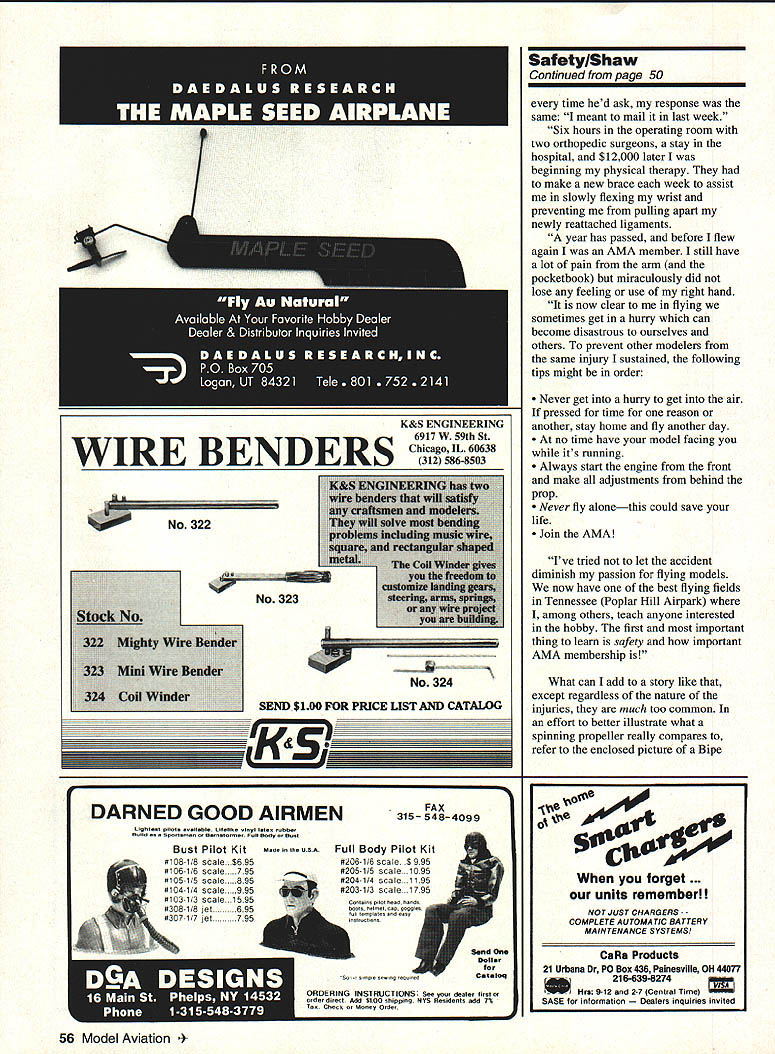
In past columns I've stressed the idea that clubs post directions to local medical facilities. First-aid kits should be stocked with enough dressing material to stop severe bleeding. Most well-stocked kits carry at least a medium-sized wound dressing for application of pressure.
Through the Arm to the Bone
Hot on the heels of the injury described in the NSRCA newsletter is a short note forwarded to me by Donnie Bennet of Lebanon, Tennessee that describes his recent encounter with a two-bladed meat cleaver.
Unfortunately for Donnie, at the time of the injury he still hadn't decided to mail his AMA membership dues and was not part of AMA. Consequently, Donnie's experience has cost him more than $12,000 and much pain and suffering.
As the story goes, Donnie and a friend were flying from a dirt field on a farm where he resides when the accident occurred. To get to and from the field, you have to go through three gates and two hay fields.
As in the previous story, after being injured severely by his prop, Donnie credits his life to that of his friend Andy Crook, who quickly said, "We gotta go!" Although we all know how commonplace prop injuries seem to have become, the way Donnie injured himself is unlike any story I've ever heard.
"We were flying Protrainers—a fun-fly model plane that specializes in hovering like a helicopter. Unfortunately, I never made it to the hovering stage. My buddy Andy had started his plane and was flying while I hurried to get into the pit.
"After starting my O.S. .32F and walking the four feet to the field box, I put my transmitter down and began putting my Ni-Cd and other equipment away. While stowing my gear, I inadvertently hit the throttle on the transmitter, and the engine went to full throttle. With the transmitter still resting against the field box, the airplane screamed toward me. With literally no time to think, I had to do something fast. As the nose wheel rotated and the plane jumped into the air, I tried to reach out and grab the fuselage! Big mistake! The prop struck my right forearm three inches above the wrist. As the prop hit me, it sliced all the way to the bone and made a sickening sound that caught Andy's attention. He promptly landed his plane and came to my rescue. I immediately grabbed my right arm with my left hand and applied tremendous pressure, knowing I was cut bad. Within the first minute I could feel the effects of shock setting in.
"Luckily, I had just finished a first-aid/CPR course three days prior and had some idea of how serious shock would be and my biggest problem. I don't remember the rest of the trip as they took me to the hospital, but I do remember thinking that I would die out there all alone.
"My truck was a stick shift, so there would have been no way I could have driven out. Thank God for good friends and fast emergency response vehicles. Andy had been trying to get me to join AMA for the past year, and every time he'd ask, my response was the same: 'I meant to mail it in last week.'
"Six hours in the operating room with two orthopedic surgeons, a stay in the hospital, and $12,000 later I was beginning my physical therapy. They had to make a new brace each week to assist me in slowly flexing my wrist and preventing me from pulling apart my newly reattached ligaments.
"A year has passed, and before I flew again I was an AMA member. I still have a lot of pain from the arm (and the pocketbook) but miraculously did not lose any feeling or use of my right hand. It is now clear to me in flying we sometimes get in a hurry which can become disastrous to ourselves and others. To prevent other modelers from the same injury I sustained, the following tips might be in order:"
- Never get into a hurry to get into the air. If pressed for time for one reason or another, stay home and fly another day.
- At no time have your model facing you while it's running.
- Always start the engine from the front and make all adjustments from behind the prop.
- Never fly alone—this could save your life.
- Join the AMA!
"I've tried not to let the accident diminish my passion for flying models. We now have one of the best flying fields in Tennessee (Poplar Hill Airpark) where I, among others, teach anyone interested in the hobby. The first and most important thing to learn is safety and how important AMA membership is!"
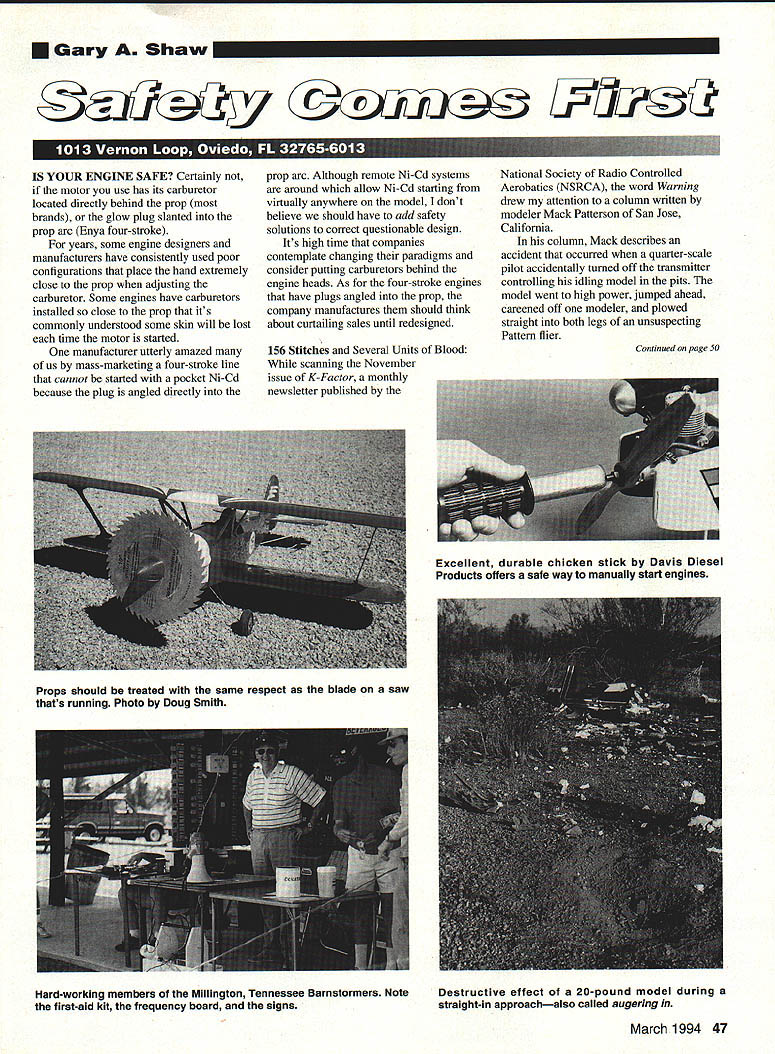
What can I add to a story like that, except that regardless of the nature of the injuries, they are much too common. In an effort to better illustrate what a spinning propeller really compares to, refer to the enclosed picture of a bipe with a new AMG blade (Advanced Meat Grinder). This particular photo was forwarded to me by longtime modeler Doug Smith of Sun City, Arizona. I'm told the model didn't fly worth a damn, but it sure did a number on the weeds.
Use a Chicken Stick
No, that doesn't mean saving what's left from your last meal at KFC so that you'll have something to flip your prop with; rather, make or buy a chicken stick from your local hobby dealer.
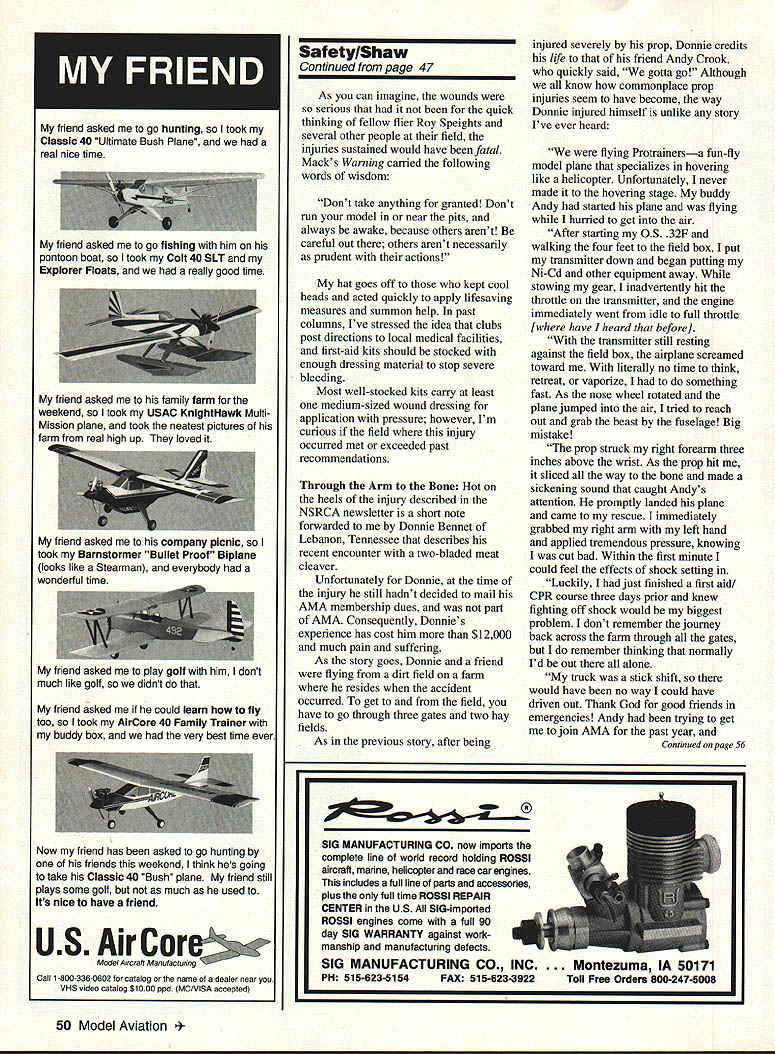
The folks at Davis Diesel Products recently sent me two of their chicken sticks (available in better hobby shops) to evaluate. One version was for quarter-scale applications; I passed it around for use and comment.
Every quarter-scale modeler who used it thought it was very durable; however, many told me that the handle grip is a little short for large-scale use. The smaller version (for .60 engines and below) was liked by all that used it.
Unlike some chicken sticks that cut in half during a strong whack, or have foam rubber that peels off after a few uses, the Davis chicken stick line seems to be very strong and durable. It is a much better alternative to bare fingers or gloved hands when spinning propellers at the flying field.
That's all for this month! Until next time: glue, glue, sand, sand.
Transcribed from original scans by AI. Minor OCR errors may remain.

