

Safety Comes First
Gary A. Shaw
Fail-Safe Autopilot
While attending a Pattern meet recently in south-central Florida, a fellow judge and I were treated to an eye-popping experience. The last of the Advanced fliers we were judging suddenly turned to us during level flight, revealed that he was disappointed with his performance, shut off his transmitter, collapsed his antenna, and walked away.
There we sat watching helplessly as a beautiful Meridian continued its flight across our view into what was obviously a bad orientation and impending disaster. Was the guy nuts? Suddenly the aircraft reoriented itself and continued flying what we considered to be a very good round—with no pilot at the controls.
Turning around to face the pits for an explanation, we were treated to a very hearty "Ha! Ha!" from everyone in attendance (about 40 people). It turned out the real pilot all along was Jason Shulman, an accomplished Pattern flier, strategically located behind us and having some fun at our expense. It was pretty funny once my heart slowed down and my embarrassment subsided.
A few days later at our local club, Jason's 60-size Super Chipmunk was airborne while the transmitter he was holding was clearly switched off. Since there were four aircraft flying and only three other pilots on the line, I suspected another practical joke. Jason informed me the model had been outfitted with an on-board "autopilot" and was flying itself.
It turned out a gentleman visiting from Israel, who represents a company developing electronics for radio-controlled drones, had installed the autopilot. He demonstrated its capabilities and impressed everyone. A unit is on the way to me so I can put it through the paces in one of my own models and report about it in the near future. If the Postal Service works fast, maybe I'll have the report in next month's column. Until then, don't trust anyone who claims their model can fly itself.
More on Field-Box Starters
Several letters arrived in record time in response to my January 1994 column; readers took issue with my using the word "invention" to describe field-box starters developed by Bob Taylor and Jim Steffens. Both gentlemen had forwarded photos of themselves using their devices to start their models. Although I did not intend a slight against those who had already built similar devices, the word "invention," as defined by my 1966 Webster's, can imply producing something new or creative imagination. The latter was my intent.
Roger H. Coleman, president of CUFFMAC (California United Free Flight Model Airplane Clubs, Inc.), wrote to set the record straight:
"Both gentlemen have merely built their own version of the type starter boxes used by Free Flight folks in mass since the development of model engines that turn our props in excess of 20,000 rpm. There have been numerous articles published over the last fifteen years describing this type of starter box.
"What has amazed me is that some folks consider those of us who use these devices to be a bunch of 'wusses.' However, we believe this beats the heck out of being stupid, or God forbid, maimed by our models."
Jim Coffin, CAAMA newsletter editor and free-flighter, also noted that these devices, in one version or another, have been around for a long time. He wrote:
"Maybe I'm missing something, but it appears to me this is a very old idea that the Free Flight world have used for well over 15 years.
"In our case, we normally mount the starter on a support about waist high so that we can stand up to start our engines. This further reduces the hazards of spinning props, since we don't have to move from a sitting or squatting position for launching or walking to a release point."
Jim included photos and construction drawings of a waist-high unit that appeared in the NFFS Digest or SAM Speaks about eight to ten years ago. The plans are clear, well-written, and include a detailed bill of materials. If you are contemplating building such a device and don't enjoy recreating the wheel, send me a letter with an SASE and I'll forward a copy to you.
Forgot the Wing Screws
Hot off the press from the Pattern Aeromaster Flyers Association newsletter Loop T Loop (edited by Bob Erhardt) is a short story many of us can relate to. I know it's rotten to use it in the column since it involves a fellow Pattern flier, but I can't help myself:
"I spent the weekend practicing with David Shulman—he's the younger brother of Jason Shulman. A funny thing happened while we were flying: David said, 'Bob, my model is acting really funny; I think my wing is fluttering.'
"He lands the model, checks it over, and takes off again. Next flight, same thing. David lands the model, and much to his surprise, David had forgotten the wing screws. I promised I wouldn't say anything—'shhh.' (We won't tell either, will we?)"
Flight-Box Maintenance
As noted in the Christmas edition of the Chicagoland Radio Control Modelers, Inc. newsletter (LeRoy Cordes, editor), a quick maintenance check of the flight box is in order now that the flying season has slowed. Do a general cleanup now so you won't be tempted to do major tying in the spring and so you're ready when the first good days arrive. Throw out broken props, field plugs, and ancient rubber bands.
When wiping off layers of grass, oil, and dirt, carefully check the wires supplying power to switches and meters. Shorted or frayed wires can ruin a good Saturday. Keep in mind that fuel and electricity in your field box are OK together as long as nothing turns your field box into a bomb box.
An editorial by Al Brose (Windy City Newsletter, 1985) provides a vivid example of how volatile a gallon of fuel can become if given half the chance:
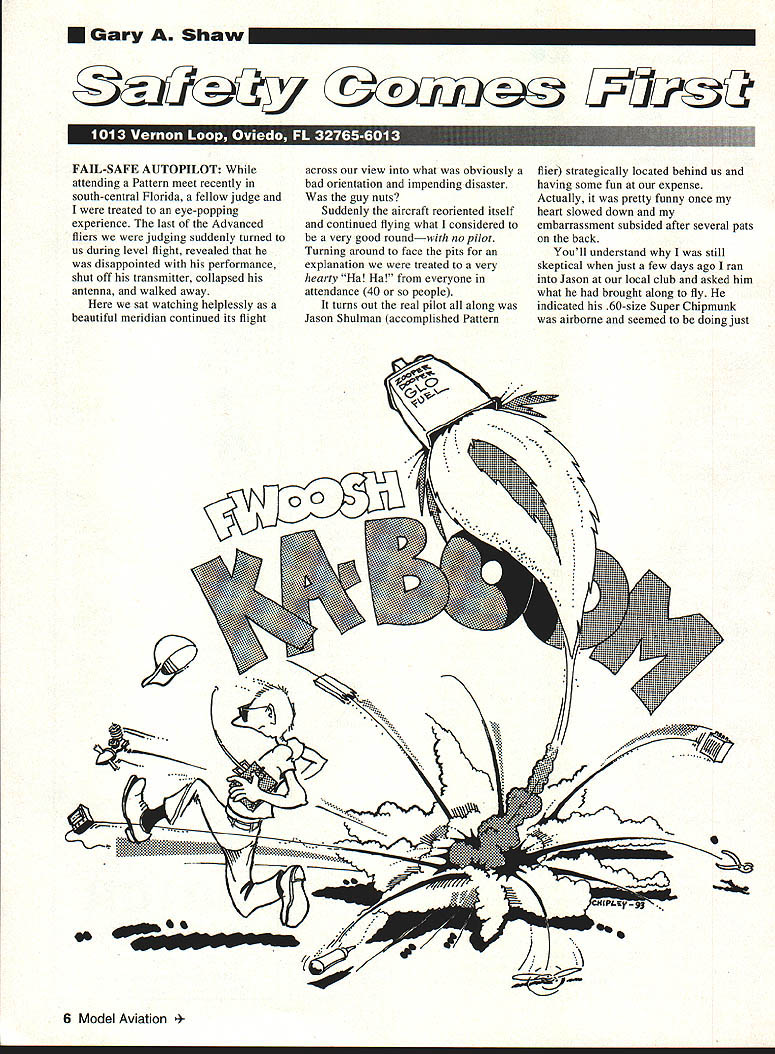
"Once upon a time, a very experienced flier was out flying when the electricity from the power panel going to the fuel pump shorted out; big arcing. The flier didn't see the flame on top of the fuel can (remember, the fuel can burns with a nearly invisible flame). The fire ignited the gallon fuel can and sent it almost 200 feet into the air. Luckily, the flier wasn't bending over the flight box when it let go! The flier experienced some burning fuel on his legs, which another flier helped to extinguish.
"Thanks again to the other flier for his help (remember, flying by yourself can be harmful to your health; in an instance such as this, the second person is all-too important). We can all learn from this by checking our flight boxes periodically for frayed wires, and replace them as necessary."
Electric Fliers' Safety Checklist
With the popularity of electric models soaring, it's more important than ever to be aware of pitfalls that can bite fliers new to this niche. Modeler Ron Fikes of Palo Alto suggests the following to help avoid mishaps:
- Safety switch: Always install an extra switch in the wiring between the motor and the rest of the circuit. If anything goes wrong with the speed control or stray radio signals interfere with controls, the motor won't come on until you want it to.
- Fuse: Always install a fuse between the motor and the rest of the circuit. If anything gets in the way of the prop (even your body), the fuse blows and the rest of the model doesn't catch fire or shave the rest of your leg.
- Propeller/shaft adapter: Most electric motors have an adapter for the prop that is held to the shaft with a set screw—periodically tighten it. We had a local flier who, when advancing the throttle for takeoff, lost the whole works: prop, hub, and set screw. It occurred out on the takeoff strip, so no one was hurt.
- Motor/battery connector changes: If you are replacing power plugs on battery packs (for example, installing Sermo plugs), remember the packs are potent. Cut off the plug one wire at a time. Put on the new plug, then cut off the other wire and replace that one. If you cut both wires at the same time, the cut and stripped ends can short, causing a fire or a bad burn in the shop.
Ron's last suggestion reminded me of a childhood experiment I shouldn't have tried: I cut the cord from my mom's old iron and attached the wires to long copper wire and an old kitchen knife, then plugged it in from the patio. The resulting short produced spectacular—and dangerous—fireworks. Shorting a powerful Ni-Cd battery in an electric model can have similarly dramatic consequences.
Always follow safety practices and check equipment regularly.
Transcribed from original scans by AI. Minor OCR errors may remain.

