
SAFETY COMES FIRST!
John Preston
Triple focus on safety
It appears you got a triple whammy on safety in the December issue of Model Aviation. Not only did we have the regular Safety Comes First column, but we also had a section on safety in the president's column and another safety item involving frequency conflict in the AMA News section. We wonder if some of the mysterious crashes of RC scale aircraft at the 1980 Nats were perhaps the result of radio frequency interference caused by harmonics generated by the operation of two transmitters, shooting down a model on a third, but differing, frequency.
AMA Safety Committee
Our dissertation on the merits of a Safety Committee in last month's issue was not ignored by the members of the AMA Executive Council. At the council meeting of November 15, a motion was approved to form a special committee to draft a document that will describe the duties and composition of an AMA Safety Committee. Bill Mathews, District V VP, is heading up this special committee and will be assisted by Professor Arthur Sabin and myself. As we said in last month's column, your thoughts on this subject are welcome.
Control-line electrocution lawsuit
In last month's column we also mentioned a lawsuit that was the result of a control-line (CL) flier's electrocution death. A newspaper clipping concerning this lawsuit was sent to us from Arthur Ryan of Farmington, MI. The clipping is from The Star, a nationally distributed tabloid, and carried the headline: "MODEL PLANES RESPONSIBLE FOR 43 DEATHS." It went on to say:
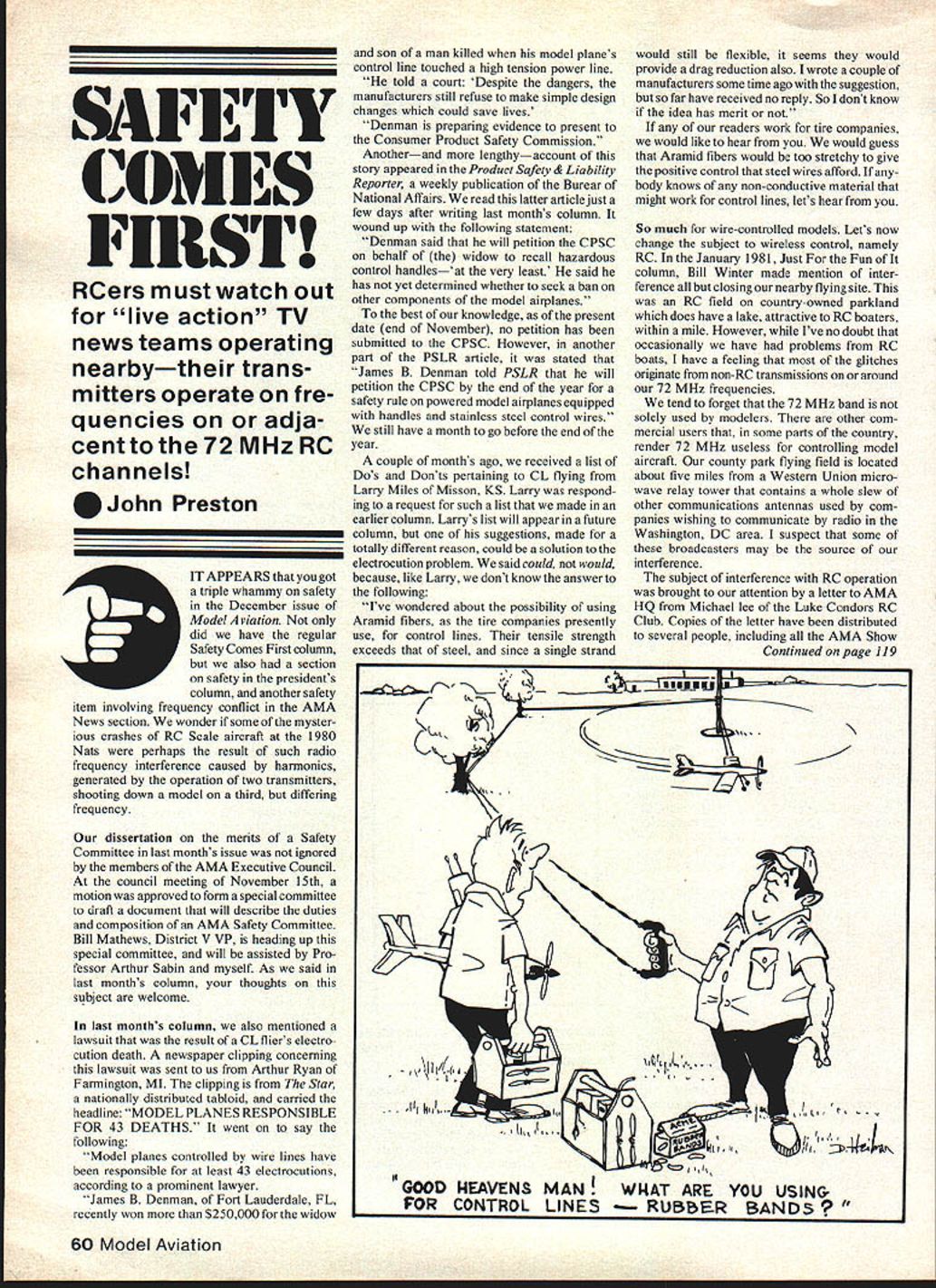
"Model planes controlled by wire lines have been responsible for at least 43 electrocutions, according to a prominent lawyer. James B. Denman of Fort Lauderdale, FL, recently won more than $250,000 for the widow and son of a man killed when his model plane's control line touched a high-tension power line.
"He told a court: 'Despite the dangers, the manufacturers still refuse to make simple design changes which could save lives.'
"Denman is preparing evidence to present to the Consumer Product Safety Commission."
A more lengthy account of this story appeared in the Product Safety & Liability Reporter (PSLR), a weekly publication of the Bureau of National Affairs. We read this article just a few days after writing last month's column. It closed with the following statement:
"Denman said that he will petition the CPSC on behalf of (the) widow to recall hazardous control handles — at the very least." He said he has not yet determined whether to seek a ban on other components of the model airplanes.
To the best of our knowledge, as of the present date (end of November), no petition has been submitted to the CPSC. However, another part of the PSLR article stated that "James B. Denman told PSLR that he will petition the CPSC by the end of the year for a safety rule on powered model airplanes equipped with handles and stainless steel control wires." We still have a month to go before the end of the year.
Non-conductive control-line materials
A couple of months ago we received a list of dos and don'ts pertaining to CL flying from Larry Miles of Mission, KS. Larry was responding to a request for such a list that we made in an earlier column. Larry's list will appear in a future column, but one of his suggestions, made for a totally different reason, could be a solution to the electrocution problem. We said could, not would, because, like Larry, we don't know the answer to the following:
"I've wondered about the possibility of using aramid fibers, as the tire companies presently use, for control lines. Their tensile strength exceeds that of steel, and since a single strand would still be flexible, it seems they would provide a drag reduction also. I wrote a couple of manufacturers some time ago with the suggestion, but so far have received no reply. So I don't know if the idea has merit or not."
If any of our readers work for tire companies, we would like to hear from you. We would guess that aramid fibers would be too stretchy to give the positive control that steel wires afford. If anybody knows of any non-conductive material that might work for control lines, let's hear from you.
Radio interference and TV news transmitters
So much for wire-controlled models. Let's now change the subject to wireless control, namely RC. In the January 1981 Just For the Fun of It column, Bill Winter made mention of interference at or close to our nearby flying site. This was an RC field on county-owned parkland that has a lake attractive to RC boaters within a mile. However, while I have no doubt that occasionally we have problems from RC boats, I have a feeling that most of the glitches originate from non-RC transmissions on or around our 72 MHz frequencies.
We tend to forget that the 72 MHz band is not solely used by modelers. There are other commercial users that, in some parts of the country, render 72 MHz useless for controlling model aircraft. Our county park flying field is located about five miles from a Western Union microwave relay tower that contains a whole slew of other communications antennas used by companies wishing to communicate by radio in the Washington, DC area. I suspect that some of these broadcasters may be the source of our interference.
The subject of interference with RC operation was brought to our attention by a letter to AMA HQ from Michael Lee of the Luke Condors RC Club. Copies of the letter have been distributed to several people, including all the AMA Show Teams — who might be the most likely to experience interference from "on-the-spot" TV news teams. The letter is as follows:
To AMA Safety People,
I am writing this letter to you all in regards to a possible hazard that may be encountered by groups putting on model aircraft demonstrations. We have experienced the hazard ourselves.
While doing an RC demonstration at Luke AFB, AZ, we had a pattern ship go down and the pilotless ship did a spiral descent into the crowd. The flight station operator had been using an FM transmitter and everything was all right until the television station arrived with their truck and started transmissions. At that time, the transmitter began to act up and the plane would not respond to controls. Fortunately no one was injured, but it could have been disastrous.
We feel that someone should be notified of this possibility so they can take the necessary precautions before they do any flying in the vicinity of television trucks or other similar transmitters.
Keep 'em flying.
Bill Warner 452-C San Vicente Blvd., Santa Monica, CA 90402
If the ship had been airborne for another full second, it would have impacted a USAF Thunderbird aircraft. And if the ship had been flying in another direction when loss of control occurred, it could very well have flown into the crowd of people (estimated at 3,000-plus). Luckily, and God willing, this was not the case. But the potential was there, and if caution in identifying this hazard is not exercised by any organization giving a demonstration, then the result can be as disastrous as mentioned above.
Sincerely yours, (s) Michael S. Lee President, Luke Condors RC Club
Fail-safe devices and regulation abroad
To wind up this month's column, an item seen in the November 1980 issue of the British magazine Radio Control Models & Electronics gives us food for thought. In the "New Products for the RC Hobby" section of the magazine is a write-up on the fail-safe device put out by Chromatronics that we mentioned in a previous column. The device neutralizes the controls and retards the throttle if either interference or transmitter malfunction occurs. The statement that caught our eye was the opening sentence: "One of the mandatory conditions for the granting of a permit to fly model aircraft in excess of 5 kg (11 lb.) weight, is the provision of a fail-safe system." It was not stated who mandates the use of fail-safe devices, but we assume it must be some branch of the British government.
We end with a question: should we consider using such fail-safe devices in our big models or in our show team models on a voluntary basis?
John Preston 7012 Elvira Court Falls Church, VA 22042
Transcribed from original scans by AI. Minor OCR errors may remain.

