
Gary A. Shaw 1013 Vernon Loop, Oviedo, FL 32765-6013
Safety Comes First
"Doing It Alone"
"DOING IT ALONE." Such is the title of a humorous story that appeared recently in the pages of Helinews, a monthly newsletter forwarded to me by editor Dick McKenna of the Everett, Washington Cascade Model Helicopter Club. The story, apparently obtained from a medical insurance claim form and published in the AMA National Newsletter, carries a message we should all remember each time we load up the car and head to the field to fly alone:
"I am writing in response to your request concerning block number 11 on the insurance form, which asks for the 'cause of injuries' wherein I put 'trying to do it alone.' You said more information was needed, so I trust the following will be sufficient.
"I am a bricklayer by trade and on the date of the injuries I was working alone laying brick around the top of a four-story building when I realized that I had about 500 pounds of brick left over.
"Rather than carry the bricks down by hand, I decided to put them into a barrel and lower them by pulley which was fastened to the top of the building. I secured the end of the rope at ground level and went to the top of the building and loaded the bricks into the barrel and flung the barrel out with the bricks in it.
"I then went down and untied the rope, holding it securely to ensure slow descent of the barrel. As you will note on block number six of the insurance form, I weigh 145 pounds. Due to my shock at being jerked off the ground so swiftly, I lost my presence of mind and forgot to let go of the rope. Between the second and third floors I met the barrel coming down. This accounts for the bruises and lacerations on my upper body.
"Regaining my presence of mind, again I held tightly to the rope and proceeded rapidly up the side of the building, not stopping until my right hand was jammed into the pulley. This accounts for my broken thumb.
"Despite the pain, I retained my presence of mind and held tightly to the rope. At approximately the same time, the barrel of bricks hit the ground and the bottom fell out of the barrel. Devoid of the weight of the bricks, the barrel now weighed about 50 pounds. I again refer you to block number six of the insurance form and my weight.
"As you would guess, I began a rapid descent. In the vicinity of the second floor, I met the barrel coming up. This explains the injuries to my legs and lower back. Slowing only slightly, I continued my descent, landing on the pile of brick.
"Fortunately, my back was only sprained and the internal injuries were only minimal. I am sorry to report, however, that at this point I again lost my presence of mind and let go of the rope. As you can imagine, the empty barrel crashed down on me.
"I trust this answers your concern. Please know that I am finished 'trying to do the job alone.'"
Three Rubber Bands?
After learning a valuable lesson early in his aeromodeling career through the near loss of his new Aerostar 44 trainer, Keith Smith of the Clayton, Ohio FAST Club wrote to remind me that if distractions occur during model setup, the truly exciting consequences may not be far behind:
"I had faithfully observed all of the safety techniques I had read about, i.e., clevis keepers, taped connectors, servo screws in place, control throws going the proper direction, etc. I range-checked the model while my 12-year-old fueled the model (yes, I took the kids along). Everything seemed to check out fine; so far, so good.
"While attaching the wing to the fuse with new (not oil-soaked) rubber bands, the 5-year-old got the RC car he had brought along and jammed it under the wing. Having dealt with that, I returned to the model to find the 12-year-old busy changing the glow plug. After a brief discussion on the detriments of unnecessary maintenance, he fired up the engine, taxied down the runway and, as the model rolled down the runway, lifted into the air and seemed to be climbing out OK. However, the model began a slow turn and just didn't seem to be responding to control inputs. I saw it going in to crash, chopped the throttle to prevent damage to the engine, and let it go down. Since the model hit a freshly cultivated cornfield, damage was very minimal. Surveying the crash site, I found the wing undamaged."
The message here is obvious: don't bite off more than you can chew. The more we overload our knowledge, skills, and abilities, the greater risk we put ourselves and others into when working with potentially dangerous equipment.
Getting children involved with modeling is as common and natural as peanut butter and jelly in sandwiches; however, as Keith pointed out, there should be enough adults in the group to supervise those needing babysitting while Dad or Mom is busy setting up equipment or off flying the model!
It's poor judgment to assume the kids will behave and/or your flying buddies will watch the kids while you're off doing loop-de-loops. Most modelers who observe Dad arriving with three young kids in tow understand that it's time to pack up and go home — unless chain link fences can be quickly erected around models and equipment. Like other hobbies that require a learning process before proficiency, getting your children involved with modeling should be considered a one-on-one process.
(Some of you might be wondering why I mention something so obvious as the need to supervise children at flying fields; take a trip to almost any flying field during a weekend to see what I mean.)
As Keith also alluded to in his letter, another necessity is a hefty number of rubber bands to retain the wing. When flying models that require rubber bands, a good rule of thumb to follow is "the more the merrier" but no less than 10. The bands should be arranged in equal order over the wing with an X in the middle (XX) to ensure that flight stresses are equally distributed.
At the end of the day, use an X-Acto blade to carefully cut the bands off the wing. This ensures that no one else will come along and use your worn-out rubber bands. Too often I've observed pilots searching through trash cans looking for bands that have been left behind. Remember, fuel, stretching, and/or old age places rubber bands in the "throw 'em out" category.
More Hands in the Prop
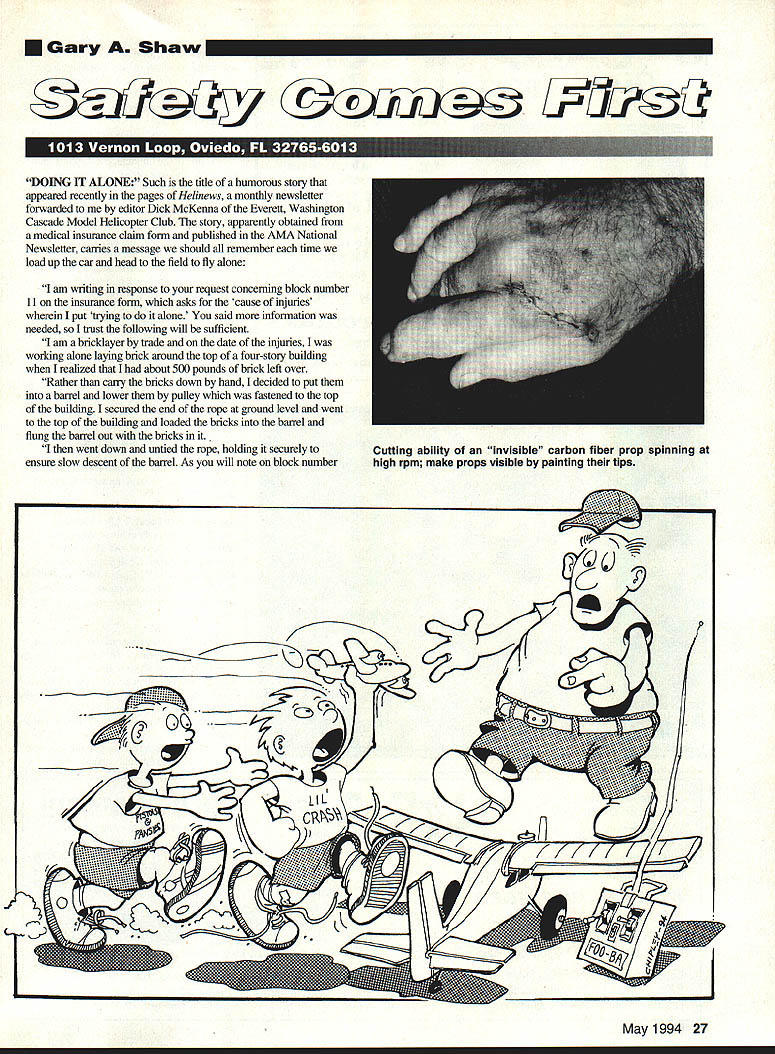
I know, it almost seems as though this column wouldn't be complete without a story related to some poor soul who had the misfortune to stick a body part into a prop.
Arriving just in time to take this month's honors is a letter from electric flier Andrew Purdon of the Coastal Propbusters Association of Meyerstown, Pennsylvania. Andrew provided a photo that reveals injuries sustained when his craft suddenly jumped across a picnic table and struck him in the chest.
Having placed his Puddle Master facing towards him on a picnic table and the transmitter between him and the model, it seems he unknowingly advanced his throttle to full power as he reached over the table to pick up the model. Using his other hand to simultaneously turn on the transmitter, his model jumped to full power once receiver and transmitter switches were activated. It sort of reminds me of what happens when helicopters are started prior to ensuring idle-up switches are in the off position — real exciting stuff.
Until next month.
Transcribed from original scans by AI. Minor OCR errors may remain.

