

Safety Comes First
1013 Vernon Loop, Oviedo, FL 32765-6013
Direct Hit
Arriving with the speed of a silver bullet was a letter from Dan Myers of Lexington, North Carolina. Dan took issue with the "painting precautions" section in my February '94 column where I quoted modeler John Benson: "The 3M company warns that hazardous isocyanate vapors are formed when epoxy paint is mixed with its catalyst."
I used the quote to help stress that adequate ventilation and respirators are necessary when painting. Dan's letter correctly pointed out the inaccuracy of the quote: isocyanates can be evolved from urethane chemistry, but not from epoxy.
To set the record straight and to clarify the chemistry a little, many two-component urethane paint systems available consist of a polyurethane prepolymer containing a reactive isocyanate and a polyester. Dan is correct that mixing the two materials initiates a reaction with the formation of a chemically resistant coating.
Initial formulations widely available in the '70s and '80s were considered hazardous because unreacted toluene diisocyanate (TDI) resulted in significant airborne exposures and, in many cases, respiratory sensitization (allergic reactions).
Since then, several companies have changed formulas by including TDI adducts and derivatives that are designed to minimize respiratory hazard. For easy application and added safety, single-package formulations containing blocked isocyanates were developed and are still readily available.
Unfortunately for modelers, the finish has to be baked in order to unblock the isocyanates and activate the reactive process. How many models can withstand the temperatures needed to activate the newer paints? Not many. The bottom line is that because newer urethane formulations require baking, the older, more dangerous formulations continue to be used by those in the hobby.
No matter what type of paint you use, remember each has its own safety precautions that need to be followed to the letter. Protective clothing, goggles, respirators, and ventilation go a long way toward protecting your health.
Shot down over France
While listening to a favorite radio channel, I was surprised to hear an Associated Press story about a man in France who was so frustrated with a model club near his home that he allegedly took matters into his own hands.
Apparently an individual had made it known to a local French model flying club that frequent passes of radio-controlled aircraft over his property would no longer be tolerated. Since the problem continued for some time, and attempts to solve it were unsuccessful, the property owner finally went to the authorities for a court order to stop the flyovers.
Evidently the court order had little effect and the airspace over the landowner's property continued to be violated until models mysteriously began falling from the sky.
After the loss of 100 models, club members became a little suspicious that something might be jamming radio frequencies. After a little detective work, a few lost-aircraft club members were able to convince police the aircraft losses were due to deliberate jamming rather than pilot error. It appears the landowner was arrested and charged with using powerful radio gear to jam frequencies used by the modelers. Both sides are waiting a court date to explain their positions.
'Tis the Season
By the time this column reaches you, spring should be in full swing, bringing with it large populations of pesky critters commonly referred to as insects.
Since it appears that most of the country will have a wetter-than-normal spring, you can bet that your first visit to the flying field will be a memorable one—unless you've come prepared to deal with what crawls up your leg or lands on your arm.
Now is the time to beat the rush for insect repellents that might be in short supply once local residents understand the critters are back for another round of summer fun.
Although insects usually present nothing more than a nuisance at the field, remember that some insects are capable of transmitting serious diseases to those who arrive unprepared.
Of particular note in recent years is a tick-borne organism that causes Lyme disease when transmitted to humans. The onset of this disease normally occurs in the summer and is usually accompanied by a distinctive skin lesion near the bite. The lesion may be accompanied by malaise, fever, fatigue, and other symptoms. If allowed to progress, it can lead to more serious complications.
Since being discovered in Lyme, Connecticut in 1982, cases of the disease have been reported in 47 states, and numbers are on the rise. To ensure you aren't on the list of newly infected, here are some simple measures that help guarantee a summer filled with flying fun:
- Avoid tick-infested areas when feasible.
- Wear light-colored clothing over legs and arms.
- Tuck pants into socks, and apply tick repellents such as DEET (e.g., Deep Woods) or permethrin repellents to pant legs and sleeves.
- Protect hands with gloves, cloth, or tissue when removing ticks from humans or animals. Search the entire body every 3–4 hours for attached ticks.
- Remove ticks promptly and carefully without crushing; gently and steadily use forceps (tweezers) applied close to the skin to avoid leaving the mouth parts in the skin.
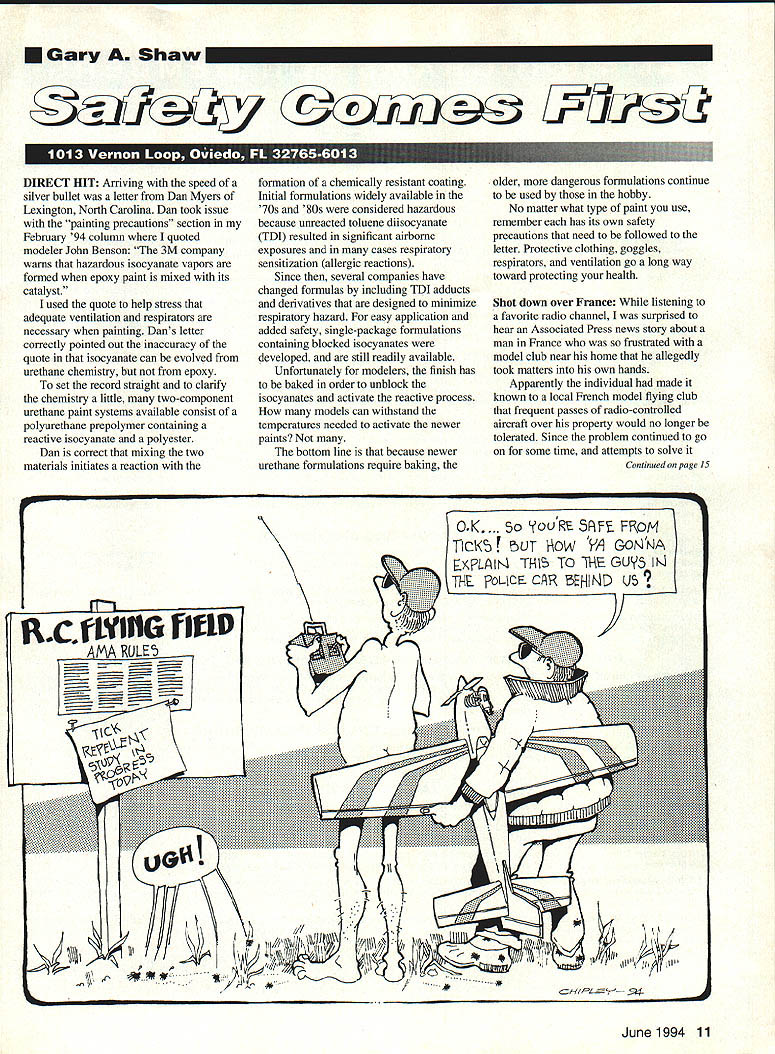
If you don't like to use repellents, you may be interested in some observations from "The Periscope" in a 1993 Newsweek. The author mentioned the unusual observations of Dr. Henry Feder Jr. concerning tick infestations of humans in Connecticut—the heart of Lyme disease country. Dr. Feder surveyed 300 visitors to a nudist camp in prime tick habitat. To his surprise, only people wearing clothes were bothered by ticks. He has reached one conclusion: clothing may influence tick attachment and warrants further study.
Another tip to "bug" you: a brochure from 3M Personal Care Products of St. Paul, Minnesota, mentions a new 33% DEET cream marketed under the brand name Ultrathon.
The new product is available in the now-familiar two-ounce squeeze tube and in a six-ounce aerosol can. Both formulations are available in all 50 states. The cream is advertised as having 12-hour protection, with eight-hour protection for the aerosol.
Debate over Cellular Phone Safety
As I'm sure most of you know, considerable discussion has taken place regarding the safety of electromagnetic radiation emitted from low-power frequency emitters such as cellular phones, police walkie-talkies, radios, and radar detectors.
To freshen your memories, the current debate stems from a Florida man's claim that his wife died of brain tumors that he feels resulted from exposure to radio waves emitted near her head while she used a cellular telephone.
In my September 1993 column, I indicated that I had received some mail from concerned modelers seeking information regarding our risk to electromagnetic radiation emitted by our transmitters. I responded that I was only aware of research related to occupational exposures (constant exposure over an eight-hour time-weighted average) from high-power emissions.
I contacted the American National Standards Institute and obtained a copy of the most recent standards available: ANSI/IEEE C95.1-1991, Maximum Permissible Exposure (MPE) Limits for Safety Levels with Respect to Human Exposure to Radio Frequency Electromagnetic Fields.
Although the standard was updated in 1991, there is still no specific information related to exposure from low-power emitters (less than seven watts).
I will be attending a conference in Virginia where several courses will cover topics related to this question. If I find anything new or useful, I'll cover it at a future date. For now, it's a sure bet that radiation received from a TV probably does more harm than that received from our transmitters.
Transcribed from original scans by AI. Minor OCR errors may remain.

