
Safety Comes First
1013 Vernon Loop, Oviedo, FL 32765-6013
SOFT LANDINGS
Having spent numerous hours on the flight line teaching the basics of radio-controlled flight, I've learned to respect the intimidation many people feel when the time to learn how to land finally arrives.
Taxiing, taking off, and even straight-and-level flying are skills that can be learned quickly. But for the vast majority, learning to land a model safely — in one piece — often requires significantly more effort.
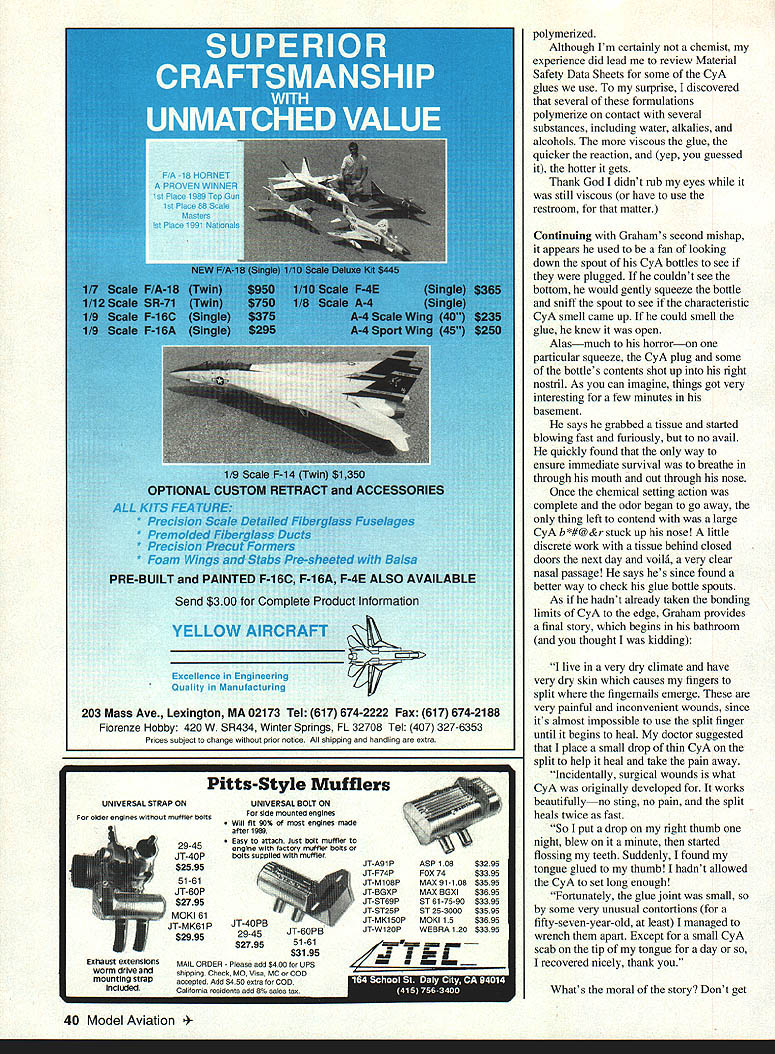
Can't land the model, you say? Not a problem for modeler Bob Holland of Coudersport, Pennsylvania, whose innovative solution allows him to get it down in one piece after each and every flight. Slightly frustrated from having to rebuild his trainer numerous times while learning to land, Bob revealed that adding a bomb bay and a large parachute was all his model needed to ensure a great day at the field.
"My problems are over — perfect landing every time. Just hit right aileron (I have none on plane), chute drops down behind tail of plane, plane stops, does vertical descent."
Since repacking the chute takes about five minutes, he's back in the air in no time. Bob hasn't told me he's learned to land the conventional way yet; I'm sure he'll master it and will have a neat trick to show at future fun-flies. That said, a parachute is a trick — not a substitute for learning to land. Seek help: club members can buddy-box a model until you become proficient. Learning to fly a model through all phases will save you (and those who fly with you) many headaches.
STICKY SITUATION
With the increased use of CyA (cyanoacrylate) these days, CyA-related accidents occur more often than most would like to admit. Not afraid to share his experiences with CyA is Graham Hicks of La Grande, Oregon, who thought we might learn a lesson — or at least enjoy some humorous (and cautionary) situations:
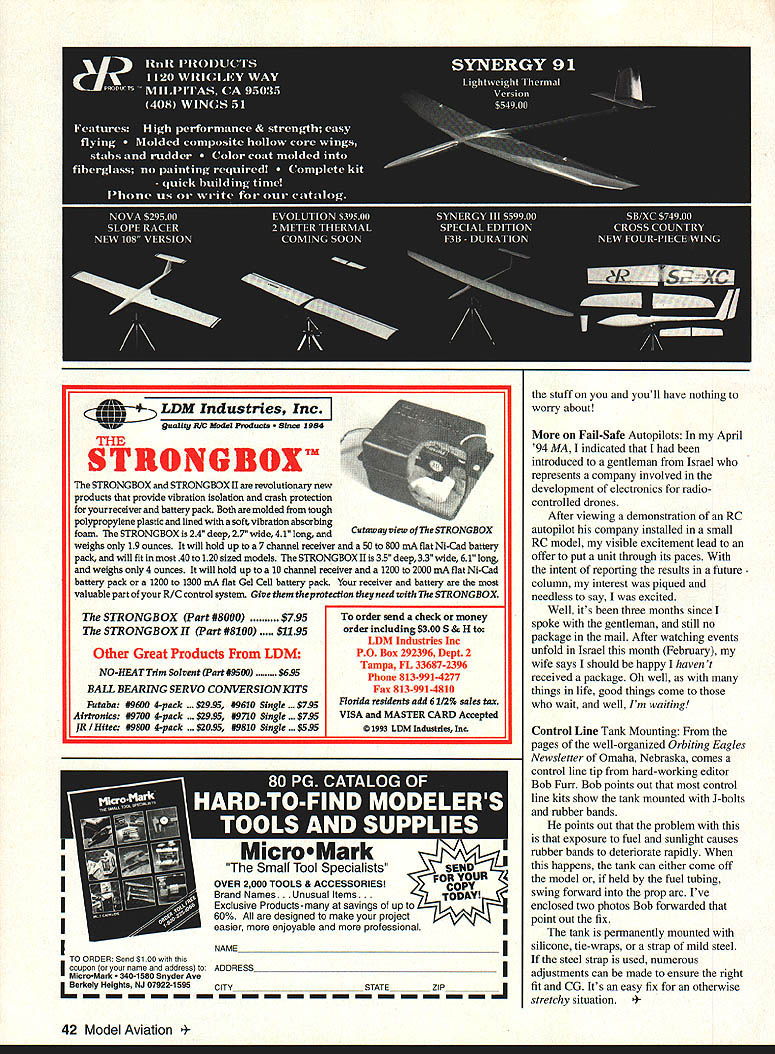
- Repairing a carving: Graham repaired a delicate wood carving that had cracked in transit. He squeezed a little CyA into the crack, held the carving at an angle to let excess run off, and a small drop fell on his finger. When the glue on the carving didn't set immediately, he sprayed an accelerator (kicker). Instantly his finger heated like a branding iron and smoke poured off the tip. A blister formed over the next few days. He learned a hard lesson about using accelerators.
- Hot reaction from residual accelerator: On another occasion he unknowingly smeared a thin film of CyA over his right hand while installing several rib sections on an Ultra Sport 60. A plastic glue extension on the bottle spout caused extra glue to run onto his palm. He applied accelerator to the rib sections immediately after applying CyA. As soon as his palm contacted residual accelerator on waxed paper, he felt a hot sensation and heard a sizzling sound — white mist hissed and the glue polymerized quickly.
Although I'm not a chemist, reviewing Material Safety Data Sheets for some CyA glues was revealing: several formulations polymerize on contact with substances such as water, alkalies, and alcohols. The more viscous the glue, the quicker the reaction — and the hotter it gets. Be especially careful not to rub your eyes or touch sensitive areas while glue is still viscous.
- Glue up the nose: Graham used to check bottle spouts by squeezing and sniffing for the characteristic CyA smell. One squeeze sent a plug and some glue up his right nostril. He blew vigorously to no avail and found the only immediate solution was to breathe in through his mouth and out through his nose until the setting action completed. The next day he discreetly removed the CyA glob.
- CyA on skin and tongue: Living in a very dry climate, Graham sometimes had painful splits at his fingernails. His doctor suggested a small drop of thin CyA to help heal the split — CyA was originally developed for surgical use and can work well. One night he put a drop on his right thumb, blew on it a minute, then started flossing and suddenly found his tongue glued to his thumb. By awkward contortions he popped it loose; a small scab on the tongue healed in a day or so.
Moral: avoid getting CyA on your skin, eyes, nose, or mouth; use accelerators with extreme caution; read MSDS information for the products you use.
MORE ON FAIL-SAFE AUTOPILOTS
In my April '94 column I mentioned being introduced to a gentleman from Israel who represents a company developing electronics for radio-controlled drones. After seeing a demonstration of an RC autopilot installed in a small model, I was offered a unit to test and report on in a future column. It's been three months since that offer and still no package. Given recent events in Israel, my wife says I'm probably lucky I haven't received it yet. In the meantime, I'm still waiting — good things come to those who wait.
CONTROL LINE TANK MOUNTING
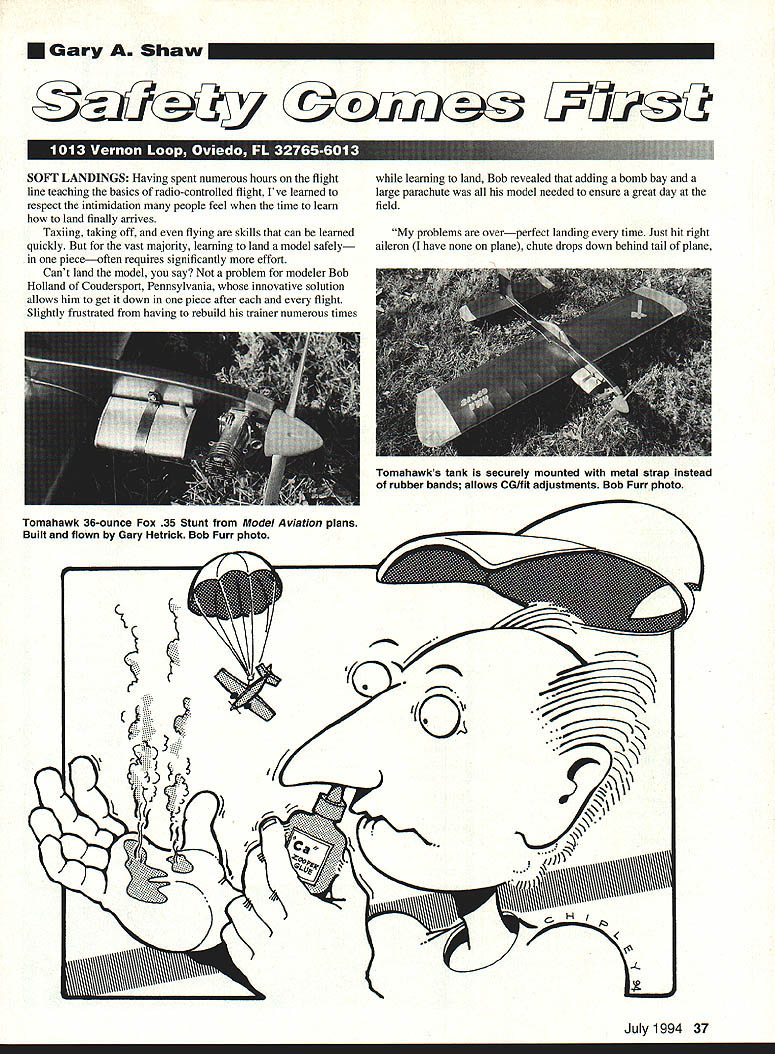
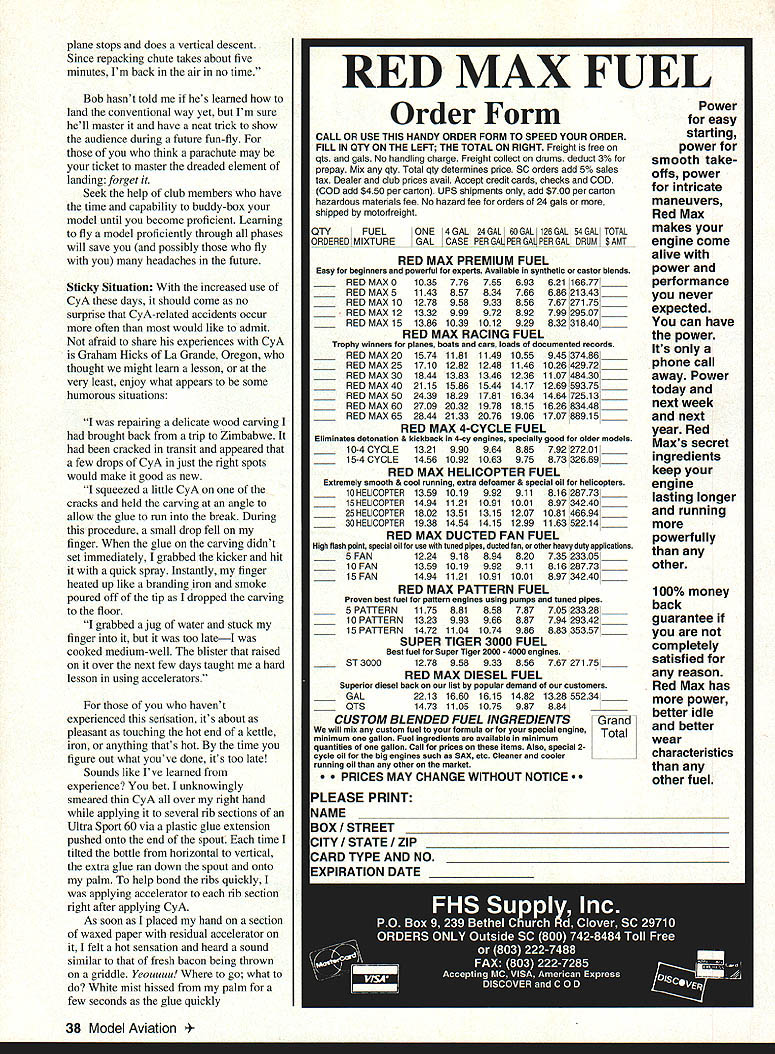
From the pages of the Orbiting Eagles Newsletter (Omaha, Nebraska), editor Bob Furr offers a useful control-line tip. Many control-line kits show the fuel tank mounted with U-bolts and rubber bands. The problem is that exposure to fuel and sunlight causes rubber bands to deteriorate rapidly. When this happens the tank can come off the model or, if held only by the fuel tubing, swing into the prop arc.
Recommended fixes:
- Permanently mount the tank with silicone.
- Use tie-wraps to secure the tank.
- Use a strap of mild steel; multiple adjustments can be made to ensure the right fit and correct center of gravity.
It's an easy fix for an otherwise risky situation.
Transcribed from original scans by AI. Minor OCR errors may remain.

